3 Mapping behaviour changes required to meet Scotland’s biodiversity objectives
This chapter presents the findings of the literature review, with a focus on evidence gathered from Phase 1 of the literature review on identifying and categorising key behaviours relevant to improving biodiversity in Scotland and beyond. It also highlights key concepts in the literature on behavioural approaches to biodiversity improvement and conservation, to provide context for the development of policy and public engagement adopting a behavioural lens.
3.1 Behavioural approaches in biodiversity and conservation
3.1.1 Why behavioural approaches are needed
Global decline in biodiversity has accelerated sharply in the past 50 years, with human activities at the heart of the major direct drivers of biodiversity loss, including changes in land and sea use, direct exploitation of organisms, climate change, pollution and spread of invasive non-native species (IPBES, 2019). Furthermore, sociocultural factors, changing demography, economy, politics and institutions, and technology, all drive biodiversity change indirectly, and it is increasingly acknowledged that measures to address these indirect drivers will be required to reverse biodiversity decline (IPBES, 2019; Pakeman et al., 2023). Realising this ambition will require transformative change in human behaviour, at multiple scales and involving a wide range of actors (Nielsen, Marteau, et al., 2021). Identifying leverage points for transformational change can benefit from both macro-level analyses focusing on institutions, power and governance, and micro- and meso-level analyses focusing on opportunities for behaviour change at the individual and group levels (Marselle & Golding, 2023; Nielsen, Marteau, et al., 2021).
There is growing recognition of the value of behavioural approaches in the conservation and biodiversity literature, as evidenced by an increase in empirical studies and reviews on the topic within recent years (Balmford et al., 2021; Nielsen, Marteau, et al., 2021; Veríssimo et al., 2024). At the same time, however, many authors point out that in general behavioural science has not been applied widely in conservation and biodiversity research, and where behavioural lenses have been applied in the conservation domain they are often not well linked to behavioural theory (Balmford et al., 2021; Rode et al., 2022). Conversely, whilst there is now a large body of research concerning pro-environmental behaviour change, behaviours addressing biodiversity improvement have been largely overlooked in the context of a focus on household-level behaviours around energy demand reduction, travel mode choice and recycling (Nielsen, Marteau, et al., 2021). Looking at leading journals in the fields of biodiversity conservation and pro-environmental behaviours, Selinske et al. (2018) found that less than 0.3% of papers in the top biodiversity journals related to psychology or behaviour change, and similarly less than 0.4% of papers in key pro-environmental behaviour journals addressed conservation or biodiversity. There are a range of possible reasons proposed for this lack of overlap between fields. One is that biodiversity challenges are often highly context-specific, and biodiversity outcomes arise of out complex interactions within social-ecological systems, meaning it can be difficult to pinpoint particular behaviours to target (Selinske et al., 2018). It is also argued that behavioural research in conservation is underfunded, and that at a more philosophical level, the links between household-level behaviours and biodiversity are often overlooked because of a disconnect between people (particularly urban dwellers) and natural environments (Selinske et al., 2018; Veríssimo et al., 2024).
3.1.2 Framing and defining pro-biodiversity behaviours
While many argue the value of increasing attention to behaviour within biodiversity and conservation science, our review found little in the way of explicit definitions or conceptual development around what constitutes a behaviour relevant to biodiversity specifically. A common thread in the literature focuses on the identification of target behaviours to inform practice within specific conservation initiatives. Within this framing, the focus is on the process of identifying and enabling behaviour changes that will help to address particular threats to identified species or habitats. In this sense of applying a behavioural approach to a specific conservation problem, the expectation is that the specific target behaviours will be highly contextualised. In literature framing biodiversity-related behaviour change in this way, particular behaviours are mentioned as examples illustrating a process of applying a behavioural approach to address a particular ‘threat chain’ (e.g. Balmford et al., 2021; Nielsen et al., 2021).
For the purposes of this review we are, however, concerned more with identifying the wide range of potential behaviours that are relevant to a cultural shift in favour of biodiversity protection and improvement at the societal level. This represents an alternative framing of behaviours impacting on biodiversity as a class of pro-environmental behaviours relevant to the general population. This higher-level (more top-down) framing of biodiversity-related behaviours can potentially offer a valuable complement to more bottom-up, threat chain based, behavioural approaches. It arguably raises questions about how we can measure uptake of relevant behaviours at the individual and societal levels, identify which behaviours might contribute to multiple objectives (within the domain of conservation and beyond), and consider potential trade-offs, as well as identifying positive actions to improve biodiversity as opposed to a focus on mitigating specific threats. To illustrate these different approaches identified in the literature, those adopting the higher level framing have considered a wide range of behaviours together despite these behaviours potentially impacting on different species/habitats and at a range of scales (e.g. conservation volunteering and choosing Marine Stewardship Council seafood products), whereas literature focusing on particular threat chains target behaviours contributing to a specific threat e.g. decline of a population of protected shorebirds in a particular area due to ingesting beach litter (Balmford et al., 2019). Literature adopting a more top-down, higher-level framing talks variously of ‘pro-biodiversity behaviours’ (Aota & Soga, 2024; Soga & Gaston, 2023); ‘biodiversity behaviours’ (Selinske et al., 2020), or ‘(pro-) nature conservation behaviours’ (Barbett et al., 2020; Borg et al., 2024). Here we adopt the term pro-biodiversity behaviours, defined loosely as ‘actions that benefit biodiversity’ (Soga & Gaston, 2023, p. 1). While the broad range of pro-biodiversity behaviours relevant to the general public can arguably include any behaviour that directly or indirectly impacts on biodiversity and ecosystem health more generally, in the present review we exclude behaviours that impact biodiversity primary through their implications for climate change mitigation, sometimes discussed as ‘low carbon behaviours’ or ‘climate change behaviours (Wei et al., 2024; Whitmarsh, 2009). We also exclude behaviours that impact primarily through material consumption and resource efficiency at the general level. Such behaviour changes contributing towards reducing consumption and moving towards a more circular economy or ‘circular behaviours’ (Colley, Hague et al., 2024), are highly relevant to the environmental footprint of Scotland’s consumption overseas (Rivington et al., 2024) but are themselves a wide category of behaviours which warrant specific attention. Whilst the scope of pro-biodiversity behaviours is narrowed for the purposes of this review, we would encourage our findings to be interpreted in the context of the wider literature addressing low carbon and circular behaviours.
3.2 Developing a framework of behaviours relevant to Scotland
In this section we catalogue the different pro-biodiversity behaviours highlighted in the literature and explore the ways that these can be categorised to help make sense of the large number of potential actions that private citizens in Scotland can take to benefit biodiversity. In doing so we aim to draw out common characteristics of behaviours which may be relevant to consider when designing policy approaches.
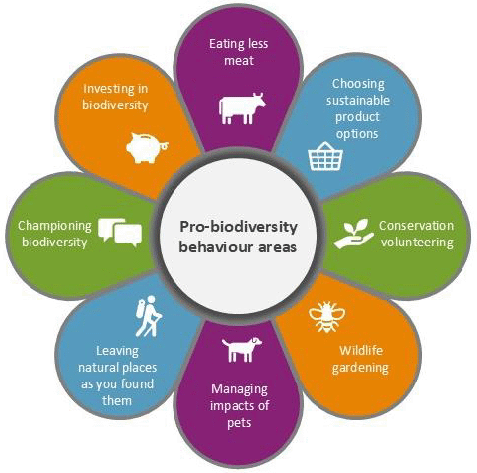
Table 2 lists a total of 43 relevant pro-biodiversity behaviours that were identified from Phase 1 of the literature review, consolidated from an initial list of over 60 in-scope behaviours, and grouped into eight behaviour categories (see also Figure 3). Appendix C contains an expanded framework of behaviours, with each behaviour mapped against the following characteristics: behavioural domain, impact pathways, direct vs. indirect impacts, location of impacts, private/public/social sphere, and behavioural frequency. These characteristics are discussed in sections 3.2.1-3.2.6 below. These characteristics for the behavioural mapping were adopted based on the reviewed literature and drawing on the research teams’ knowledge of key concepts in the wider pro-environmental behaviour literature.

3.2.1 Behavioural domain
We classified behaviours into six domains: consumption, responsible outdoor recreation, stewardship, advocacy and social, and financial behaviours. These categories were adapted from those developed by Selinske et al. (2020) who used participatory methods to engage biodiversity and conservation experts in assessing pro-biodiversity behaviours relevant to the general public in Australia.
Table 2: Private citizens’ behaviours identified in the literature as impacting on biodiversity*
Behaviour category
Eating less meat
High level behaviours identified**
Eating less meat/ Eating less beef and lamb
Behaviour category
Adopting a plant-based diet
Behaviour category
Choosing sustainable product options
High level behaviours identified**
Choosing sustainably sourced fish/seafood
Behaviour category
Choosing sustainable product options
High level behaviours identified**
Choosing organic produce
Behaviour category
Choosing sustainable product options
High level behaviours identified**
Choosing local and seasonal produce
Behaviour category
Choosing sustainable product options
High level behaviours identified**
Choosing palm oil free/ certified palm oil products and certified cocoa products
Behaviour category
Choosing sustainable product options
High level behaviours identified**
Choosing certified paper and wood products from sustainable sources
Behaviour category
Choosing sustainable product options
High level behaviours identified**
Avoiding consumption of products made using at-risk plant or animal species (e.g. ivory, rhino horn, rare ornamental plants, fur or leather from certain species)
Behaviour category
Conservation volunteering
High level behaviours identified**
Conservation volunteering
Behaviour category
Conservation volunteering
High level behaviours identified**
Participating in citizen science or wildlife monitoring
Behaviour category
Conservation volunteering
High level behaviours identified**
Volunteering time and skills to support operations of a conservation organisations (e.g. IT, design, accounting etc.)
Behaviour category
Wildlife gardening
High level behaviours identified**
Wildlife gardening
Behaviour category
Wildlife gardening
High level behaviours identified**
Planting species that flower at different times of the year
Behaviour category
Wildlife gardening
High level behaviours identified**
Maintaining plants with fruits/berries
Behaviour category
Wildlife gardening
High level behaviours identified**
Mowing the lawn less often
Behaviour category
Wildlife gardening
High level behaviours identified**
Avoiding chemical weedkiller/pesticides/fertilisers and using peat-free compost
Behaviour category
Wildlife gardening
High level behaviours identified**
Leaving unmaintained areas in garden
Behaviour category
Wildlife gardening
High level behaviours identified**
Avoiding cutting/trimming hedges during bird nesting season
Behaviour category
Wildlife gardening
High level behaviours identified**
Creating shelter for wildlife e.g. log piles/deadwood, nest boxes, bee and bug hotels
Behaviour category
Wildlife gardening
High level behaviours identified**
Providing food and/or water for animals e.g. birds
Behaviour category
Wildlife gardening
High level behaviours identified**
Home composting
Behaviour category
Wildlife gardening
High level behaviours identified**
Creating ponds
Behaviour category
Managing impacts of pets
High level behaviours identified**
Reducing cat predation by keeping cats contained or putting bells etc. on collars
Behaviour category
Managing impacts of pets
High level behaviours identified**
Keeping dogs on lead in natural areas and picking up dog mess
Behaviour category
Leaving natural places as you found them
High level behaviours identified**
Avoiding routes or areas containing sensitive vegetation and staying on trail
Behaviour category
Leaving natural places as you found them
High level behaviours identified**
Avoiding picking wildflowers or damaging vegetation
Behaviour category
Leaving natural places as you found them
High level behaviours identified**
Adopting good hygiene practices for outdoor recreation (e.g. cleaning shoes before walking in a protected area, cleaning boats).
Behaviour category
Leaving natural places as you found them
High level behaviours identified**
Putting rubbish in bins or taking it home
Behaviour category
Leaving natural places as you found them
High level behaviours identified**
Picking up litter seen in natural environments
Behaviour category
Championing biodiversity
High level behaviours identified**
Voting to influence governments to change policy/implementation
Behaviour category
Championing biodiversity
High level behaviours identified**
Campaigning, lobbying or advocating for biodiversity conservation action
Behaviour category
Championing biodiversity
High level behaviours identified**
Attending local council meetings about nature conservation issues including local development
Behaviour category
Championing biodiversity
High level behaviours identified**
Writing to elected officials – members of parliament or councillors
Behaviour category
Championing biodiversity
High level behaviours identified**
Signing petitions supporting nature conservation
Behaviour category
Championing biodiversity
High level behaviours identified**
Running for local government on an environmental platform
Behaviour category
Championing biodiversity
High level behaviours identified**
Sharing your appreciation of nature with others, in person or online
Behaviour category
Championing biodiversity
High level behaviours identified**
Supporting or encouraging others in pro-biodiversity behaviours
Behaviour category
Championing biodiversity
High level behaviours identified**
Talking about environmental issues relating to biodiversity, conservation and food with friends and family
Behaviour category
Championing biodiversity
High level behaviours identified**
Sharing/re-posting communications from nature conservation organisations on social media
Behaviour category
Investing in biodiversity
High level behaviours identified**
Donating to conservation organisations or organisations protecting private land
Behaviour category
Investing in biodiversity
High level behaviours identified**
Making biodiversity friendly investment decisions
*Colours in the table relate to the domain behaviours are mapped on to. Pink=consumption; blue=stewardship; green=outdoor recreation; orange=advocacy and social; yellow=financial.
*Some behaviours were combined in the process of developing the framework. For detailed behavioural analysis it may be necessary to separate these into more than one constituent behaviour.
3.2.2 Impact pathways
The pathways by which behaviours of private citizens influence biodiversity can be considered in relation to their contribution to the key drivers of biodiversity change. Here we adopt categories based on IPBES’s (2019) characterisation of direct drivers of change (changes in land and sea use, direct exploitation of organisms, pollution, invasion of alien species) where behaviours contribute towards mitigation of these drivers. We excluded the fifth of IPBES‘s direct drivers, climate change, as it is the focus of separate actions to address behaviour change. To these, we add further pathways relevant to further represent positive biodiversity improvement and protection pathways (such as improving habitats and reducing disturbance), as well as pathways relating more to indirect socio-cultural and political drivers of change (e.g. in influencing other actors/institutions that hold power and spreading positive social norms).
3.2.3 Direct vs. indirect impacts on biodiversity
Pro-biodiversity behaviours may impact directly on natural environments, or indirectly through collective effects on markets, institutions, or other actors within the social-ecological system.
3.2.4 Location of impacts
While behaviours that directly affect biodiversity are likely to contribute to benefits at the local level, many of those acting more indirectly have implications for biodiversity further afield at the regional level (taken here to include at the Scotland and UK levels), or internationally (outside of the UK). International impacts can contribute to Scotland’s global environmental footprint, which must be reduced substantially if we are to live within our planetary boundaries and consume our fair share of resources as a nation (Jennings et al., 2021; Lin et al., 2024).
3.2.5 Private, public or social sphere behaviours
Private sphere behaviours relate to the action of individuals in the household or leisure contexts, typically relating to consumption and lifestyle choices (Larson et al., 2015; Stern, 2000). Private sphere behaviours have received the most attention in research on pro-environmental behaviours. Public sphere behaviours involve civic engagement through activist (e.g. campaigning) or non-activist (e.g. environmental citizenship in the form of voting, petitioning, donating etc.) means (Larson et al., 2015; Stern, 2000). We also include the category of social sphere behaviours, which involve group participation and talking to, informing or persuading others with respect to environmental issues (Larson et al., 2015). Social behaviours are sometimes considered as falling within either the public sphere (e.g. Selinske, 2020) or private sphere (e.g. Borg, 2024).
3.2.6 Frequency of behaviour
It can be useful to distinguish between behaviours that represent a one-off, or infrequent, decision, such as voting in a parliamentary election, with more frequent, perhaps quite everyday behaviours, such as those relating to choices while grocery shopping. Everyday behaviours can become habitual, whereas one-off choices are more likely to be intentional, involving a process of reflection. These differences are meaningful when it comes to selecting potential interventions to encourage and enable behaviour change (Verplanken & Whitmarsh, 2021).