




Leadership Tensions Rock Tata Sons: Chandrasekaran Declines Reappointment Amidst Board Discord
N Chandrasekaran will step down as chairman of Tata Sons when his current term ends on February 20, 2027
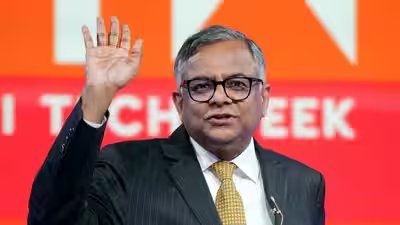
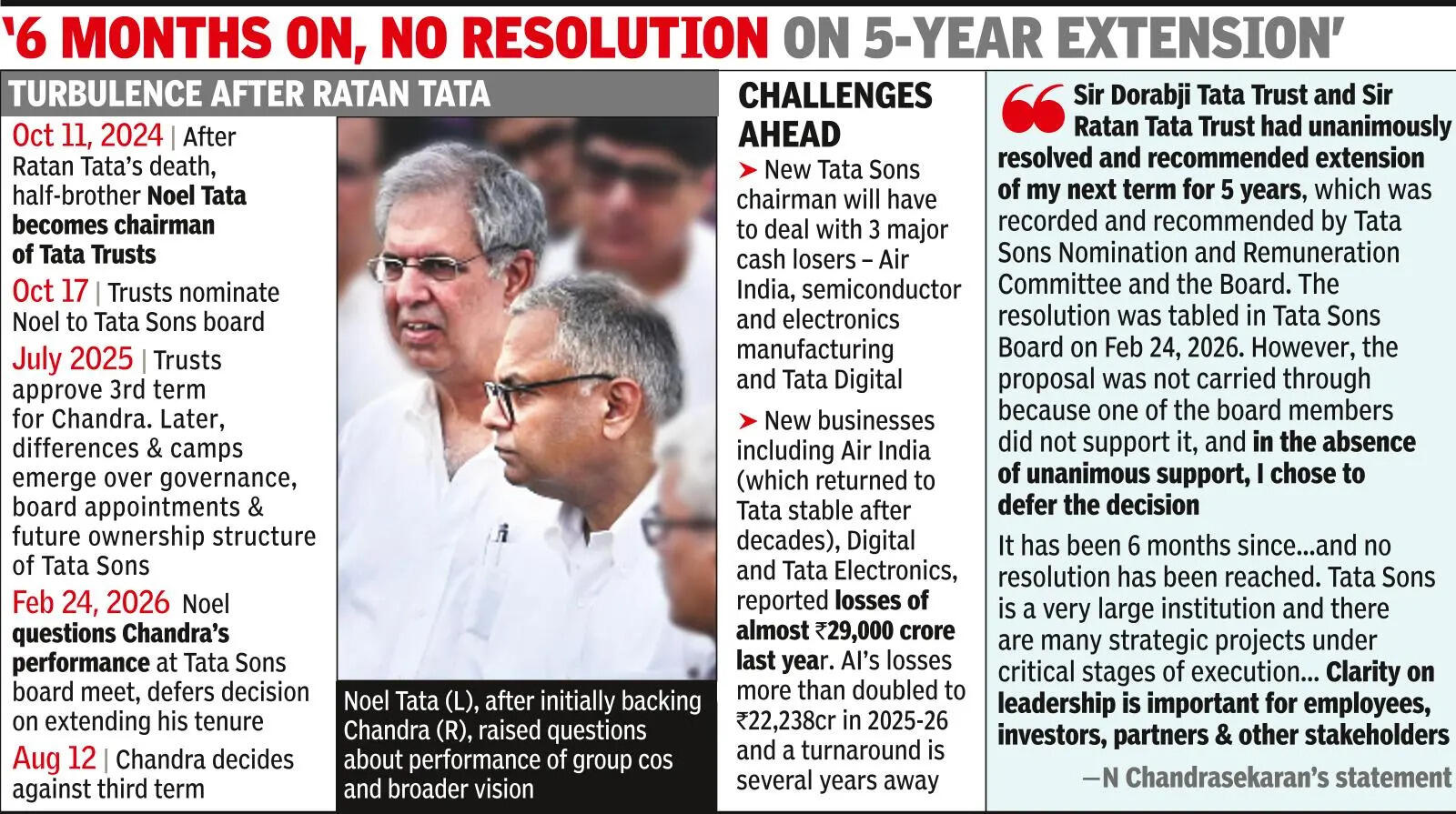
MUMBAI: In a surprising turn of events, N Chandrasekaran (62), Chairman of Tata Sons, has announced his decision not to seek reappointment when his current term concludes on February 20, 2027. This declaration comes about a year after Tata Trusts, which commands a 66% stake in the conglomerate’s holding company, had unanimously approved a third five-year term for him.
Chandrasekaran cited a lack of unanimous support from the Tata Sons board, stating, “one of the board members (of Tata Sons) did not support the proposal.” While he refrained from naming the individual, industry insiders widely attribute the reference to Noel Tata, Chairman of Tata Trusts. Initially a supporter of Chandrasekaran’s extended tenure, Noel Tata reportedly began to voice concerns regarding the performance of several group companies, substantial capital expenditure, and the conglomerate’s overarching strategic direction.
Sources close to the ongoing developments indicate that Noel Tata was inclined to support a three-year extension, aligning with Chandrasekaran turning 65, but not a full five-year term. This underlying disagreement, which reportedly simmered within a select circle of trustees and board members since the July 2025 approval by the Trusts, has recently escalated, spilling into public view and reaching various forums including courts, the charity commissioner’s office, and even the highest echelons of government.
Communication Breakdown and Looming AGM Uncertainty
Insiders suggest a significant breakdown in meaningful communication between Noel Tata and Chandrasekaran contributed to the current impasse.
Won’t Seek Reappointment As Tata Sons Chair After Tenure Ends In Feb 2027
Chandrasekaran’s abrupt announcement precedes a critical Tata Sons annual general meeting (AGM) scheduled for August 18, where shareholders are slated to vote on the renewal of his directorship. This board seat is paramount to his chairmanship; despite his term extending to February 2027, he must maintain his position as a Tata Sons director to retain the top role. The AGM itself faces considerable uncertainty, as reported by TOI on July 27.
The public charities regulator has imposed a ban on Sir Ratan Tata Trust (SRTT) from holding trustee meetings, citing alleged violations of public trust laws. This prohibition prevents SRTT from nominating a representative to attend Tata Sons’ AGM. For quorum and to vote on Chandrasekaran’s directorship, SRTT and Sir Dorabji Tata Trust must jointly nominate a representative.
Should the ban remain in effect, the AGM would necessitate an adjournment until December, the maximum period permitted by regulations. Such a delay could further complicate Chandrasekaran’s standing. If his directorship is not renewed by then, he would be compelled to relinquish the Tata Sons chairmanship and, under internal Tata rules, the chairmanship of other Tata companies. This rule was instituted following the removal of Cyrus Mistry as Tata Sons chairman, who initially retained leadership positions in several other Tata companies.
A prevalent theory suggests Chandrasekaran may have opted to avoid the potential uncertainty and perceived humiliation of not being reappointed as director, either due to the AGM deferral or a vote against his continuation by the Trusts. Speculation also circulates that New Delhi, despite its concern over the unsettling situation at the sprawling $185 billion conglomerate, chose to remain neutral.
“Don’t forget Noel’s surname – he’s a Tata, and that counts for something,” commented a person with intimate knowledge of the situation.
Noel Tata’s Challenges and the SP Group Dispute
Chandrasekaran’s departure places significant pressure on Noel Tata to reassure investors and policymakers regarding the sustained trajectory of the group’s major investment projects, particularly those integral to India’s push into advanced manufacturing. Beyond operational concerns, Noel Tata faces two substantial and interconnected challenges: preserving Tata Sons’ privately held status and resolving the protracted dispute with the Shapoorji Pallonji (SP) Group, a key minority shareholder.
These issues are deeply intertwined as an initial public offering (IPO) of Tata Sons would offer the SP Group, which holds an 18.4% stake, a much-needed liquidity avenue. The SP Group is burdened with over Rs 55,000 crore of debt, with its entire Tata Sons stake pledged as collateral. The prospect of an IPO is also linked to Reserve Bank of India (RBI) regulations that mandate core investment companies in the upper layer, such as Tata Sons, to list on stock exchanges.
In FY24, Tata Sons applied to surrender its CIC registration after repaying its debt, a move currently under RBI consideration. However, Noel Tata remains opposed to a listing, fearing it could dilute the Trusts’ control and fundamentally alter the closely held structure of Tata Sons.
Upon the conclusion of his term in February 2027, Chandrasekaran will be recognized as the fifth-longest-serving chairman in Tata Sons’ history. Individuals close to Noel Tata confessed they had an inkling Chandrasekaran might decline another term without the Tata Trusts chairman’s explicit support, yet they were caught off guard by the timing of his announcement.
Those familiar with the SP family’s perspective indicated that the outcome was not entirely unforeseen, with signs of a rift having been visible for some time. A trustee expressed that Chandrasekaran’s decision reflected the difficult position he had been placed in, having been initially selected by Ratan Tata. The trustee further opined that even if he had continued, working alongside Noel Tata would have presented persistent challenges, expressing disappointment that the trustees, including Noel, had initially cleared Chandrasekaran for another five-year term.