






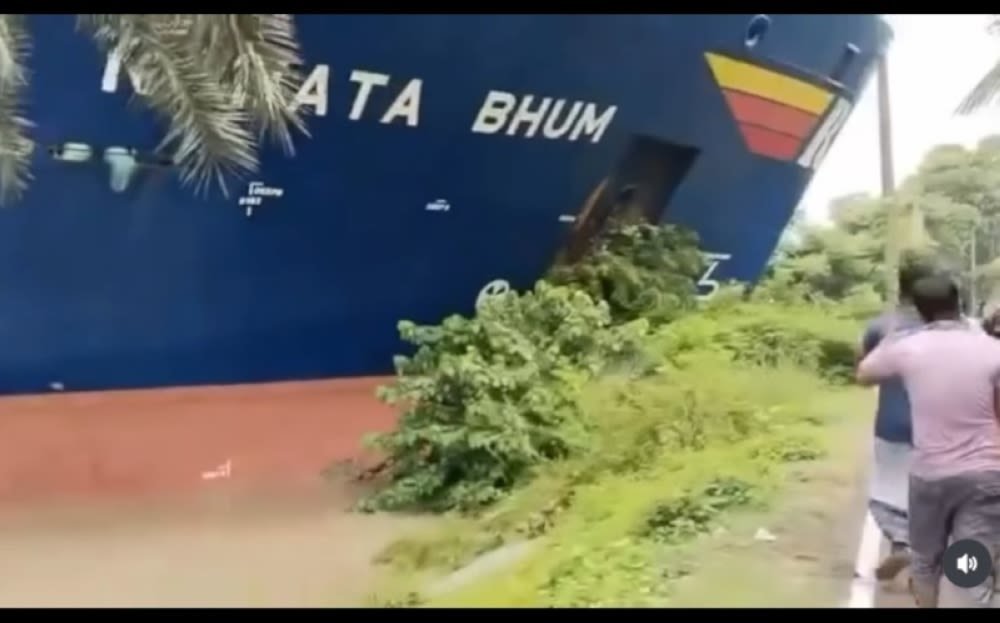
A Singapore-flagged container ship experienced a dramatic incident in West Bengal, India, when it veered off course and crashed into a riverbank. The vessel, identified as Nawata Bhum, reportedly failed to navigate a challenging bend in the River Hooghly, a critical waterway known for its intricate navigation challenges. This maritime mishap, which occurred around 11 am local time on Wednesday near Diamond Harbour, has been attributed to a combination of powerful river currents and a suspected malfunction in the ship’s steering system.
According to vessel-tracking data provided by MarineTraffic, the Nawata Bhum, a substantial container ship laden with cargo, was observed heading directly towards the riverbank before making impact. Thankfully, initial reports indicate that there were no injuries sustained by any of the crew members aboard. Social media platforms quickly became a source of visual evidence, with videos circulating that depicted the ship’s unsettling trajectory as it approached the embankment.
The journey of the Nawata Bhum began on August 3rd from Port Klang, Malaysia, with its ultimate destination being Kolkata’s Syama Prasad Mookerjee Port. However, approximately 50 kilometers from its destination port, the vessel encountered difficulties. MarineTraffic’s analysis suggests that the ship was unable to recover from a sharp bend in the river near Diamond Harbour. The confluence of strong currents, turbulent river conditions, and a potential steering malfunction are being thoroughly investigated as the primary causes behind this unexpected event.
The River Hooghly, a distributary of the Ganges, poses significant navigational challenges to even experienced mariners due to its numerous sharp bends and shifting sandbars, as highlighted by Indian media outlets such as The Hans India. A local official, speaking to The Hans India, shed light on a common issue in such scenarios, stating, “The steering gear sometimes gets stuck, particularly when a ship is attempting to recover from a turn.” This detail adds weight to the theory of a steering malfunction contributing to the incident. The official further elaborated that the captain, upon realizing the steering system had jammed, took immediate action by repeatedly sounding the ship’s horn, a crucial distress signal, to alert other vessels in the vicinity. Fortunately, video footage confirmed that no ferries or other watercraft were in the ship’s direct path as it moved towards the riverbank, averting a potentially more severe outcome.
Following the impact, the ship’s pilot promptly contacted the Syama Prasad Mookerjee Port Authority to report the incident, initiating immediate response protocols. In response, tugboats were dispatched to the site of the grounding. These powerful vessels are now awaiting the next high tide, which will provide the necessary water depth and leverage to safely pull the container ship away from the riverbank, according to reports from MarineTraffic and The Hans India.
The Nawata Bhum is registered under the Singapore flag, and its ownership lies with Regional Container Lines. In the aftermath of the incident, relevant authorities, including the Maritime and Port Authority of Singapore, the Syama Prasad Mookerjee Port Authority, and Regional Container Lines, have been contacted for further details and official statements regarding the ongoing investigation and recovery efforts. This maritime incident underscores the complexities and inherent risks associated with commercial shipping in challenging waterways. The full extent of any damage to the vessel or the riverbank, as well as the precise sequence of events leading to the grounding, will undoubtedly be the subject of thorough investigation by the relevant maritime authorities. The international shipping community will be keenly awaiting the findings from this investigation, especially concerning the potential role of mechanical failure in such a critical operational aspect. Further updates are expected as recovery operations progress and investigations unfold into the Singapore-flagged container ship incident.