








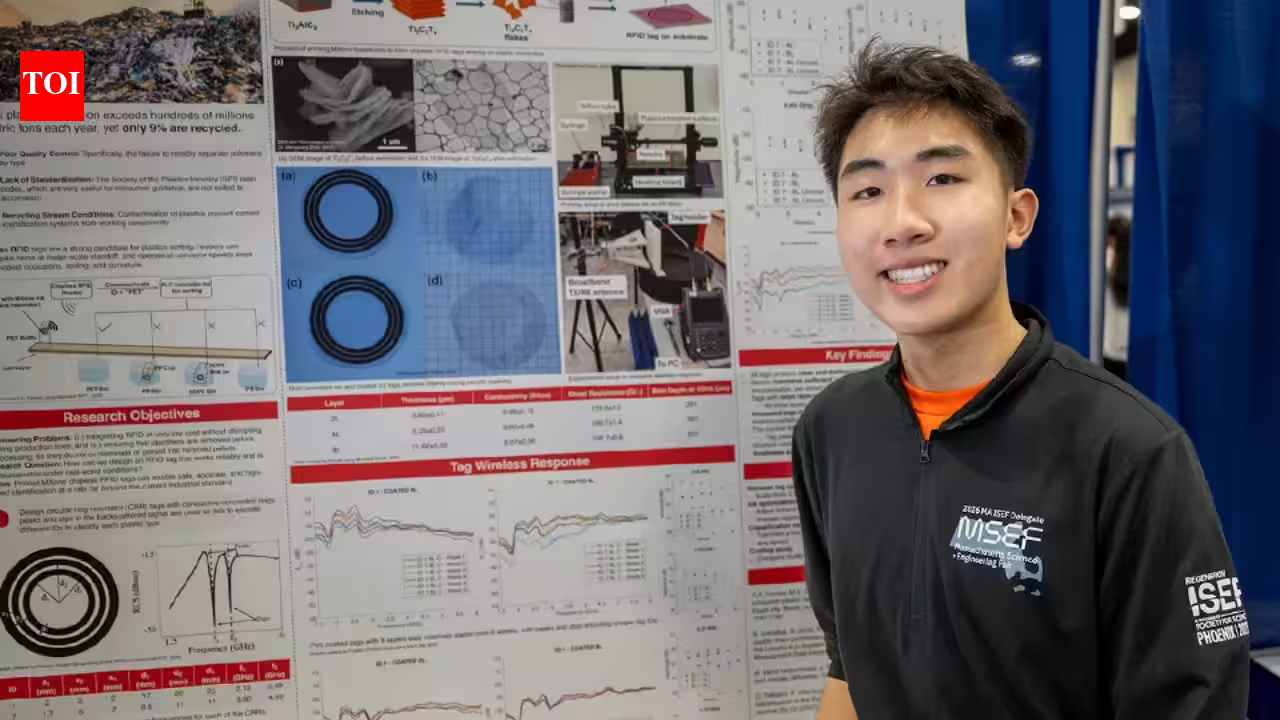
At the precocious age of 17, Kevin Sun, hailing from Andover, Massachusetts, has engineered a groundbreaking solution to one of the most persistent hurdles in plastic recycling: the accurate identification and sorting of diverse plastic types. Sun’s ingenuity has led to the creation of a dissolvable radio-frequency tag, essentially a wireless barcode, designed to facilitate the precise categorization of plastic materials during the recycling workflow. This remarkable achievement was recognized by the Society for Science, the esteemed organization behind the Regeneron International Science and Engineering Fair (ISEF). Sun was honored with the prestigious 2026 Craig R. Barrett Award for Innovation, accompanied by a substantial $10,000 prize, acknowledging the profound impact of his project. His invention offers a novel method to convey vital information about plastic without introducing contaminants that could compromise the integrity of the recycled product.
The efficacy of plastic recycling is intrinsically linked to effective sorting. Given that different plastics possess distinct chemical and physical attributes, they typically demand separate processing streams. Yet, the precise identification of plastic types can be an arduous task, particularly when materials are colored, adorned with labels, or feature other characteristics that impede conventional visual sorting methods. Sun’s innovative concept was to bestow upon plastic a form of digital identity. He accomplished this by directly printing a radio-frequency tag onto plastic materials, thereby establishing a system capable of wirelessly transmitting information. Unlike traditional barcodes that necessitate visual scanning, this tag communicates through radio-frequency signals.
The Society for Science highlights that this technology functions as a “wireless barcode,” enabling the identification of plastic types for sorting purposes. This has the potential to dramatically enhance the accuracy with which recycling facilities can categorize materials before they undergo processing. What makes this approach particularly compelling is the tag’s inherent design: it is engineered to vanish during the recycling process, rather than persisting as a permanent fixture on the finished material.
A pivotal aspect of Sun’s project revolved around the meticulous selection of materials that could execute their sorting function without becoming indelible contaminants. The core radio-frequency component is fabricated using MXene, a conductive material adept at transmitting radio-frequency signals. Sun ingeniously printed this material onto plastic and subsequently enveloped the tag with a thin, protective coating. Crucially, this coating is designed to dissolve in alkaline water, a deliberate choice given that recycling plants routinely employ hot washing procedures to cleanse plastic prior to further processing. Experiments conducted by Sun, as reported by the Society for Science, revealed that both the tag materials and the protective coating rapidly disintegrated during the hot-washing phase commonly utilized in recycling facilities. Once washed away, the plastic can seamlessly proceed through the recycling continuum, free from any residual tag material that could compromise its quality. In essence, the technology is purposed for a temporary but critical role: to identify the plastic precisely when sorting is required, and then to disappear during subsequent processing.
Sun’s experiments also investigated the longevity of the printed tags’ readability before they entered the recycling process. The findings indicated that the tags retained their readability for a minimum of six weeks, suggesting their capacity to preserve identifying information for a substantial duration prior to recycling. This durability is paramount, as a tag would possess limited utility if its information transmission ceased shortly after application. Concurrently, the tag must disintegrate at the appropriate juncture to prevent any interference with the recycled plastic. Sun’s project thus harmonizes two seemingly contradictory demands: the tag must exhibit sufficient robustness to identify plastic during handling and sorting, yet be dissolvable enough to vanish during the recycling process. This innovative synthesis offers a promising pathway to significantly improve plastic recycling efficiency.
Sun’s exceptional work garnered him significant accolades at the 2026 Regeneron ISEF, an international platform that saw the participation of nearly 1,700 students from over 65 countries, regions, and territories. His receipt of the $10,000 Craig R. Barrett Award for Innovation underscored the immense potential of his dissolvable tagging system to address a tangible and pressing challenge in the real world of recycling. While this invention does not purport to resolve every impediment associated with plastic recycling, and further developmental stages would undoubtedly be necessary for widespread adoption, Sun’s project powerfully illustrates how the convergence of materials science and wireless technology can be leveraged to tackle critical environmental problems. For a high school student, this represents an incredibly ambitious and forward-thinking endeavor to redefine a small but incredibly significant facet of the recycling process: accurately ascertaining the composition of plastic traversing the system.