








The period leading up to and during the Emergency in India marked a profound transformation in the nation’s psyche, particularly concerning where its citizens sought justice. This shift, from an inherent trust in state institutions to an increasing disillusionment, was vividly mirrored and amplified by the evolving narratives of Hindi cinema. The initial post-independence euphoria, a belief in India as a "miracle democracy," gradually eroded as economic hardships and political unrest gripped the country. Citizens, having endured a long struggle for azadi, or freedom, found themselves questioning why the idealized India they envisioned remained so elusive.
The Emergency, far from being the origin of this disillusionment, served as its stark crystallizing moment. By unilaterally suspending fundamental constitutional freedoms in the guise of enforcing national discipline and internal security, the state inadvertently taught its populace a crucial and unsettling lesson: its institutions could no longer be blindly trusted. This period fundamentally altered how Indians perceived power, authority, and the delicate balance between them. For many, the locus of justice – whether political, economic, or social – began to migrate away from the official apparatus of the state and towards alternative channels.
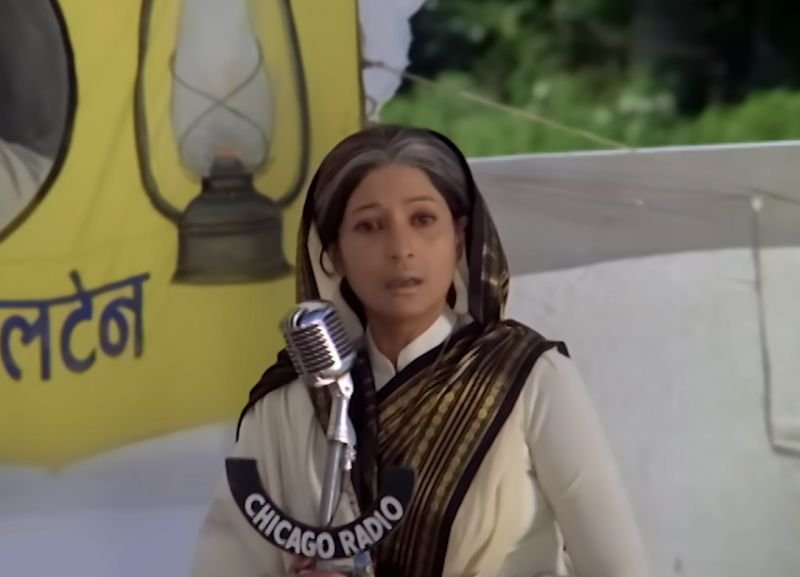
Cinema, like other art forms, often serves as a societal mirror, reflecting collective anxieties and offering a psychological snapshot of public sentiment. In this context, Hindi cinema became one of the earliest and most visible arenas where this societal shift became palpable. The year 1975, coincidentally the year the Emergency was declared, stands out as a watershed moment for Indian cinema. Gulzar’s Aandhi (1975) captured this mood with searing satire. In a memorable scene, Aarti Devi, a politician portrayed by Suchitra Sen, arrives by helicopter expecting adoration but is met with public discontent and even a stone-throwing incident, forcing her hasty retreat. This fictional portrayal eerily paralleled real-life events, where a prominent political figure faced dissent and a court verdict invalidating her election, leading Jayaprakash Narayan to issue the rallying cry, "Vacate the throne, for the people are coming." Instead of democratic introspection, the response was a decisive and heavy-handed declaration of Emergency by Indira Gandhi, suspending civil liberties, imprisoning opposition leaders, and restricting press freedoms, effectively transforming a "freewheeling, rumbustious, corrupt and inefficient perhaps, nonetheless flourishing" democracy into an authoritarian state.
During this turbulent year, the country was presented with two diverging narratives of power: one propagated by the state, and the other, often more truthful, flickering across the silver screen. Beyond Aandhi, 1975 saw the release of cinematic giants like Sholay, which depicted a retired police officer seeking justice not through the established system but through two petty criminals, and Deewar, alongside Nishant and Dharmatma. These films were not mere products of the Emergency but rather expressions of a deeper, prolonged period of social and political disillusionment. Earlier works, such as Gulzar’s Mere Apne (1971), had already articulated the frustrations of an educated yet unemployed generation, with lyrics like "B.A. kiya hai, M.A. kiya / lagta hai woh bhi ainvayi kiya" ("I did my B.A., I did my M.A. / Feels like I just wasted my time doing that"), all ironically punctuated by the refrain, "Haal chaal theek thaak hai, sab kuch theek thaak hai" ("Everything is fine, everything is just great").
The cinema of the 1970s gave voice and a face to this simmering frustration. The "Angry Young Man" archetype, first introduced in Zanjeer in the early seventies, became a powerful symbol. This character, often from marginalized backgrounds – streets, railway stations, forgotten villages – embodied the very anxieties that the Emergency sought to suppress. In an era where the state appeared either incapable or unwilling to ensure fairness, these films imagined justice being delivered not through official channels, but through flawed, solitary individuals acting outside the system. Vijay from Deewar resonated deeply because he rejected idealism, embraced his street-hardened experiences, and indicted society, the state, and even divinity for the betrayals he and his family endured. He, witnessing the impunity with which the law was flouted by the powerful, became convinced that the law no longer equated to justice, moving with a brooding moral authority that audiences increasingly felt was absent in official figures.
Simultaneously, alternative cinema, often referred to as the "Indian New Wave," offered a different but equally potent response. Filmmakers like Shyam Benegal, Adoor Gopalakrishnan, Govind Nihalani, and Mrinal Sen eschewed escapism for realism, exploring uncomfortable truths rather than offering distractions. Actors such as Smita Patil in Manthan (1976) embodied the breaking of oppressive power structures through collective action, while Shabana Azmi’s characters in films like Ankur (1974) portrayed a more cerebral weariness with social and institutional hypocrisy. Despite their vast differences in style, ambition, and audience, both mainstream and alternative cinema of this era shared a fundamental conviction: that state and societal institutions did not automatically command reverence and were ripe for challenge.
This marked a significant departure from the dominant sensibilities of earlier Hindi cinema, which largely reflected the youthful optimism of Nehruvian India. While films of the 1950s and early 1960s, such as Bimal Roy’s Do Bigha Zamin (1953) and Guru Dutt’s Kagaz Ke Phool (1959), acknowledged hardship and profound loneliness, and Pyaasa (1957) even hinted at future disillusionment, they largely operated within a moral universe where justice, though delayed, was believed to be ultimately attainable. This was a generation, as noted by parliamentarian Manoj Kumar Jha, that "did not inherit India as a ready-made nation-state; they had to imagine it first," confident in its founding story and its future. The "Gentle Dreamer" preceded the "Angry Young Man."
The Emergency did not shatter this dream unexpectedly; rather, it starkly revealed its fragility. The shift in Hindi cinema from the fifties to the seventies mirrored a profound societal transformation. The question for many Indians had evolved from "What should India become?" to the more troubled "Why had the India we imagined failed to arrive?" Hindi cinema thus embodied one of modern India’s most subtle yet significant shifts: the movement from faith in existing institutions to an active search for justice outside them.
History, sometimes, arrives insidiously, disguised as ordinary events. A declared emergency, with its clear commencement date and overt display of power and abuse, creates a distinct moment of confrontation. However, a slower erosion of democratic norms can be far more difficult to perceive, operating beneath the surface through weakened institutions, managed public discourse, diminished accountability, and a changing understanding of citizenship itself. A crucial lesson from the Emergency is that democracy is not a static achievement but a continuous responsibility demanding constant vigilance, protection, and reinforcement. Perhaps this is why the films of that intense summer, over five decades ago, continue to resonate: they serve as a powerful reminder that when institutions fail to address society’s moral questions, imagination finds other, often artistic, ways to articulate them.