









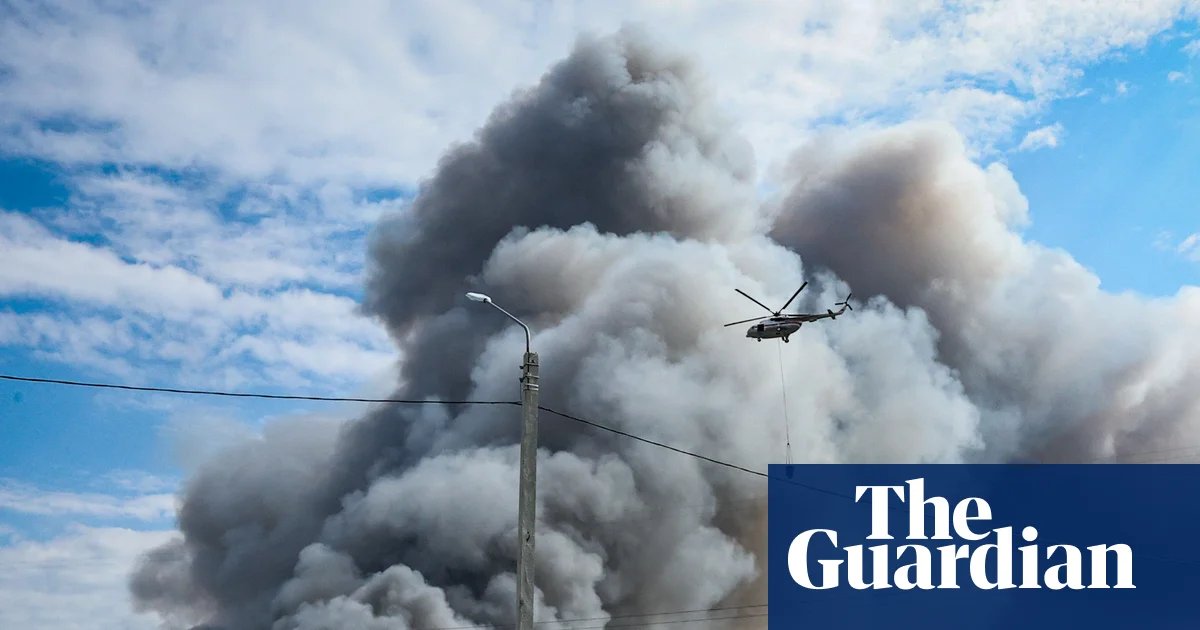
In a significant escalation of hostilities, Ukraine has reportedly executed one of its most extensive drone attacks since the onset of the conflict, targeting Russian infrastructure and leading to considerable damage and casualties. Russian authorities confirmed that a massive fire erupted at a major distribution warehouse located near Moscow, and tragically, at least six individuals lost their lives during the overnight assault.
According to the Russian defense ministry, an astonishing 822 drones were purportedly shot down across various regions. Meanwhile, Moscow’s mayor, Sergei Sobyanin, provided a slightly different figure for the capital’s vicinity, stating that 600 drones were detected heading towards the Moscow region, with 201 of these successfully intercepted. Sobyanin characterized this as the largest aerial raid on the Russian capital in two years, a claim corroborated by the rapid advancements in Ukraine’s drone capabilities, suggesting this might indeed be the most substantial attack wave since the war began in 2022.
The targeted warehouse, a facility belonging to the prominent Russian distribution company Wildberries in Podolsk, south of Moscow, became a focal point of the attack. Photographs circulating after the incident depicted a devastating blaze engulfing the enormous 200,000 square meter structure, with plumes of thick black smoke billowing into the sky. Andrey Vorobyov, the governor of the Moscow region, described the assault as “one of the most massive drone attacks in recent memory.” Further amplifying the scale of the ongoing aerial confrontation, the Russian defense ministry later asserted that it had neutralized nine Ukrainian cruise missiles and an astounding 1,478 drones within a 24-hour period, though independent verification of these figures remains pending.
This surge in Ukrainian offensive actions is largely attributed to its significant expansion of long-range, deep-strike missile and drone capabilities throughout 2026. These enhanced capabilities now enable Ukraine to strike critical Russian targets, including warehouses, oil refineries, ports, and military installations, at impressive distances of up to 1,500 miles (2,400km) from its borders. This development marks a crucial shift, allowing Ukraine to nearly match the long-range strike capacity that Russia has possessed since the war’s commencement, at a time when both nations’ air defenses are reportedly stretched to their limits.
Over the past month, Kyiv has strategically shifted its focus, increasingly targeting facilities associated with the Wildberries company, a vital component of Russia’s online retail infrastructure. These deliberate attacks, which have reportedly struck approximately 20 warehouses and buildings, are aimed at disrupting the Russian economy and imposing financial pressure on ordinary citizens. In addition to the Moscow-area fatalities, five people were reported killed in Russia’s southern Rostov region, which shares a border with Ukraine, where the governor claimed another 150 incoming drones were destroyed.
The conflict, however, remains a two-way street. Russian drone and missile attacks also inflicted casualties in Ukraine, claiming seven lives in total. Two individuals died in the central city of Kryvyi Rih, two in the Sumy border region, and three others elsewhere in the country. A ballistic missile attack on Kyiv shortly before 3 AM injured six people and ignited several fires within the capital. Furthermore, a Spanish F-18 jet, operating as part of a NATO patrol mission, intercepted and shot down what appeared to be a Russian drone after it violated Romanian airspace at approximately 5 AM. A NATO military spokesperson confirmed the drone’s suspected Russian origin.
The morning after the attacks, a large section of the Petrovka book market in Kyiv’s Obolonskyi district was devastated by fire, with many booksellers reporting the complete loss of their stock. Ukrainian President Volodymyr Zelenskyy commended his country’s emergency services and vehemently accused Russia of targeting civilians, stating in a social media post, “Wherever the Russians can reach with their ballistic missiles, they strike civilian infrastructure.” Zelenskyy also detailed the intensity of recent Russian offensives over the past week, citing more than 1,550 attack drones, nearly 1,560 guided aerial bombs, and 62 missiles, predominantly ballistic, launched at Ukrainian cities and communities. While Ukraine has demonstrated effectiveness in countering slower-moving drones, its defenses against high-speed ballistic missiles are severely limited, with its inventory of US-made Patriot interceptor missiles—the only effective defense against such threats—reportedly depleted. This underscores a critical vulnerability in Ukraine’s air defense capabilities.