







Global financial markets presented a mixed picture on Monday, with Asian exchanges largely trending upward despite a slight retreat in U.S. stocks from their record highs, following a surprisingly subdued U.S. economic report. Asian markets, particularly in the East, demonstrated resilience and gains.
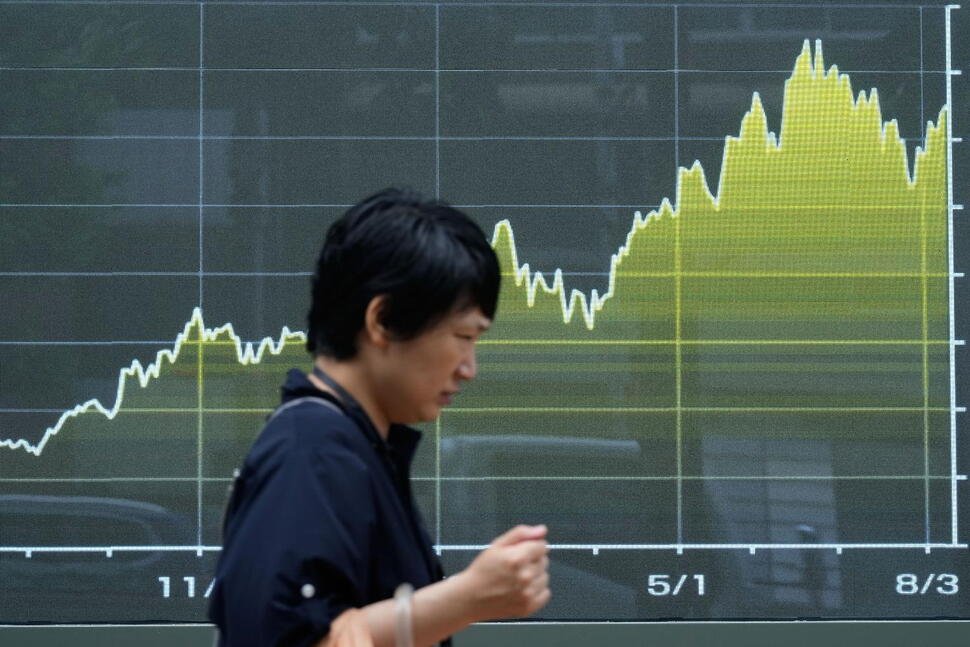
In Japan, the Nikkei 225 index advanced by 0.3%, closing at 68,929.33. This positive movement was buoyed by government data revealing that the Japanese economy expanded at a slightly faster pace than anticipated in the April-June quarter, registering a 1.1% annual growth rate. While private spending and investment remained flat and export growth decelerated, the quarterly economic growth still reached 0.3% during the second quarter of the year.
Other major Asian markets also saw upward momentum. Hong Kong’s Hang Seng index climbed 1.6% to reach 25,521.99, and the Shanghai Composite index in mainland China increased by 0.8% to 3,960.19. However, markets in South Korea were closed for a public holiday. Conversely, Australia’s S&P/ASX 200 experienced a slight dip of 0.4%, settling at 9,076.90. Taiwan’s Taiex posted a gain of 0.5%, while India’s Sensex registered a decline of 0.5%.
Across the Pacific, U.S. futures showed minimal change, and oil prices exhibited a mixed performance. The previous trading session saw the Dow Jones Industrial Average fall by 0.2% and the Nasdaq composite shed 0.3%. Market analysts are closely watching the upcoming week for crucial insights into the health of the U.S. economy, particularly concerning consumer spending and inflationary pressures. Major retailers such as Home Depot, Target, Lowes, and Walmart are slated to release their latest financial results, providing a more comprehensive understanding of how businesses and consumers are navigating persistent inflation.
The Federal Reserve’s interest rate policy also remains a central point of focus for investors and economists alike. The central bank is expected to release the minutes from its July meeting on Wednesday, which will offer further details and potentially signal future monetary policy decisions. The current economic landscape presents a complex challenge, as the Fed grapples with the delicate balance of addressing both economic stagnation and high inflation simultaneously. The potential for “stagflation,” a scenario characterized by slow economic growth coupled with rising prices, is widely considered a worst-case outcome, given the limited tools available to central banks to address both issues effectively.
In the commodity markets, Brent crude, the international benchmark, saw a marginal increase of 0.1% early Monday, reaching $88.62 per barrel. However, U.S. benchmark crude experienced a slight decline of 0.3%, trading at $82.19 per barrel. Geopolitical tensions, particularly the uncertainty surrounding a potential deal to end the conflict with Iran, continue to cast a shadow over the stability of global oil supplies. The Strait of Hormuz, a critical passageway for oil and gas tankers from the Middle East, remains a point of concern due to the risk of disruption.
In currency markets, the U.S. dollar weakened against the Japanese yen, falling to 159.09 yen from 159.32 yen. Conversely, the euro strengthened slightly against the dollar, rising to $1.1587 from $1.1588. These fluctuations reflect the ongoing global economic uncertainties and the varying investor sentiment across different regions.