








Day two of the APTRA India Conference in Bangalore shifted the focus from infrastructure and data to experience, culture and consumer connection, with speakers underlining the need for airports and brands to evolve in line with India’s fast-changing traveller profile.
Airports must compete beyond aviation
The day opened with a keynote from Kevin Roche, who explored the evolution of airport environments and the growing importance of non-aeronautical offerings.
Drawing on experience across LVMH, DFS Group and Moët Hennessy, Roche highlighted how leading global destinations – from the TWA Hotel to La Samaritaine and Westfield Forum des Halles – are redefining retail and hospitality. Airports, he argued, must compete with these off-airport destinations by delivering authentic, locally relevant and design-led experiences that resonate emotionally with travellers.
This theme was reinforced by Shalini Rao, CMO of Bangalore International Airport Limited (BIAL), who emphasised the importance of creating a sense of place, ensuring travellers leave with a lasting emotional connection to the airport.
Airport leaders double down on experience and investment
A panel of airport leaders – Rajesh Arora (GMR Airports), Arun Bansal (Adani Airports) and Hari Marar (BIAL) – expanded on this vision, highlighting strategic investment in experiential infrastructure.
Speakers pointed to the importance of integrating local culture and heritage into airport design, alongside balancing self-managed and partner-led retail models. The discussion also addressed cost efficiencies, with Bangalore’s Terminal 2 cited as a benchmark project delivered at significantly lower cost than comparable US developments.
Premiumisation and travel retail exclusivity were identified as critical levers for growth, supported by digital innovation and immersive, experience-led environments.
The Indian traveller abroad
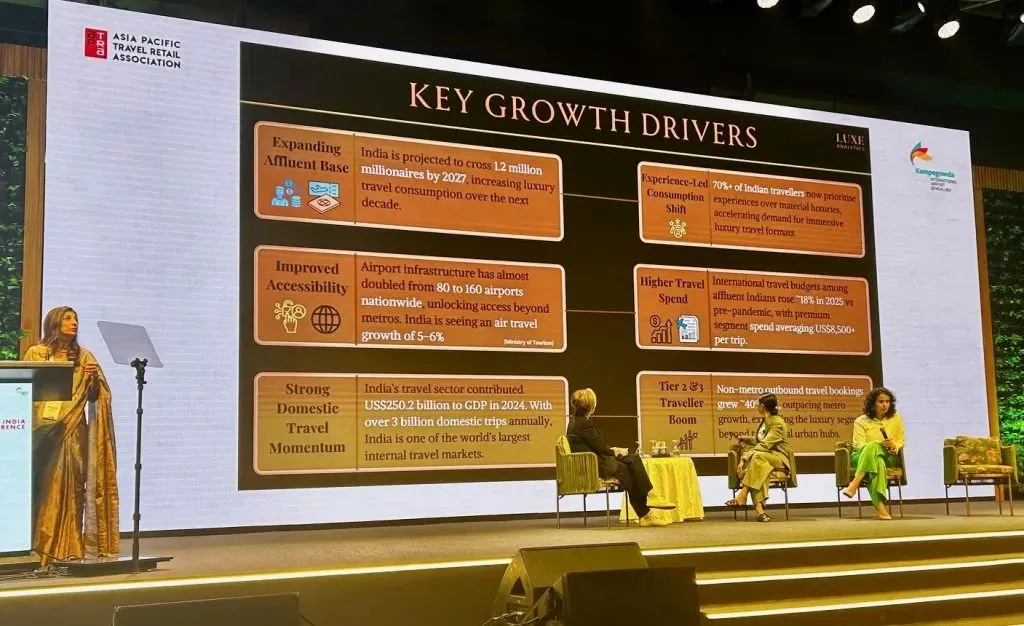
A session led by APTRA’s Anne Kavanagh brought together Lilly Choi-Lee (TravConsult), Rajshree Dugar (Gebr. Heinemann Asia Pacific) and Dr Sheetal Jain (Luxe Analytics) to examine the evolving Indian traveller.
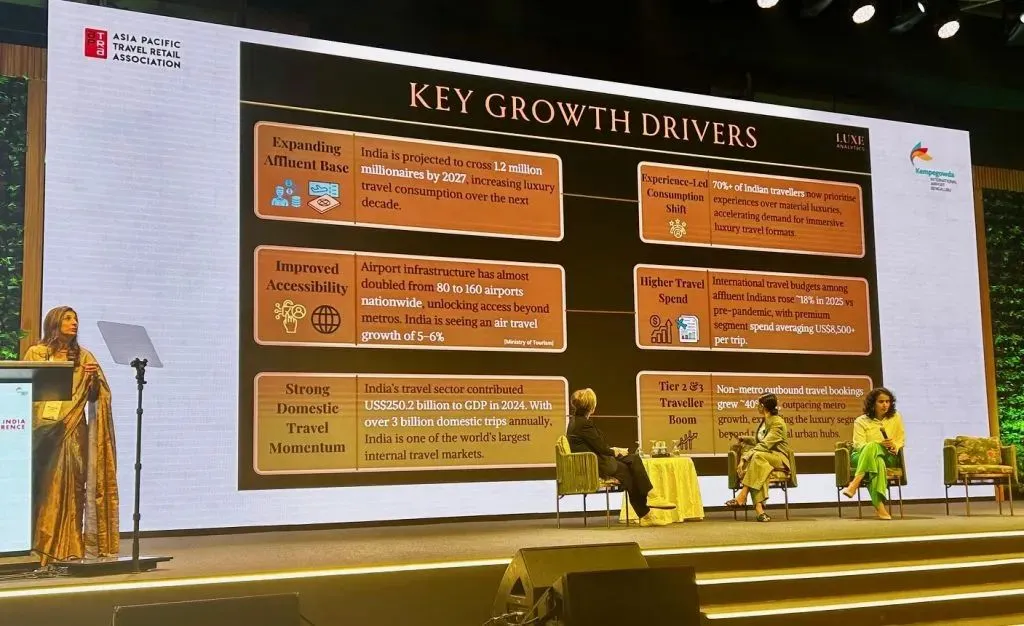
“Experience is definitely the new currency for the Indian luxury market,” said Jain, pointing to a broader shift towards experience-led consumption. Data shared during the session highlighted that 81% of Indians prioritise travel over major life events such as weddings, while 70% favour experiences over material goods.
The affluent Indian traveller is increasingly active, taking an average of six international trips per year, with strong growth in wellness, culinary and spiritual tourism. Millennials and travellers from non-metro cities are driving this expansion, while sustainability and personalised service are becoming key expectations.
Panellists also stressed the importance of cultural nuance. Choi-Lee highlighted bargaining as an intrinsic part of the Indian buying journey: ““It is not about confrontation; it is about participation. It’s part of the Indian buying journey,” she said. While Jain summarised the winning formula for brands as the “five Cs”: customisation, convenience, comfort, consciousness and care.
Global brands urged to localise with depth
A panel moderated by DFNI Editor Kapila Ireland explored how global brands can better connect with India’s diverse and complex consumer base.
“India being such a high growth opportunity, it’s not a homogenous market… its cultural diversity demands that global brands go beyond surface level localisation to truly connect,” Ireland said.
Panellists from Coty, Suntory, Ospree Duty Free, GMR Duty Free and IRHPL highlighted key drivers including value, brand loyalty and demand for travel retail exclusives, alongside continued premiumisation – particularly in beauty, where average basket sizes are reaching $248.
Engagement at point of sale emerged as critical, with Coty’s Veiane Cador emphasising the role of well-trained beauty advisors in driving conversion. She stressed: “Most importantly… it’s all about the engagement with our beauty advisors… they need to be engaging with every single one of the travellers.” Meanwhile, IRHPL’s Kavita Tiwari and GMR Duty Free’s Krishnan Unny Mukkapuzha underlined the importance of aligning with India’s calendar of festivals and occasions, reflecting a shift towards occasion-led purchasing behaviour. “Brands are still thinking that they’re giving products to the market, but Indians have moved on to occasion‑based shopping already,” said Tiwari. Indeed, Mukkapuzha added: “Most people believe that Diwali is the festival, but… we have more festivals than our weekly off days.” The need for better consumer insights, prioritisation, and digital engagement was also stressed.
India’s influence on global trends
Additional sessions explored the broader “India effect”, including insights from IWSR and WGSN, as well as the rising global influence of Indian brands.
Across discussions, a consistent theme emerged: India is not only shaping its domestic travel retail landscape, but increasingly influencing global consumer trends, brand strategies and product development.