









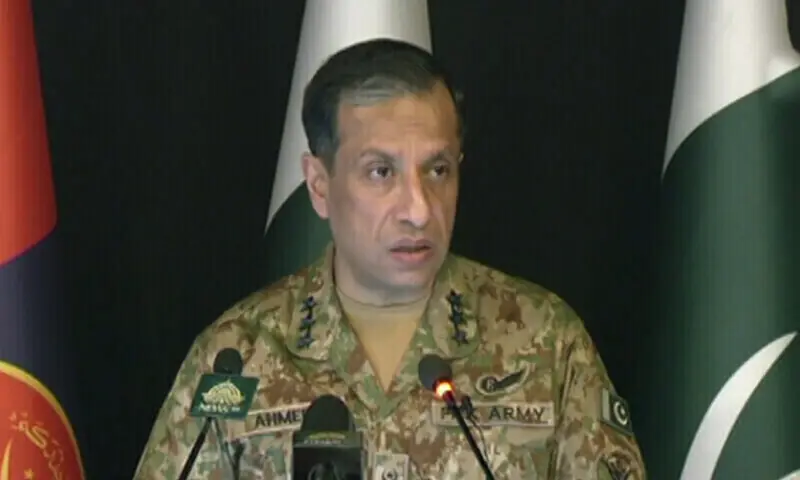
ISLAMABAD – August 19, 2026 – Pakistan’s military has vehemently denounced India’s recently released "Bollywood-style" documentary on its ‘Operation Sindoor,’ labeling it a "propaganda video" designed to misrepresent a military failure as a triumph. The Inter-Services Public Relations (ISPR), the military’s media affairs wing, issued a strong statement on Tuesday, asserting that the documentary attempts to "cobble together a propaganda video to project a military blunder as a successful endeavour."
According to the ISPR, more than a year after the brief military conflict dubbed "Marka-i-Haq" (Battle of Truth) by the state, India is refusing to acknowledge its defeat. The conflict, which commenced with the April 22 Pahalgam attack and concluded with a ceasefire on May 10 after US intervention, saw Operation Bunyanum Marsoos by Pakistan. Instead of accepting the outcome, India has opted to "colour history in her preferred hues," the ISPR statement read.
The military’s media arm criticized the documentary, which features senior Indian political and military leadership, as a "highly dramatised, coloured and factually inaccurate account" of ‘Operation Sindoor.’ This term was used by New Delhi to describe its strikes against Pakistan on May 7, 2025.
"For its lack of nuance and seriousness, the documentary can be characterised as a tragedy and a comedy at the same time," the ISPR stated. It further elaborated that "selectively edited interviews, emotional narration and cinematic Bollywood style reconstruction have been used to alter established facts and rewrite the operational outcome."
The ISPR highlighted "fundamental contradictions" within the documentary, suggesting it was a "belated attempt to manufacture a domestically palatable version of events." A key point of contention raised by the Pakistani military was the documentary’s attempt to link an address by the army chief on April 16, 2025, with the Pahalgam incident on April 22, 2025, which the ISPR dismissed as "conjuring a conspiracy theory out of nothing."
The statement further challenged India’s narrative by pointing out that the alleged perpetrators of the Pahalgam attack were identified and eliminated on July 28, 2025 – 82 days after ‘Operation Sindoor.’ The ISPR questioned, "If the alleged perpetrators were eliminated on July 28, India must explain, who it claims to have punished on May 7, 2025."
Pakistan also refuted India’s claim of "100 per cent mission success," labeling it "equally detached from operational record." The ISPR asserted that during Marka-i-Haq, Pakistan’s armed forces "successfully thwarted Indian aggression and shot down 8 military aircraft." Furthermore, Pakistan conducted Operation Bunyanum Marsoos, utilizing "Fatah precision-guided rockets and missiles, PAF precision munitions, long-range loitering munitions and precision artillery against 26 military targets." These targets included facilities allegedly used to target Pakistani citizens and entities involved in fomenting terrorism against Pakistan.
The ISPR contended that the documentary itself undermines its claims of Indian dominance, noting that "Indian military leadership acknowledges extensive Pakistani missile, drone and air activity, sustained engagements along the Line of Control and the activation of Indian air-defence systems." These admissions, the statement argued, are "difficult to reconcile with its repeated portrayal of Pakistan being decisively defeated."
Regarding the cessation of hostilities, the ISPR highlighted that the documentary’s own narration confirms that fighting ended through communication between the two Director Generals of Military Operations and an agreed cessation of military action. This, according to the ISPR, "contradicts the attempt to portray Operation Sindoor as a unilateral Indian military triumph. A cessation of hostilities, facilitated by the United States, cannot subsequently be repurposed as evidence of unconditional victory."
The Pakistani military also pointed out internal contradictions within the documentary concerning escalation dynamics. It noted the simultaneous emphasis on "surprise, precision, deep strikes and escalation dominance," while also claiming India "deliberately limited the conflict and provided Pakistan an ‘exit window’." These "competing claims expose the production as a carefully constructed domestic narrative rather than an objective military account," the ISPR concluded.
"No amount of cinematic reconstruction can change the chronology, erase aircraft losses, conceal military casualties, alter the military engagements that actually took place or convert a battlefield defeat into a self-proclaimed victory," the ISPR declared.
The statement concluded by emphasizing that "Pakistan has no need to manufacture a narrative around Marka-i-Haq." It asserted that the "operational record, battlefield evidence, diplomatic exchanges and India’s own subsequent statements speak for themselves and are widely acknowledged by international community." Pakistan reiterated its commitment to regional peace and stability, but also warned that its armed forces remain "fully prepared and capable of defending the country’s sovereignty, territorial integrity and national interests." Any future military misadventure, it stressed, "will be met with a firm, decisive and disproportionate response, after which no amount of cinematic perjury will be able to provide any face-saving to India."