







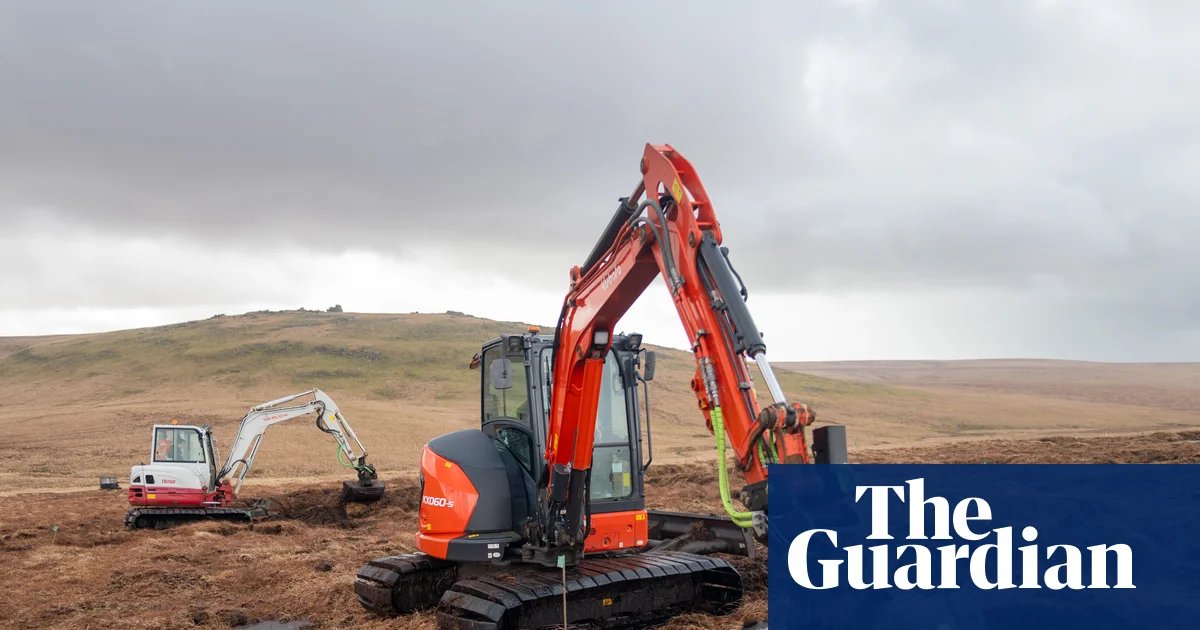
At one of the most remote spots in southern England, Al West skilfully tilts and rotates the bucket of a small digger, like a giant mechanical hand. He lifts turf, and pats it down gently on to the rich, dark brown peat beneath. Above him, the granite stack of Fur Tor looms above the vast, boggy, wild expanse of northern Dartmoor.
It is repetitive, delicate work, which West carries out with dexterity and care. Within a boundary of white flags, he takes from a borrow pit and fashions a peat embankment across each ditch and depression covering the land, to restore it to its natural smoothness and to stop the rainwater running off down the valley.
For West this is personal. His family have had common grazing rights on Dartmoor since 1904. In the early 1920s, his great-grandfather came to the same place where West works today to cut sods of peat, along with hundreds of others, before taking it back home for domestic heating.
It was one of many human interventions that – unwittingly for most – have left the 8,500 hectares (21,000 acres) of blanket bog on Dartmoor severely degraded. Tin mining, drainage for agriculture, deforestation, burning and military testing of ordnance are among the activities that have damaged what should be a springy, wet, mossy, trampoline, scarring it with deep gullies, ditches and depressions. This leads to water runoff, which dries out the peat, causing it to crack and collapse.
Peat, formed by layers of decomposing plant matter in waterlogged conditions, is a type of wetland that occurs in almost every country in the world. A globally important ecosystem, peat bogs provide huge value to humans and the environment. When healthy, they store twice as much carbon as all the world’s forests, reducing global emissions, providing clean water, helping to alleviate flooding and supporting biodiversity.
West is part of a project that is gradually helping to reprofile the landscape, building blocks and embankments across the gullies and ditches to capture rainwater, raise the water table and restore the wetness to the land.
Over time, the pools created by the reprofiling will fill with sphagnum moss and other plants, and the process of peat forming will begin once more, restoring the springy bog to its natural condition.
“It is my second season doing this restoration work,” said West. “I have driven a digger for 40-odd years, and I farmed until four years ago as a commoner. I feel like I am making history – I am helping the environment that is part of the life cycle.”
Across the vast expanses of Dartmoor, Exmoor, Bodmin Moor and West Penwith in Cornwall, more than 5,000 hectares of peat bog have been restored over 17 years.
In the last four years, in a £13m restoration project, the South West Peatland Partnership, funded by organisations including Natural England, South West Water and the National Trust, has restored 1,700 hectares of damaged peat bog, out of a target of more than 2,600 hectares.
Morag Angus, the manager of the partnership, said the peat bogs had been degraded over centuries in a series of human interventions.
“This has happened over huge timeframes, ever since humans have been here really,” she said. “Peatland is a degrading system now and it will continue to degrade without the restoration work we are doing.”
The degradation of peatland by human intervention has left about 15% of the world’s peatlands drained, releasing huge amounts of greenhouse gases, such as carbon dioxide, from the carbon stored within peat soils. CO2 emissions from drained and burned peatlands equate to 10% of all annual fossil fuel emissions.
In the UK, about 80% of peatland is degraded or damaged, and what could be the country’s biggest carbon store has become a net carbon emitter, responsible for at least 3.5% of the total UK greenhouse gas emissions. The Committee on Climate Change, which advises the UK government on climate policy, has said 50% of upland peatlands and 25% of lowland peatlands should be restored to near natural condition by 2050 to meet legally binding UK climate policy.
The peat bogs of the south-west could cease to exist if conditions become – as predicted – warmer and drier.
“We are a canary in the coalmine for the rest of the UK,” said Justine Read, a communications officer for the South West Peatland Partnership. “What happens to UK peatlands over the next 15 to 20 years will impact the peatland in the Peak District and Scotland, but it is going to hit the south-west first.
“Unless this restoration work is done, this blanket bog on top of the hill here will really struggle to form and we will not see it past 2060. What we are trying to do is make the peatland as resilient as we can now, so it can face what is coming.”
Forming at a rate of 1mm a year (0.04in), the deepest peat bog on Dartmoor, at 9 metres (29ft 6in), represents 9,000 years of natural archaeology, its layers containing the secrets of environmental and human history.
This natural archaeology, including globally rare remains of tin streaming – an ancient method of extracting tin dating back to the bronze age – has to be protected during the restoration work.
While the restoration across the vast landscape is long-term, some of the positive effects can be seen much more rapidly, including an increase in the number and types of species of dragonfly.
Edward Adam, a monitoring officer for the partnership, said: “Dragonflies are almost at the bottom of the food chain and they support everything above it – all the wading birds and mammals that live on the moor. So it is really amazing to see, it is the start of the healing process.”
Research from Exeter University highlights an urgent need to accelerate and scale up peatland restoration to combat the climate crisis, identifying Dartmoor, the blanket bog in Caithness and Sutherland, northern Scotland, known as the Flow Country, and the Peak District as particular areas at risk.
West, whose work is a pinprick on the surface of the vast, forbidding moor, is undaunted by the scale of the task.
“I just keep going every day that I am here,” he said. “Bit by bit, every little helps. If we keep this up, year on year, we will be over the next valley, then over the next valley. It is quite remarkable what you can do in 12 months if you just keep going.”