









Spring has arrived, to the nation’s great relief, after a remarkably soggy winter — the eighth wettest on record.
Given this, you might have reasonably assumed we have enough water. But analysis from the Environment Agency (EA) shows England faces a shortage of five billion litres of water per day by 2055, equivalent to more than a third of our current water supply.
James Wallace, the chief executive of River Action, says the crisis has already arrived. “I’ve spoken to senior people at the EA over the past year who have speculated that this summer or next could see parts of England relying on standpipes in the road, with people queueing up for water,” he says. “Water scarcity has been completely ignored. The veins of our nation are rivers and they are running dry.”
Decades of underinvestment in our water network means that while rainfall is plentiful, there aren’t enough reservoirs to catch it — no big reservoir has been built in the UK since 1992.
On top of this, a succession of water companies have opted for cheap fixes to our Victorian plumbing that have left parts of England with the oldest water networks in Europe. As a result, nearly 19 per cent of all our water is lost to leaks, equating to 2.6 billion litres a day.
At the same time climate change-driven heat is compacting soil, so it’s unable to absorb winter rainfall. Instead it runs off back into the sea rather than recharging essential aquifers (vast natural reservoirs).
The most densely populated parts of England, the south and east, rely heavily on chalk aquifers for their water supply, which are drying up due to over-abstraction.
England’s chalk streams — which make up 85 per cent of the world’s total — have been described as “our Great Barrier Reef”. To protect them, regulators have told water companies including Affinity Water to cut groundwater abstraction by up to 68 per cent by 2055, drastically shrinking the water supply.
The main alternatives — treating seawater and transporting raw water from other parts of the country — are expensive, carbon-intensive and risk spreading invasive species, harmful algae and pathogens into new ecosystems.
All this is already blocking housebuilding in our green and increasingly thirsty land. Homes cannot be completed unless they are physically connected to the water grid and waste systems.
Housebuilding stalled
In Sussex North water resource zone, for example, 4,000 homes were stalled for four years because the only way to supply water was by abstracting it from a nearby site that would have threatened the lesser whirlpool ramshorn snail, a protected species. The government deployed a water delivery taskforce to come up with a package of measures, otherwise the water shortage would have blocked another 17,000 homes from being built by 2029.
In Kent there are 23,000 homes planned across Canterbury, Whitstable and Herne Bay, but last week South East Water (SEW) said it will “struggle to supply” them with water. The week before, regulators confirmed that the water company faces a £22.46 million fine for water outages across the county between 2020 and 2023.
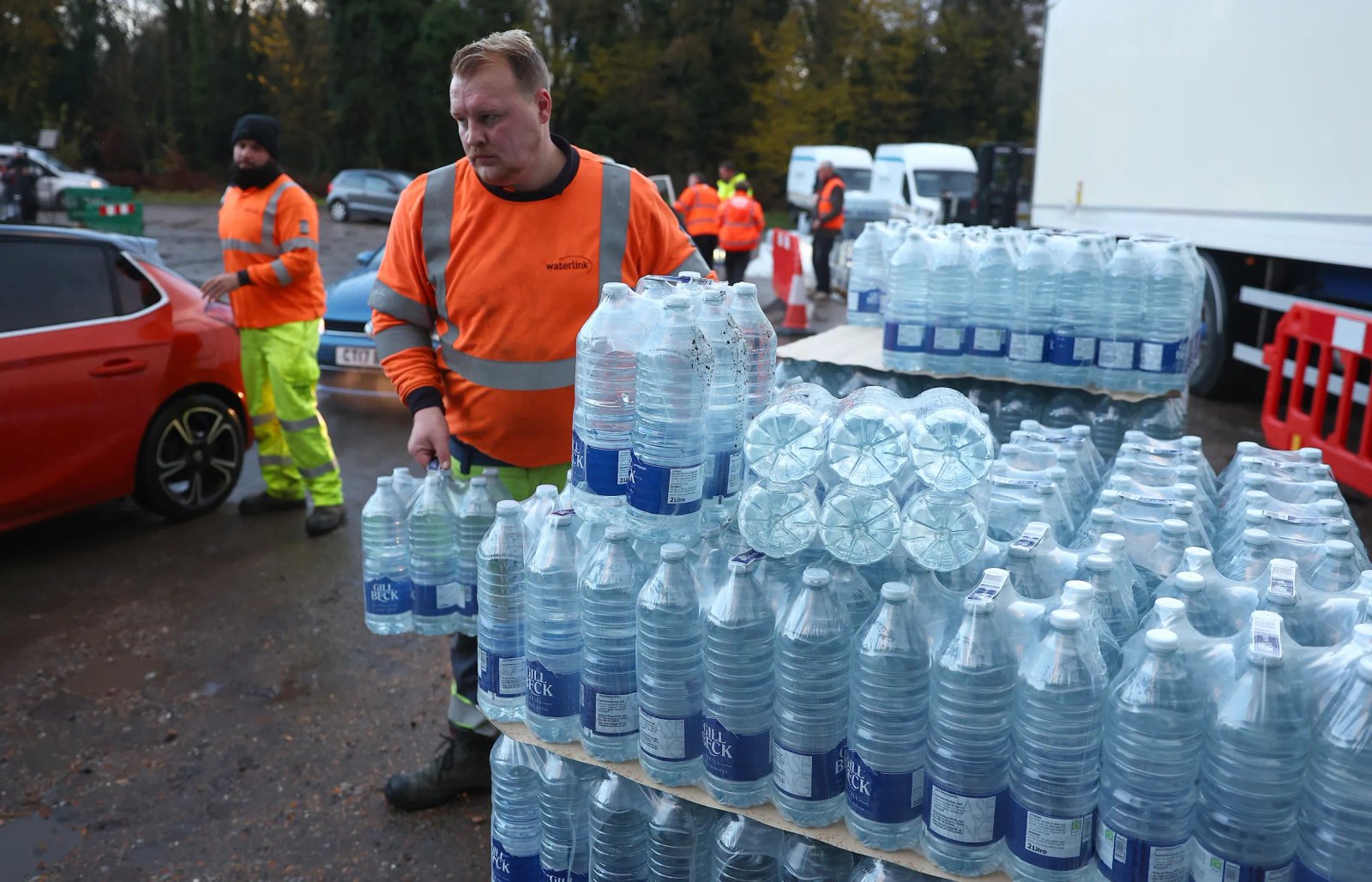
Residents in North Leigh in Oxfordshire, East Grinstead in West Sussex, and Tunbridge Wells and Tonbridge, both in Kent, have had a taste of life without enough water this year, due to burst pipes and a power outage at a pumping station.
Schools were forced to close, residents had to queue to collect bottled water and in Tunbridge Wells portable lavatories were installed in the town square. To Wallace, these incidents “demonstrate how dependent and totally unprepared we are”.

The government is also hoping to build another 1.5 million homes by the end of this parliament. Building even 1.3 million homes would add nine million litres to daily demand — roughly the entire usage of a town the size of Dudley in the West Midlands — which current supply plans cannot meet.
Data centres draining supply
At the same time the government is pursuing a growth agenda in the very areas most affected by this water shortage, driven by technology jobs. Those jobs are reliant on data centres that are cooled down, unbelievably, with drinking water — an estimated ten billion litres of it per year.
Affinity Water, which supplies water to 3.9 million homes in the home counties and northwest London, has 88 new data centres planned in its area; 40 of these have planning permission and two are so large that, together, they will require the same amount of water as 49,000 new houses.
Responsibility for water is spread across four regulators (Ofwat, the EA, the Drinking Water Inspectorate and Natural England). “No one is in charge and there is no strategy [to deal with it],” says Richard Emmott, a public affairs adviser for Affinity Water.
To fix this, a government white paper published in January called A New Vision for Water proposes scrapping Ofwat and merging the others into one all-powerful regulator, in addition to building nine reservoirs (although the first won’t arrive until 2030).
In the meantime our locally controlled planning system isn’t helping us to prepare either. At the moment, water companies rely on four-year local plans to plan their water supply, and they are not consulted on bigger, centrally planned projects, like Universal Studios in Bedfordshire, or the Oxford-Cambridge growth corridor. This means that mediators and special taskforces have to be brought in to get everyone in the same room.
“It is a case of water, water, everywhere, nor any drop to drink,” says Phil Harker, the technical director of the Cambridge Growth Company (CGC), which was set up in 2024 to unlock the infrastructure needed to build a “British Silicon Valley” in Cambridgeshire, where 97 per cent of the supply is groundwater from chalk aquifers.
To meet new demand, Cambridge Water needs a greater share of water from the Grafham Water reservoir that it cannot access until neighbouring Anglian Water completes the Grand Union Canal transfer project in the early 2030s, and the new Fens Reservoir won’t be finished until a few years later.

To bridge the gap, CGC is working with the council, housing associations and universities to address water wastage in their buildings, and with local farmers to capture water run-off from their fields. It is also funding a study into a series of “winter reservoirs” that store rainfall for summer months. Harker says, “Let’s roll it out and make sure it happens everywhere else.”
The Cambridge Water Scarcity Group, an advisory organisation chaired by Paul Leinster, the former chair of the EA and former lead on infrastructure for Homes England, is piloting a water credits system in which housing developers can offset the water demand from homes they want to build by paying for water-saving fittings and leak-reduction measures in older buildings such as schools and social housing.
How we can save water
Leinster thinks that all new-builds should have rainwater harvesting features and water butts in the garden, similar to the ones used in new homes in Eddington in northwest Cambridge, alongside smart water meters that tend to reduce usage by 10-15 per cent. He also wants planners to incorporate dual pipe systems: one for drinking water; the other for recycled water. A government consultation is considering whether to include this in updated building regulations.


“Isn’t it a nonsense that you could put your cup into your toilet cistern and drink the water?” he says. “It’s crazy to me. You just don’t need to water your garden with drinking water.”
Households are the single biggest drain on the public water supply, accounting for 59 per cent of total usage. But can we ever save enough water in our homes to make a difference?
The government is proposing a water target of 80 litres per person per day in Cambridge. At the moment the average person uses 137 litres of water a day in the UK, rising to 140 litres in hot weather. This is far higher than our European neighbours: in Belgium and Denmark, for example, each person uses little more than 100 litres a day.
But a new poll by Thinks Insight and Strategy, a consultancy, shows that 81 per cent of people are already employing at least three water-saving measures at home, such as turning off the tap when brushing their teeth, or watering the garden less frequently.
Unlike with energy consumption, households have little control over how much water domestic appliances like washing machines, dishwashers and lavatories use. Mandatory labelling of white goods for water efficiency, similar to current A to G energy ratings on household appliances, is coming soon, ministers say.
Current usage is also weighted towards homes because water companies are forced to prioritise household water usage over other types. In the Hartismere water resource zone, for example, which covers parts of north Suffolk and the town of Eye, there is already a de facto ban on new non-household water usage because of a severe shortage.
This blocks business development and could result in £8.5 billion in lost economic activity, according to a 2025 report by the think tank Public First, depriving the Treasury of £2.5 billion in tax revenue.
Large water users like airports benefit from “falling block tariffs”. “The more water they use, the less they pay,” Emmott explains, noting there is “no incentive” for large users to switch to recycled grey water. “We’re changing that now, but that practice is common across the water industry. Water is a commodity, and it’s arguably way too cheap, which also means that there’s not much of a price incentive for households to use less water either.”
Polling in 2024 suggested that 64 per cent of households were willing to pay more for water security, but 49 per cent said they would only pay between £5 to £10 more a year.
Wallace, from River Action, does not believe the onus should fall on households to pay for water companies’ lack of planning and investment. He also thinks Whitehall should be looking to continental Europe for inspiration, where most water companies are publicly owned.
“The government is not looking at financial structures, therefore the problem will persist,” Wallace says. “It is a corporate rip-off. There’s no question in my mind that we are being had by unregulated corporations.”
“Absolutely, water companies should have done more,” Emmott concedes. “[But] when water companies do want to invest, especially in the last 15 years with the previous government, the strategy was to keep bills low. They said no to a lot of potential investment, or it wasn’t seen as a priority in that period.”
But if we do not pay more to fix our water networks now, we won’t be able to build the housing we need — and an even larger bill will await the next generation. The National Infrastructure Commission predicts that emergency drought measures, such as using road and ship tankers or emergency desalination, will cost between £25 billion and £40 billion over the next 30 years.
“Every drop of rain that falls,” Wallace says, “should be treasured and valued.”