




On a sunny January afternoon in Bodega Bay, some 70 miles north of San Francisco, the White Abalone Culture Lab is humming with activity.
It’s spawning day. Alyssa Frederick, the lab’s program director, invites me into an industrial room full of troughs and tubs of bubbling seawater. The abalone program is tucked away in the UC Davis Bodega Marine Laboratory, a research facility devoted to studying ocean and coastal health. The goal is to bring the endangered sea snails, known for their iridescent shells and delicate meat, back from the brink.
Inside, a mix of volunteers and biologists stand in the aisle holding the abalone, some as big as coconuts. They’re measuring, weighing, and performing health diagnostics. If the animals are deemed robust enough, they’ll be moved into buckets filled with a “love potion” of hydrogen peroxide, which stimulates the females to expel eggs and the males to release sperm.
The researchers here hope that the 110 white abalone on the premises will successfully produce offspring. They’ll then nurse the marine mollusks until they’re big enough to be released into their native waters along the southern California coast.
It’s part of a 25 year effort to repair the damage from overfishing and other factors to the species. In 2001, the year the first artificial spawning program took place, only 1% percent remained – about 2,000 individuals.
If left alone in the wild, they were doomed to go extinct within a decade. The white abalone became the first marine invertebrate to be listed as an endangered species and a program was established to restore their numbers. Since the Bodega Bay lab opened in 2011, scientists have released over 20,000 animals into the ocean – a ten-fold increase.
Today, the atmosphere in the lab is almost jolly. Everyone is grinning and laughing. After all, this is what scientists who help endangered animals strive for: the chance to see the struggling species reproduce.
Frederick hopes that by the end of the day, millions of larvae will fill the troughs. But successful spawning depends on factors outside of human control.
In case it might help, the researchers set the mood. They turn off all the lights except for the red bulbs suspended above the buckets. Sometimes they even play romantic music for the abalone. A little Marvin Gaye might just tip the vibe in the right direction.
“It’s totally unscientific, but it makes us feel like we’re doing something,” laughs Frederick. “I haven’t found any evidence that music helps abalone reproduce. It doesn’t seem to hurt.”
Funding cuts
This spawning day feels significant because it almost didn’t happen.
Last April, Donald Trump proposed $1.7bn in cuts to the National Oceanic and Atmospheric Administration (NOAA), which protects and restores more than 160 endangered marine species, as part of an effort weaken protections for vulnerable wildlife and open critical habitat to commercial interests like oil drilling, logging, and fishing.
The white abalone program was caught up in these changes. The cuts included the three-year grant that funds the lab and the salaries of its five employees. Suddenly the laboratory was plunged into uncertainty. If the project was gutted, it would interrupt momentum that has been building for decades.
Luckily, anonymous donors soon provided a stopgap for the missing money. Then, a few months later, federal funding came through for 2026. As of writing, it’s likely the lab will receive the remainder of the grant, meaning the program should have financial support for another two years.
Still, Frederick was left questioning how to ensure the lab stays open in such a volatile political atmosphere.
“If you want to save a species, you can no longer rely fully on federal funding,” Frederick says. “That’s just poor risk management.”
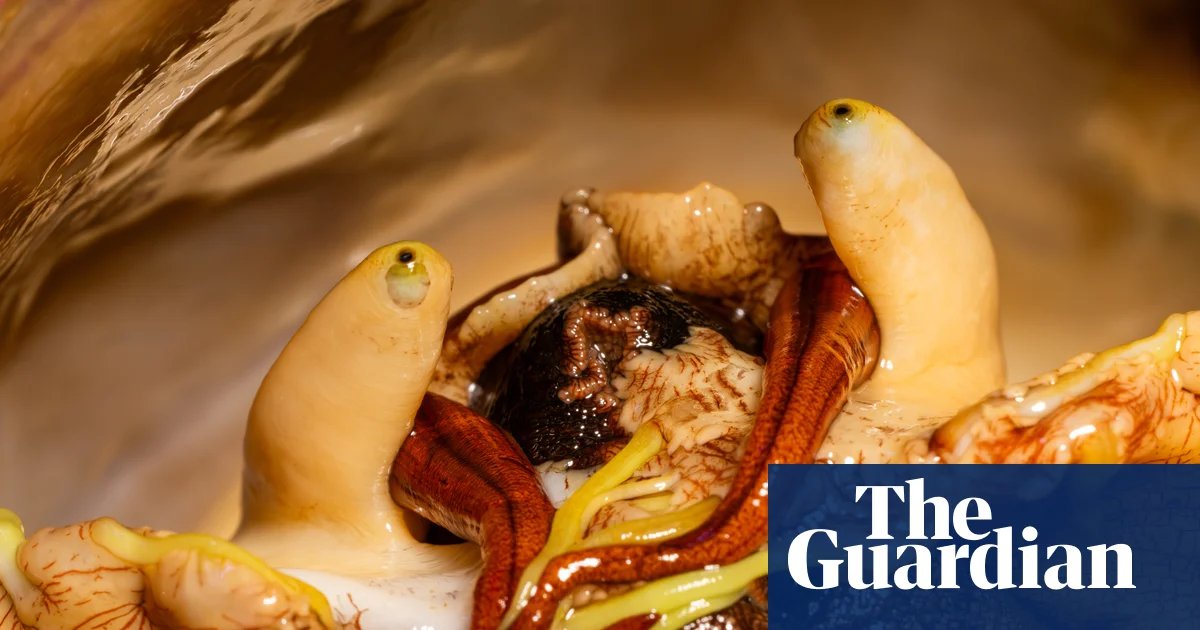
Frederick holds up a white abalone for me to see. Its mauve shell is covered with ridges and bumps. Inside is the “foot”, the yonic, beige muscle it uses to cling to rocks. I’m a little disappointed. This creature looks more like a catcher’s mitt than the charismatic sea snail I was anticipating.
Then, as I watch, the abalone begins to move. Slowly it lowers its foot, revealing the pearly interior of its shell. Two tentacles poke out and then the brown head appears. The snail is looking at me. I’m delighted by this strange creature, at once alien and yet seemingly curious and shy. Frederick calls them “derpy”, and the word seems to fit.
Struggling species
Six of California’s abalone species – white, red, black, green, pink, and flat – are struggling. The black abalone is also now listed as an endangered species. A ban on harvesting red abalone was recently extended until 2036: currently, the only way to buy the gourmet delicacy is from a farm. The white abalone, meanwhile, cannot be fished or purchased.
At one time, the giant gastropod was so plentiful, they were stacked on top of each other along the coastline. Slow moving, easy to catch, and delicious, they have a long cultural history as a food in California. Many indigenous tribes harvested them and used their iridescent shells as jewelry, tools, or currency. In the early 20th century, writers like Jack London sang the Abalone Song while tenderizing the meat. “Oh, some folks boast of quail on toast / Because they think it’s toney, / But I’m content to owe my rent / And live on abalone.”
By the 1970s, overfishing had depleted most populations of the sea snail. Attention shifted to the white abalone, which were found in high concentrations in deeper waters from Point Conception down to Punta Abreojos in Baja California. A feeding frenzy followed. Within a decade, people had harvested 280 tons of the species. A 1992-93 survey of the 15 historic sites revealed only three white abalone living where once there had been thousands.
Abalone reproduce by “broadcast spawning”, which is when the males and females release their reproductive cells into the ocean. When these gametes meet, they create larvae, which swim around in the water column for a week or two before settling on rocks. Slowly, over its lifespan of 35-40 years, the microscopic sea snails can grow up to 10 inches wide.
In 2001, the remaining white abalone were too far apart to spawn on their own. The White Abalone Program started that year when 18 wild snails were brought into a southern California facility. While initial spawning worked, a fatal disease called withering syndrome swept through and killed the animals. In 2011, UC Davis opened the Bodega Bay lab, as the withering syndrome had yet to appear in Sonoma county waters.
The other concern for the species is habitat degradation through the loss of kelp forests – underwater jungles that sustain a variety of marine life, including abalone. In a 2021 study by UC Santa Cruz, satellite imagery revealed that 95% of kelp forests along the northern California coast has disappeared, likely due to warming waters and the invasion of purple sea urchins. At the same time, the sunflower sea star, the urchin’s major predator, was dying out due to the sea star wasting disease. Without it, there was little to stop the urchins from mowing the kelp to the rocky sea floor, causing the abalone to starve.
The good news is that it’s possible to repair some of the damage that has been done. In fact, chances are high that the white abalone can be saved. One spawning produced more than 12m fertilized eggs. Only a portion of that larvae will survive, but with luck, many will eventually be released into the wild.
If that continues for long enough, Frederick believes the white abalone can someday thrive again. And that, she explains, is why she’s happy to make restoring the giant sea snail her life’s work.
“It’s just so hopeful,” she says. “So many people studying the ocean or studying endangered species have a really hard job. They have to watch the ocean degrade or they’re watching a species go extinct. In this situation, we get to actually restore the white abalone. It’s kind of amazing. That never happens.”