









Breakthrough in Water Purification: IIT Guwahati Develops Low-Cost System to Remove Arsenic and Fluoride
Researchers at the Indian Institute of Technology (IIT) Guwahati have unveiled a groundbreaking water-treatment technology capable of simultaneously removing two of the most dangerous groundwater contaminants—arsenic and fluoride—in a matter of minutes. This innovation offers a promising, cost-effective solution for communities facing the dual threat of groundwater toxicity.
The new system, detailed in a study published in the Chemical Engineering Journal, utilizes a rotating-anode electrocoagulation (RA-EC) reactor. During laboratory testing, the device achieved impressive results, removing up to 98.2% of arsenate and 91.8% of fluoride from contaminated water samples.
The Challenge of Dual Contamination
Groundwater remains a vital lifeline for millions across India, yet it is frequently tainted by naturally occurring arsenic and fluoride. Historically, treating these pollutants has been a complex endeavor; because they exhibit different chemical behaviors, they often compete for removal sites during traditional purification processes, making simultaneous treatment inefficient or costly.
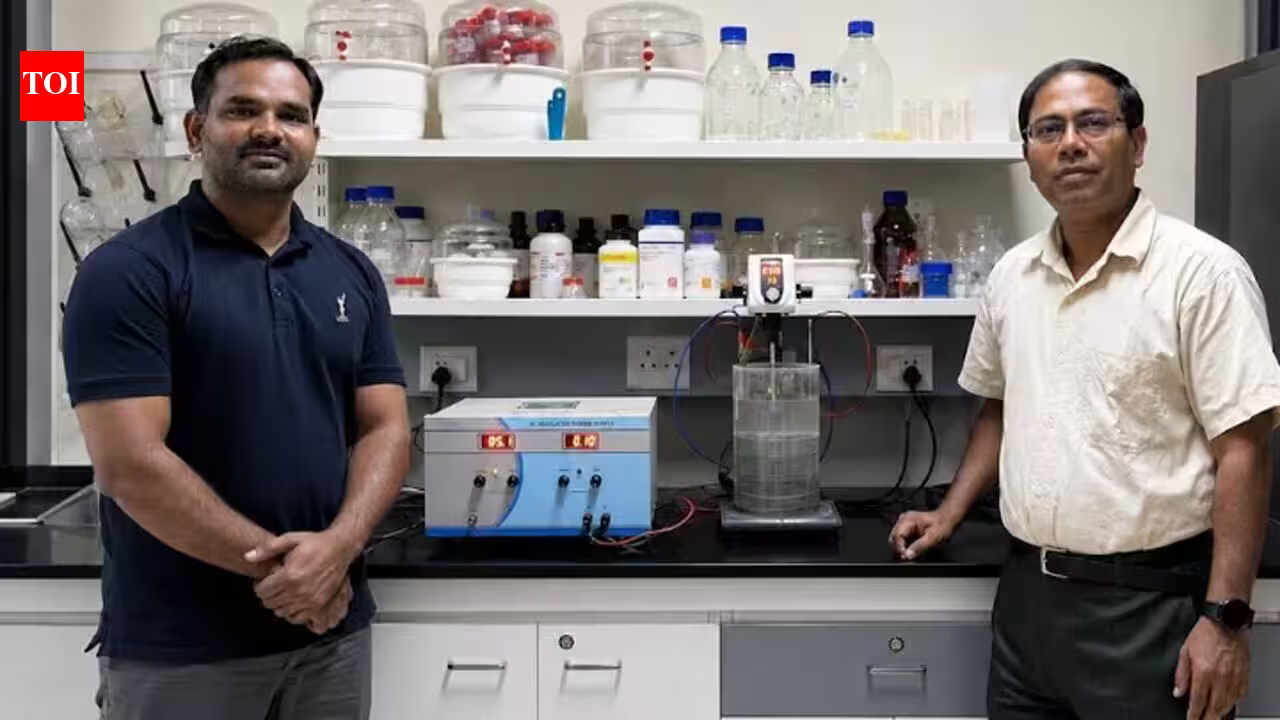
“Treating both contaminants together is particularly challenging because they behave differently,” explains Prof. Mihir Kumar Purkait of the Department of Chemical Engineering at IIT Guwahati. To address this, his team—including research scholar Mukesh Bharti—developed a unified process that tackles both pollutants in a single, streamlined reactor.
Innovative Engineering: The Rotating-Anode Approach
Conventional electrocoagulation relies on stationary electrodes to generate the chemical reactions necessary to capture contaminants. The IIT Guwahati team revolutionized this by introducing a rotating aluminium anode.
The rotation of the electrode serves several critical functions:
- Enhanced Mixing: It optimizes the transfer of contaminants toward the reacting surfaces.
- Surface Renewal: It prevents “passivation,” a common limitation in standard systems where the electrode surface becomes coated and loses efficiency.
- Superior Floc Formation: As electricity passes through, it generates aluminium and hydroxide ions that form microscopic “flocs.” These flocs act as traps, binding to arsenic and fluoride, which are then easily removed through precipitation or adsorption.
Towards Affordable, Scalable Solutions
A significant highlight of this research is its economic potential. The team estimates an operating cost of approximately Rs 18 to Rs 58 per 1,000 litres of water, depending on contaminant concentration. While this represents a preliminary demonstration cost rather than a final commercial price, the potential for affordability is high.
The system has already shown resilience by performing effectively under realistic conditions, including the presence of common minerals like calcium, magnesium, and sulphates, and even when tested using real groundwater samples from the state of Assam.
The Road Ahead
As the world grapples with increasing water insecurity, this water-treatment technology offers a beacon of hope for decentralized, rural water facilities.
The research team is now moving toward the next phase of development: building a pilot-scale, continuous-flow version of the reactor. Future iterations are expected to incorporate sensor-based automated controls that monitor pH, conductivity, and rotational speed in real-time. While further validation and large-scale testing are required, this innovation represents a significant leap toward simplifying the purification of contaminated groundwater for populations in need.