







From Labs to AI Agents: How IIT Madras Alumni are Revolutionizing Chip Material Discovery
The rapid evolution of artificial intelligence has triggered a global arms race for computing power. However, beneath the sophisticated algorithms and massive data centers lies a pressing physical limitation: the chips themselves are reaching critical thermal thresholds. As modern AI processors face heat fluxes of approximately 140 watts per square centimeter, the hardware industry is hitting a thermal wall that traditional engineering struggles to overcome.
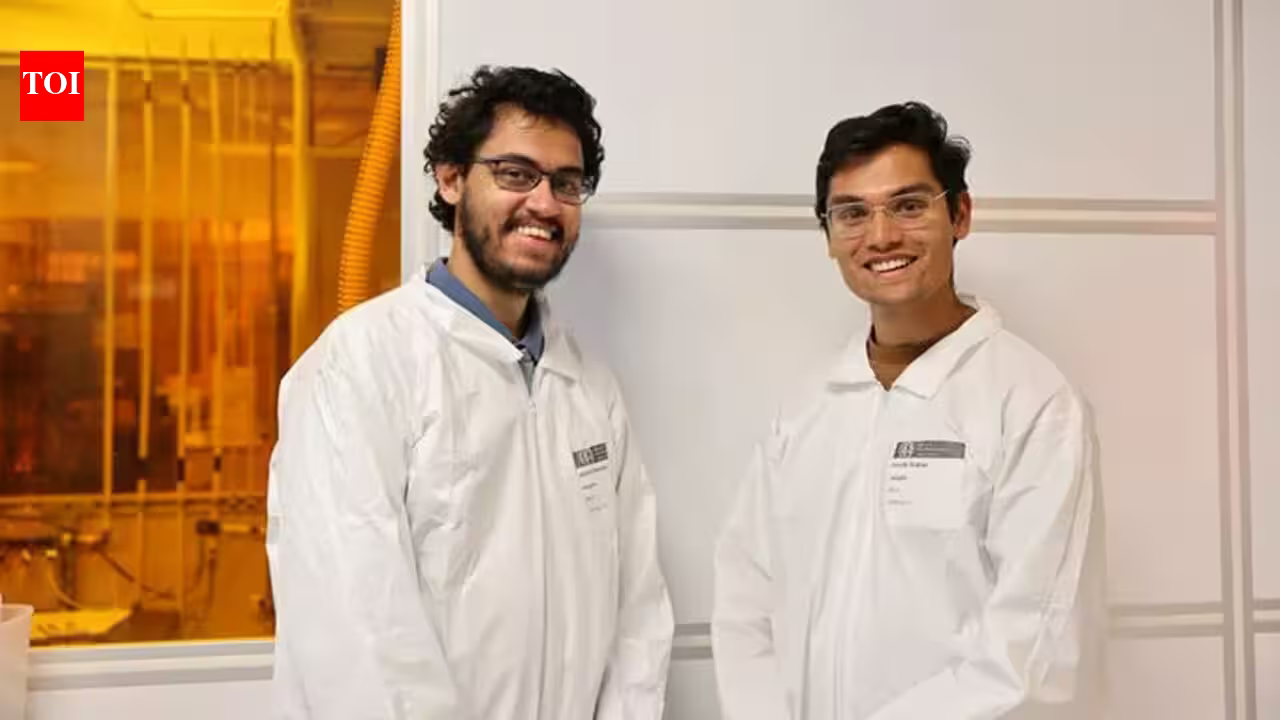
Enter IIT Madras alumni Advaith Sridhar and Akash Ramdas. The co-founders of the deep-tech startup Discovered Materials are betting that the very technology fueling the AI boom can also solve its most daunting physical bottleneck: the discovery of next-generation semiconductor materials.
Bridging the Gap Between AI and Material Science
The process of identifying, synthesizing, and validating new materials for chip manufacturing has historically been an arduous journey, often spanning over a decade. By utilizing a “swarm” of autonomous AI agents, Discovered Materials aims to compress this decade-long timeline into a matter of months.
The venture recently announced a significant $9 million seed funding round in August 2026, spearheaded by Lightspeed India Partners, with strategic backing from Y Combinator, Peak XV Partners, and notable angel investors, including Y Combinator co-founder Paul Graham.
The founders bring a powerful synergy of expertise to the table. Akash Ramdas, a Stanford-educated materials scientist whose research on nanoscale interconnects has influenced industry leaders like Intel and TSMC, provides the domain mastery. Advaith Sridhar, an AI specialist from Carnegie Mellon University with experience in autonomous agent systems at Persona AI and Luma Labs, provides the computational engine.
The Challenge of Real-World Synthesis
While the potential of AI is immense, the transition from “computational candidate” to “physical component” remains a notorious hurdle in materials science. To address this, the company launched the Material Discovery Bench, an open benchmark designed to test AI models against real-world semiconductor constraints.
While the project has successfully identified over 500 previously unknown material candidates, it has also highlighted the harsh reality of modern research: discovery is only half the battle. Of those 500 candidates, only one initially demonstrated a plausible pathway for laboratory synthesis. This gap between theoretical innovation and manufacturing reality is precisely what the startup aims to close.
A New Frontier for India’s Tech Ecosystem
Despite the early hurdles, the founders remain optimistic. Ramdas recently noted that in the last three months, the team has successfully developed thermal materials that match the performance of existing commercial products—solutions that previously took industry giants years to perfect.
By focusing on the fundamental chemistry and physics of chips, Discovered Materials is positioning itself upstream in the semiconductor value chain. While much of the global discourse remains fixated on manufacturing fabs and factory capacity, Sridhar and Ramdas are looking further ahead, focusing on the discovery of entirely new materials that do not yet exist in commercial use.
As the industry grapples with the thermal limits of current silicon-based tech, this IIT Madras-led initiative underscores a shift in how we approach hardware innovation: using the intelligence of machines to build the very foundation upon which the future of computing will stand.