





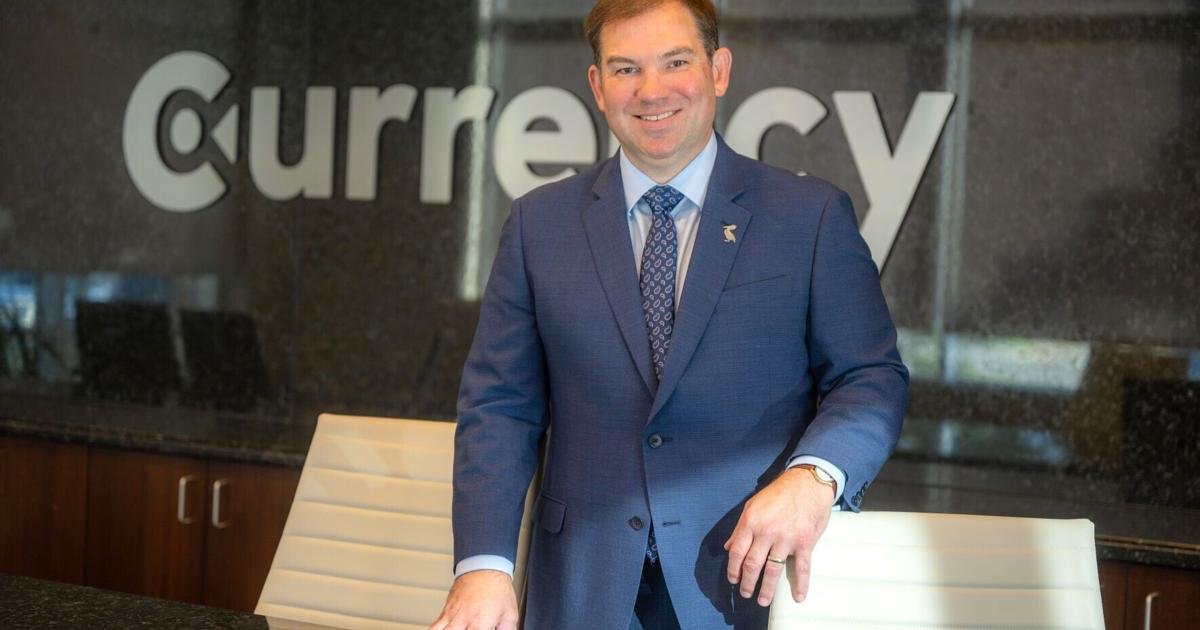
Currency Bank President and CEO Scott Gaudin lovingly calls Baton Rouge the “biggest small town in America.”
The bank serves mainly small to midsized businesses, and Gaudin plans to make his company the go-to bank for local companies in the capital region. Currency is headquartered in Towne Center and has been positioning itself for growth in the state, acquiring a b1Bank branch in Kaplan and selling its Arkansas branch in the past year.
Gaudin started Currency during the pandemic after spotting a gap in the market for companies serving small to midsized businesses — which describes most in Baton Rouge — mainly due to the consolidation of other banks. Since then, it’s become one of the fastest-growing banks in the state, with about $250 million in assets and $207.4 million in deposits.
Its revenue grew more than 560% over the past three years, landing itself a spot on the Inc. 5000 list of fastest growing companies last year.
With three branches across Baton Rouge, Kaplan and Oak Grove, Currency has built a base of 144 shareholders, primarily Baton Rouge-based business owners.
In this week’s Talking Business, Gaudin discusses Currency Bank’s competitive advantage, his plans for growth and why he’s set on growing in the capital region.
This interview has been edited for length and clarity.
What are your plans for the bank’s future?
Right now, our focus is on the capital region. People ask me, “Why is 90% of our growth in Baton Rouge?” I said, “Let me run through some numbers with you.” Baton Rouge has 35 banks. We started with 32; three more have joined us. We did a market share study a year ago, two years ago, and we were ranked 16th out of 35, not bad for year five. We have 2% of the market share. There’s so much business here that we could still go get that we don’t even know about most of it.
Our batting average when we have a chance to do business with somebody is very high. We typically win most deals that we touch. We find a way to make it happen because, again, we’re the bank for business owners, owned by business owners. We understand those requests. Now I want to make sure I don’t confuse anybody either. If I’m not a business owner, can I still bank there? Well, of course, we just tend to add the most value with a small to medium-sized business and that owner. It’s not a prerequisite. It’s not a requirement. That tends to be where we shine. As far as focusing on growth in Louisiana, our focus, at least for the immediate future, is going to be on the capital region.
How do you plan to keep that same focus on small to midsize businesses?
I believe a little romantically, perhaps a little naively, that people bank with people. I go back to relationships and sometimes certain bank names may be on the sign, but in the day, people bank with Scott and Matt, and so we tend to gravitate toward folks who are proven and have a following. We are very, very deliberate and intentional about who we bring aboard, because, for being the fastest growing bank in the state last few years, we only have 35 people. We get the people part right first. I happen to believe that sometimes skill sets are interchangeable. They get the people part and the culture part right first. If you’re a good fit for that, that’s a good start, and we can kind of go from there. We’re currently located here in Baton Rouge right now. We pay attention to the outlying areas such as Ascension, which continues to boom and is one of the fastest growing parishes in the state over the last 10 or so years. We’ve got a desire to expand out to that area with the right leader.

Currency Bank, 7054 Jefferson Hwy.
What else do you think distinguishes the bank, and how do you guys plan to compete?
I’m not trying to share too much personal information, but I took all my pennies I had saved in my couch, and I put them in the bank stock. I’m an owner in the bank, and so when you talk to me, you’re talking to someone who, if the bank fails or succeeds, personally impacts a great deal. A lot of folks you may deal with at the banks don’t necessarily have skin in the game; they’re more order takers. Another very deliberate, intentional thing we did — think about some of the best experiences you’ve had either at a restaurant or a hotel, some of your most favorite meals from memories, and had a certain concierge approach to the service. We wanted to emulate that concierge approach to the bank.
I’d like to talk about the sale of your Arkansas branch. How does that fit with your long-term plans?
It’s my belief that a $250 million bank has challenges having the right infrastructure in place to support a bank in two states, and it takes up bandwidth, and not to mention, Louisiana laws are different than other states. That’s another challenge for us being a community bank is knowing two sets of laws and two sets of state regulations. We were approached unsolicited about it. We didn’t try to sell it. I said no three or four times at first, but I will tell you, the thing that made me reasonably assured was that he promised me all the employees of that branch would keep their jobs. In a town where it’s at, it’s a town of 800 people and just two banks. The bank job is a really good job. It was very important to me that they kept their job. When I was reasonably sure that was going to occur, and I saw the big picture of our growth related to focusing on Louisiana, it clicked.
We keep coming back to that point of you being based here in Baton Rouge, and what that means for you in the bank.
Baton Rouge, believe it or not, as far as the mid-major cities go in the South, is one of the most coveted banking markets. When you combine LSU and Southern; the petrochemical sector, which employs probably about 20% of our population; and state government, which employs a chunk as well, both internally and externally, whether it’s state workers or lobbyists or whatever, those three things make Baton Rouge amazingly consistent. I can speak from the point of view of a business owner, a fixed, predictable outcome, even if it’s not the very best possible, is helpful. I think Baton Rouge is a great place to be.