






Beyond the Rocket: Breakthrough in Materials Science Could Finally Unlock the ‘Space Elevator’
While President Trump recently reaffirmed a commitment to permanent American lunar outposts and eventual Mars missions during a visit to NASA’s Johnson Space Center, leading researchers are warning that the “golden age” of space exploration may soon hit a brick wall. The culprit? The inherent inefficiency of chemical rockets.
For decades, the “tyranny of the rocket equation” has governed space flight—a brutal reality where 85% to 95% of a vehicle’s mass must be fuel, leaving only a tiny fraction for cargo and crew. To truly open the cosmos, experts argue we must move away from the explosive uncertainty of rocket launches and toward a stable, permanent infrastructure: a space elevator.
The Bridge to the Stars
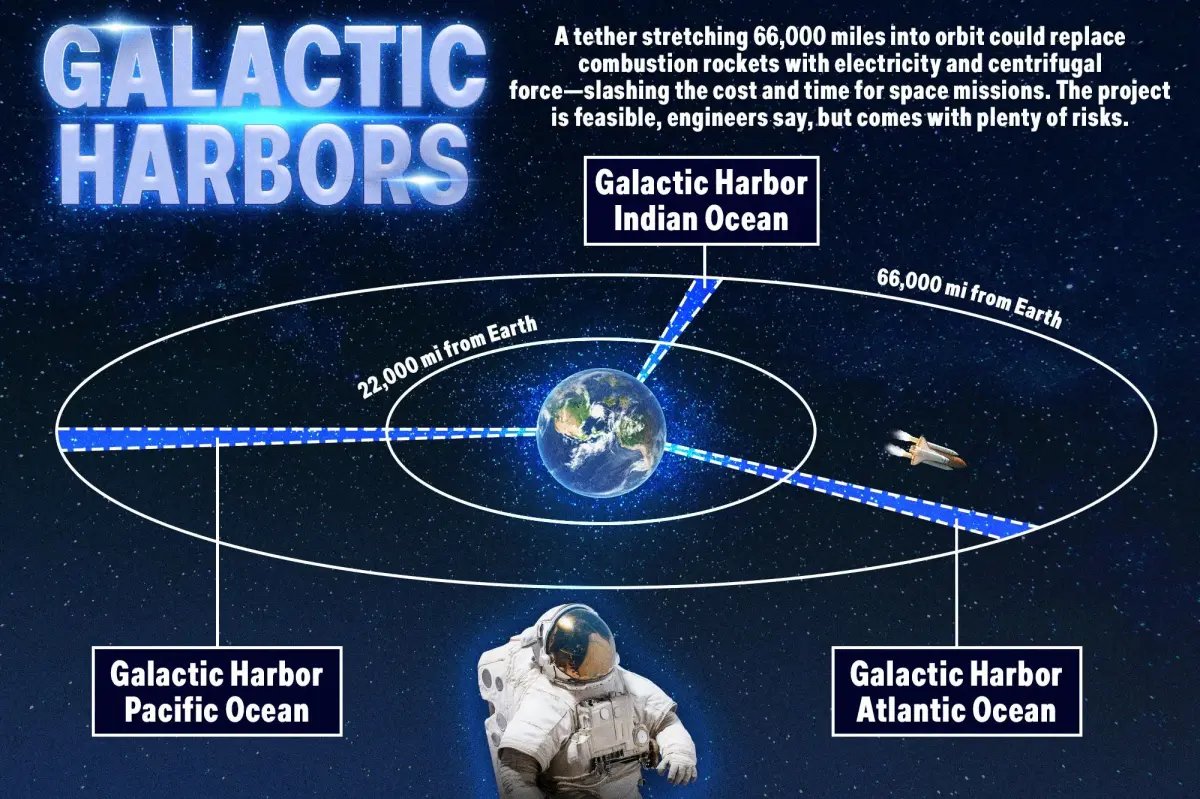
The concept, famously popularized in Arthur C. Clarke’s 1979 novel The Fountains of Paradise, is deceptively simple: an ultra-strong electrified tether anchored to an “Earthport” at the equator, extending 62,000 miles into space. A counterweight floating beyond geostationary orbit would keep the line taut, allowing robotic “climbers” to transport cargo and eventually passengers, using electricity rather than combustible fuel.
“We’re really pushing for permanent infrastructure, like a bridge replacing ferries to cross a river,” said Pete Swan, president of the International Space Elevator Consortium (ISEC). “The beauty is that raising it with electricity saves our atmosphere from pollution, it doesn’t leave any debris, and it will be routine, daily, inexpensive, and safe.”
A Material Breakthrough
The primary hurdle to this sci-fi dream has always been the tether. The cable needs to be 100 times stronger than steel yet light enough to reach the heavens. However, a major development is about to change the narrative.
Next month, the ISEC is expected to unveil its most promising material yet: polycrystalline graphene.
While standard graphene—a single layer of carbon atoms—has long been the theoretical “holy grail” for such projects, polycrystalline graphene allows for a more scalable, durable patchwork structure. Swan notes that the material is remarkably resilient; it is already being used to develop advanced bulletproof vests capable of stopping small-caliber rounds.
“It looks like we found the material,” Swan told The Post. “Every once in a while, somebody makes a discovery and all of a sudden the capabilities go from linear to really huge jumps. That’s what’s happening in our tether material arena.”
From Fiction to Logistics
The current roadmap for a space elevator is staggering in scope. The ISEC estimates a project cost of $15 billion—a bargain compared to the $200 billion projected for the multi-decade Artemis program.
If built, the structure could deliver 30,000 metric tons of cargo annually. Once a payload reaches the “gravitational sweet spot” of geostationary orbit, the Earth’s rotation would handle the rest, flinging cargo toward the Moon in just 14 hours or toward Mars in as little as two to four months.
The Economic Reality Check
Despite the engineering potential, the project faces a steep uphill battle in the realm of finance. Dr. Armen Papazian, a professor of space economics at the American University in Dubai, warns that the timeline for return on investment remains a massive deterrent for private backers.
“Even if one were to start building a space elevator tomorrow, assuming they find the risk capital, it will take a decade or two to complete,” Papazian noted. “Investors are looking for a return, and they want to make it hopefully while they’re still alive.”
Public funding, meanwhile, is susceptible to the shifting tides of political administrations and national debt limits. Yet, for those looking toward the stars, the allure of a permanent, low-cost “railway” into the galaxy remains the only path forward. As Swan reminds skeptics, when rockets were first proposed, the experts laughed—until they didn’t.
“Technology doesn’t go on a linear line,” Swan said. “It grows.”