







Innovative Wearable Tech: Indiana Students Develop Advanced Navigation Aid for the Visually Impaired
In a remarkable fusion of academic ambition and social responsibility, a team of engineering students at the Rose-Hulman Institute of Technology has developed a groundbreaking wearable device designed to enhance mobility for the visually impaired. By extending detection capabilities beyond the traditional reach of a cane or a guide dog, this project represents a significant leap forward in accessible technology.
The initiative was spearheaded by John Marum, a 1983 electrical engineering and mathematics alumnus and founder of the Oakland-based non-profit AuralVision. The inspiration for the project struck Marum after observing the practical use of time-of-flight (ToF) sensors—the same LiDAR-based technology used in automated airport bathroom paper towel dispensers to monitor stock levels.
“I began to think about how it would be possible to use that same sensor to measure distance to objects and relate that distance to someone who can’t see,” Marum explained. His vision was to create a solution that was cost-effective, battery-operated, and entirely independent of smartphones, Wi-Fi, or paid data subscriptions.
A Multidisciplinary Collaboration
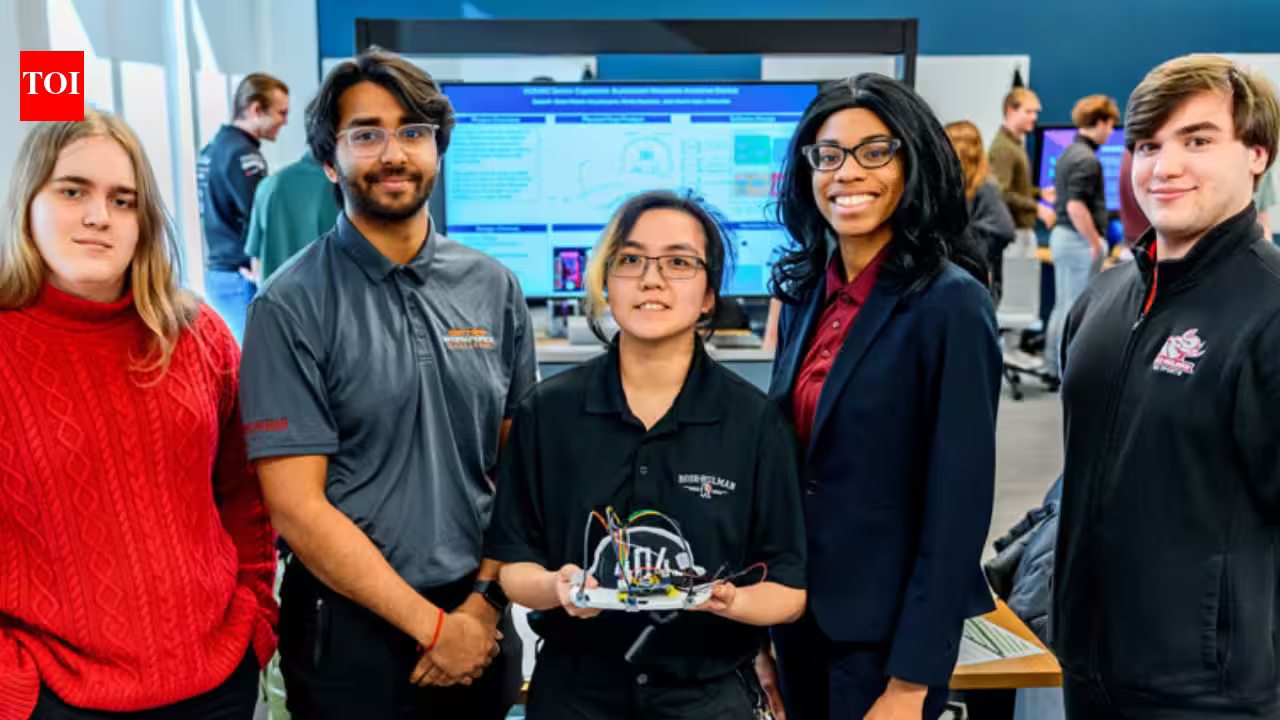
Marum brought this concept to his alma mater, where it became a cornerstone of the ECE 460 multi-disciplinary senior design course. The team—comprising students Anuj Suvarna, Anica Cao, Rhiley Epperson, Jada Hunter-Hays, and Ethan Powell—spent months refining the technology.
“When we first learned of the project, we realized how this idea can really help people,” said Suvarna, who is pursuing a dual degree in computer engineering and engineering management. “I’ve really enjoyed being part of a project that has an impact.”
From Prototype to Wearable Hat
Following feedback from visually impaired beta testers who suggested a hat-based form factor for convenience, the team pivoted their design. The final prototype consists of a baseball cap equipped with a strip of ToF sensors along the brim. These sensors trigger haptic feedback—vibrations inside the hat—that alert the user to the distance and direction of approaching obstacles. The device features a robust battery system, allowing for 12 hours of continuous, self-contained operation.
Learning Through Real-World Feedback
A critical component of the project involved user testing at an assisted living community in Terre Haute. Students Hunter-Hays and Powell conducted focus groups with residents aged 70 to 99, providing invaluable insights into user experience.
The feedback highlighted a generational gap in how users interact with technology. “Our generation has grown up with an oversaturation of information,” Powell noted. “Having something constantly buzzing… is normal to us. But for a more elderly user, that may cause confusion.” This insight has set the stage for future iterations, including adjustable vibration patterns to better accommodate different sensory preferences.
A Legacy of Innovation
While the current student team is set to graduate following the winter quarter, the project’s future is secure. The students have documented their work for the next cohort of Rose-Hulman engineers, and Marum remains committed to the development process.
Ultimately, the goal is to keep the project open-source, ensuring the technology remains accessible for those who wish to build or adapt it to their specific needs. As Marum looks toward the future, he hopes to involve other alumni and partners to help transition this [innovative navigation aid](https://timesofindia.indiatimes.com/education/news/five-indiana-engineering-students-built-a-12-hour-wearable-that-helps-visually-impaired-users-detect-obstacles-beyond-a-cane-or-guide-dog/articleshow/133701138.cms” target=”_blank” rel=”nofollow) from a classroom prototype into a widely available commercial product.