








Sikkim Unveils Ambitious Engineering Projects to Mitigate Glacial Lake Outburst Risks
GANGTOK: In a decisive shift from passive hazard assessment to proactive disaster mitigation, the government of Sikkim has unveiled three major engineering interventions aimed at neutralizing the threat posed by potentially catastrophic Glacial Lake Outburst Floods (GLOFs).
As the Himalayan region grapples with the accelerating impacts of climate change, state authorities are focusing on concrete structural solutions to protect vulnerable downstream communities. Sandeep Tambe, Principal Secretary of the Science and Technology Department, emphasized that while scientific monitoring remains vital, the state’s priority has pivoted toward direct intervention.
“Studying glaciers is one thing, but we are mostly working towards glacial hazard mitigation,” Tambe stated, underscoring the urgency of the new proposals.
Solar-Powered Pumping at Shako Chho
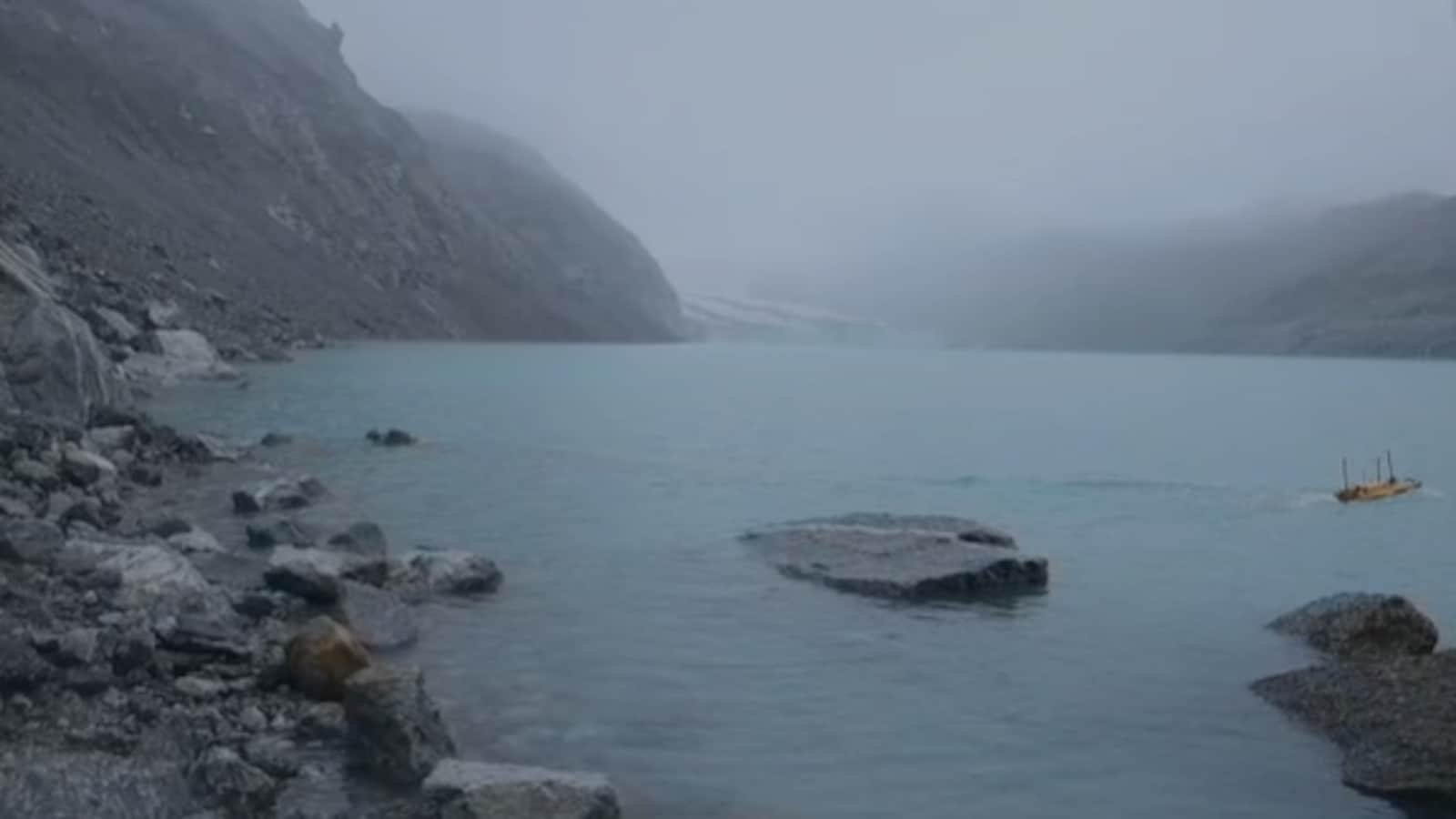
The most ambitious of the three projects targets Shako Chho, a high-altitude lake situated at 17,000 feet. With no natural outlet and an estimated volume of 27 million cubic metres, the lake presents a significant danger to areas along the route to the Gurudongmar complex.
To address the risk without compromising the integrity of the fragile surrounding moraine—a practice advised against by the National Disaster Management Authority (NDMA)—Sikkim plans to deploy eight solar-powered pumps. This setup aims to extract approximately 8 million cubic metres of water, effectively lowering the lake level by 20 to 40 metres. Chief Engineer Ashim Basnett noted that this reduction is critical to tempering the force of any potential water release caused by future avalanches or landslides.
Retention Strategy at Lhonak Valley
The second proposal shifts focus from direct lake intervention to terrain-based management. Drawing lessons from the October 2023 disaster at South Lhonak—which released nearly 30 million cubic metres of water—the state plans to construct a flood-retention structure at Dolma Sampa.
Located about 24 km downstream from the Lhonak complex, Dolma Sampa features a naturally widening valley. During the 2023 outburst, this topography proved effective in slowing the surge by allowing water, boulders, and debris to disperse over a wider area. By formalizing this “natural buffer” with an engineered structure, officials hope to significantly dampen the momentum of future floods.
Safety Infrastructure at Gurudongmar
The third intervention centers on the Gurudongmar Lake complex, which has expanded considerably over the past thirty years. Officials have proposed the construction of a moraine-plug safety wall, utilizing stone masonry at the lake outlet. The primary objective is to regulate water release during extreme events.
“Once it starts rolling down the valley, it gains momentum and picks up boulders and debris. Then it is almost impossible to do anything about it,” explained Dhiren Shrestha, Secretary of the Science and Technology Department.
A Path Toward Resiliency
The NDMA has identified 40 high-hazard glacial lakes in Sikkim, with 16 classified as high-priority “Category-A” sites. Detailed assessments have already been completed for 13 of these.
As the state awaits final clearances for these engineering projects, the shift represents a broader national effort to harden infrastructure against the unpredictable nature of the Himalayas. By combining traditional masonry with innovative solar-powered engineering, Sikkim is positioning itself as a leader in the race to outpace the evolving threats of a warming climate.