








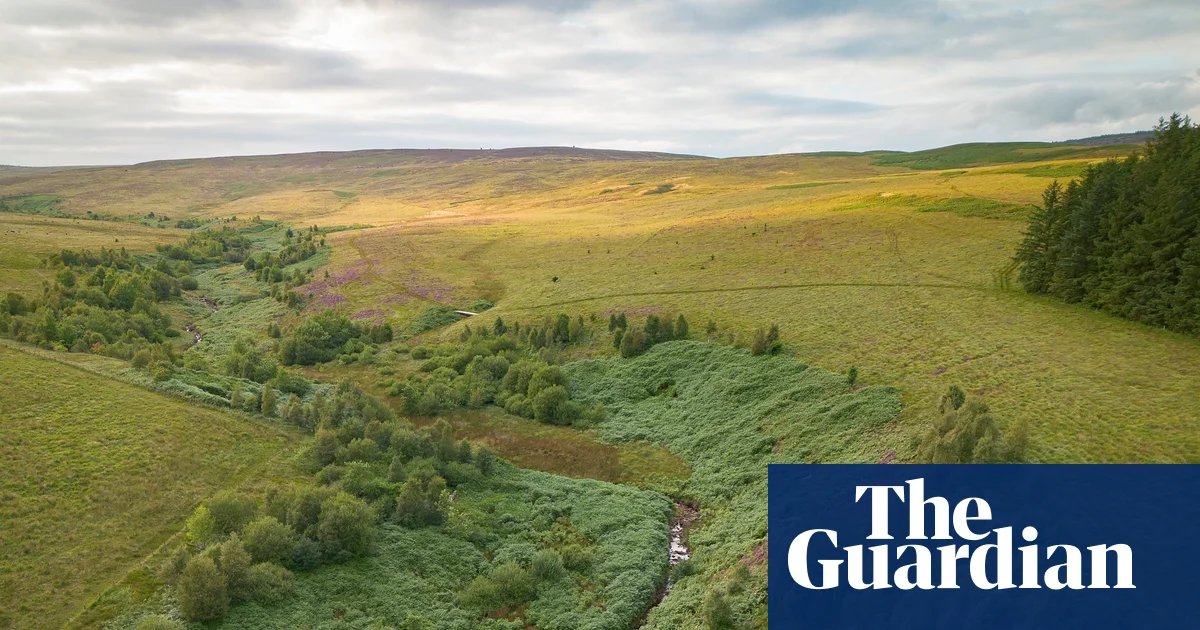
Tucked away in the far north of Northumberland lies a landscape so remote that online route finders often fail to navigate its gravel tracks. Devoid of public transport and human habitation, this vast glacial bowl known as Emblehope Moor has become the focal point of an ambitious experiment in British land management. Spanning 7,500 acres, the estate was recently purchased for £8.5m by Restore, a nature restoration company, with a mandate to transform the site from a traditional shooting and farming ground into a sprawling haven for wildlife.
The project is the largest contiguous rewilding site under single ownership in England, aiming to restore populations of golden eagles, curlews, black grouse, and beavers. However, the initiative is distinguished by its unconventional exit strategy. Once the company has achieved its biodiversity goals, generated returns for its investors, and repaid the £4.5m loan provided by Triodos Bank, the ownership of the land will be transferred to a local community or charitable entity.
“We want to prove that the bank is paid back, investors get their two-times return, but we don’t need to become the next forever laird,” says Benedict Macdonald, environmental writer and founder of Restore. “It’s not an aggressive land-holding model; it’s both a capitalist and community model. We’ve got to take the greed out of it for it to work.”
The restoration efforts are already underway. The first critical phase involves the rewetting of desiccated peat moorland. Over decades, a hidden network of man-made drains has left the soil parched, turning what should be water-retentive sphagnum moss into brittle, dry patches. Modeling indicates that by plugging these drains, Emblehope could store an additional 100,000 cubic meters of water, providing a vital defense against drought and flooding in the region.
Beyond hydrological repair, the site faces the challenge of non-native species. Swaths of Sitka spruce, which support little biodiversity, are slated for removal. The company plans to address the persistent issue of self-seeding “little shitkas” by planting broadleaved shelterbelts along the site’s periphery to block wind-blown seeds from neighboring commercial forests. To manage fire risk and restore the delicate sward needed for ground-nesting birds like the curlew, Exmoor ponies will be introduced to graze the heavy thatch of dry grass.
While the project has been hailed by environmentalist Ben Goldsmith as a cornerstone of what he calls “Britain’s Yellowstone,” the team remains pragmatic about controversial reintroductions. Although the site’s potential for biodiversity is immense, Macdonald has clarified that Restore has no plans to introduce lynx, citing strong opposition from local sheep farmers.
The project intends to maintain financial viability through a combination of traditional forestry income, livestock grazing, eco-tourism, and government environmental land management payments. A significant portion of funding is expected to come from “natural capital” markets, where corporations sponsor 30-meter by 30-meter plots of habitat restoration.
Despite the shift toward wilding, the estate’s existing workforce remains integral to the transition. Restore has retained the site’s farmer and gamekeeper, valuing their intimate, long-term knowledge of the landscape. “These guys work 18-hour days, they live and breathe the area,” Macdonald notes.
As it seeks to raise an additional £4m for its 20-year roadmap, Emblehope sits as a test case for a new era of British conservation—one that seeks to balance corporate investment with long-term public benefit, aiming to prove that even in the remote uplands, the future of the environment can be both wild and locally owned.
Disclaimer: This content is auto-generated for informational purposes only. It has been rewritten and paraphrased from the original source.
Source: Read Original News