







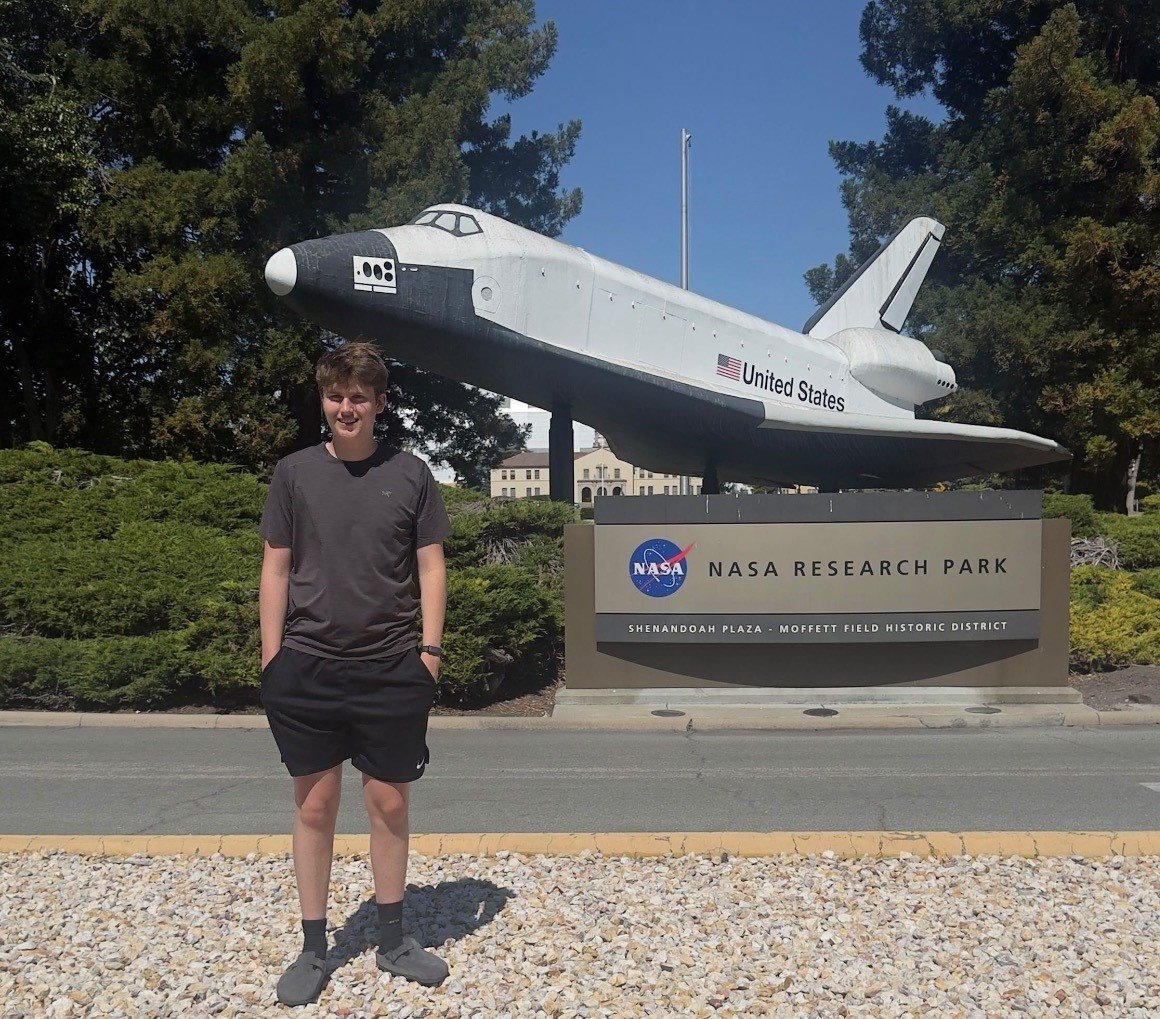
For most high school students, summer vacation is a time to unplug, but for Alexei Barrow, a senior at BASIS Flagstaff, this past summer was a crash course in aerospace engineering and wildfire mitigation at the highest level. Representing Arizona as the sole participant from the state, the 17-year-old spent eight weeks working with NASA’s Ames Research Center in Silicon Valley on a mission to modernize how we track and fight forest fires.
The internship program focused on a project titled “A Multi-Tier Autonomous Aerial Architecture for Wildfire Detection, Characterization and Communication in Infrastructure-Denied Environments.” Working remotely alongside a six-member team, Barrow dove deep into the complexities of combustion chemistry and fluid dynamics to help build a smarter, faster response system for wildfires.
## Leveraging Advanced Tech for Environmental Resilience
At the core of the project was the challenge of operating in “infrastructure-denied” environments—areas where traditional communication networks, such as cell towers, are often destroyed by fire. To combat this, the team explored the integration of High-Altitude, Long-Endurance (HALE) drones and low-altitude Unmanned Aerial Vehicles (UAVs).
The goal was to create a fully autonomous loop: HALE drones would use remote sensing to detect the initial ignition or spread of a fire, then automatically cue lower-altitude UAVs to provide real-time data for ground crews. This system aims to bypass the need for human intervention or terrestrial technology that could be compromised during an emergency. To design these architectures, Barrow utilized sophisticated industry-standard software, including Computer-Aided Design (CAD) and Computerized Fluid Dynamics (CFD), tools often reserved for professional research and development firms.
## AI and Autonomous Systems in the Wildland Sector
The shift toward autonomous systems is part of a broader trend in the tech industry to integrate artificial intelligence into critical infrastructure. Much like the developments seen in Google’s own climate-resilience research—which utilizes AI to track wildfire boundaries in near real-time via satellite imagery—NASA’s initiative highlights the vital role of edge computing and automation.
By removing the reliance on human-operated hardware in the thick of a fire, engineers like Barrow are focusing on “autonomous sensing.” This allows for a more predictive approach to fire management. After finalizing their research, the team delivered a comprehensive hour-long presentation to 50 NASA faculty members. Their technical report is currently undergoing federal review, after which it will be archived on NASA’s public servers for use by the scientific community.
## From Flagstaff Forests to Future Innovations
Barrow’s interest in the field is deeply personal. Growing up in Flagstaff, surrounded by the world’s largest continuous ponderosa pine forest, he has seen the devastating effects of wildfires firsthand. Before his NASA stint, he sharpened his expertise with “Team Snuffed,” a local engineering group competing in the global XPRIZE Wildfire challenge. This prior experience with wildfire mitigation experts proved to be a significant advantage during his internship.
Alex Cohen Gray, his guidance counselor and teacher at BASIS Flagstaff, praised his ability to balance high-level technical aptitude with a humble, collaborative spirit. As Barrow looks toward his future, he plans to combine his passion for environmental science with his engineering background to help protect forests and human communities alike. With a NASA internship under his belt and a paper soon to be published on a federal archive, this Arizona senior is already contributing to the next generation of wildfire technology that could one day save lives and vast tracts of wilderness.
Disclaimer: This content is auto-generated for informational purposes only.
Source: Read Original News