






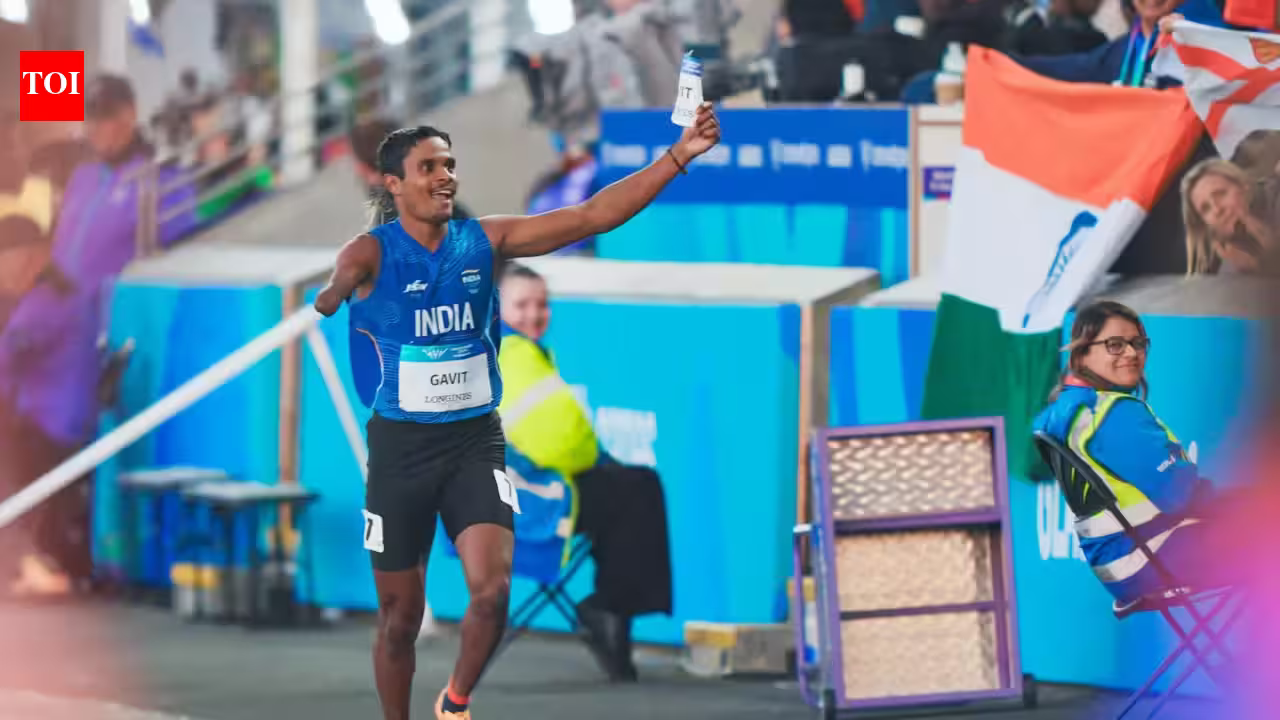
GLASGOW — At just five years old, Dilip Mahadu Gavit’s life was irrevocably altered by a simple, tragic fall from a tree. What began as a childhood injury quickly spiraled into a medical crisis, resulting in a septic infection that forced doctors to amputate his right arm. For many, such a profound loss at a tender age would have served as a definitive ceiling on their ambitions. For Gavit, it was merely the opening chapter of a grit-filled narrative that reached its zenith on the global stage earlier this year.
In a performance that will be etched in the annals of Indian sporting history, the 23-year-old athlete stormed to a sensational victory in the men’s 100m T47 final at the 2026 Commonwealth Games. By clocking a blistering 10.71 seconds, Gavit not only secured the gold medal but also shattered the Commonwealth Games record, cementing his status as the first Indian male para-athlete to strike gold at the prestigious event.
The Guru Who Shaped a Champion
The victory in Glasgow was not merely a triumph of physical conditioning; it was a testament to an unbreakable bond between an athlete and his mentor. Gavit, who hails from the small tribal hamlet of Tora Dongri in Nashik, Maharashtra, attributes much of his success to his coach, Vaijnath Kale.
The two met when Gavit was a boy competing in local races, struggling with limited infrastructure and the socioeconomic realities of his village. Kale, a corporate professional who saw past the surface to identify raw, unbridled talent, stepped in when the financial burden of training became too much for Gavit’s family. In an act of extraordinary support, Kale effectively adopted Gavit, providing him with the stability and professional guidance he needed to thrive.
“The day of my event was Guru Purnima,” Gavit said, reflecting on his gold-medal run during an event organized by SBI Life Insurance. “In a way, I gave my guru his gurudakshina that day. That makes me feel very good, and it is something I will always remember. To take me from my village and keep me at his home—he has been like God to me.”
A Strategic Shift on the Wet Tracks of Glasgow
While Gavit stood atop the podium as a 100m champion, his journey to that moment was paved with the discipline of a 400m specialist. Coming into the 2026 Commonwealth Games, the absence of the 400m from the official program forced a tactical pivot. Rather than stepping away from the competition, Gavit leaned into the speed endurance he had spent years cultivating.
The 100m final in Glasgow was a masterclass in tactical patience. Facing a field of explosive, pure sprinters, Gavit found himself trailing through the opening 60 meters. However, as his competitors began to fade, the endurance gained from his rigorous 400m training kicked in. With a surge that stunned the crowd, Gavit ate into the deficit in the final 40 meters, crossing the line in record time.
The move was no accident. According to coach Kale, the preparation for this transition had been ongoing for four years. “He competed in the 100m at the 2023 Asian Para Games, but a foul led to his disqualification,” Kale explained. “That stayed with Dilip. We had been training for both events in parallel, and since the 400m wasn’t on the program, we focused entirely on the 100m.”
‘Still a 400m Runner’ at Heart
Despite his newfound status as the Commonwealth’s fastest T47 sprinter, both Gavit and his coach maintain that his identity remains firmly rooted in the 400m. The two events require fundamentally different physiological outputs—one demanding raw, maximum-velocity acceleration and the other requiring the tactical management of fatigue over a full lap.
“The 400m is a speed-endurance event; you have to plan the entire race,” Gavit noted. “In the 100m, you just have to run hard, and it’s over quickly. I enjoy the 100m because it finishes so fast, but the 400m is where my focus has been for so long.”
Looking Toward the Future
Even as the dust settles on his Glasgow triumph, Gavit is far from satisfied. The conditions in Scotland, he notes, were less than ideal, which affected his explosive start—a technical detail he is already working to refine. His eyes are now fixed on the 2030 Commonwealth Games, where he intends to not only compete but reset his own record.
The more immediate challenge, however, is the upcoming Asian Para Games in Aichi-Nagoya. The challenge of switching gears back to the 400m after months of 100m-specific training is significant, but the pair is undeterred. Gavit has set his sights on a dual-medal haul.
“At the next Asian Games, I want to compete in both the 100m and 400m and win gold in both,” Gavit declared.
With a track record of overcoming the impossible—from a childhood tragedy to the pinnacle of international athletics—it would be a fool’s errand to bet against him. Gavit has proven that when talent meets unwavering guidance, the boundaries of what is possible are meant to be broken.
Disclaimer: This content is auto-generated for informational purposes only.
Source: Read Original News