


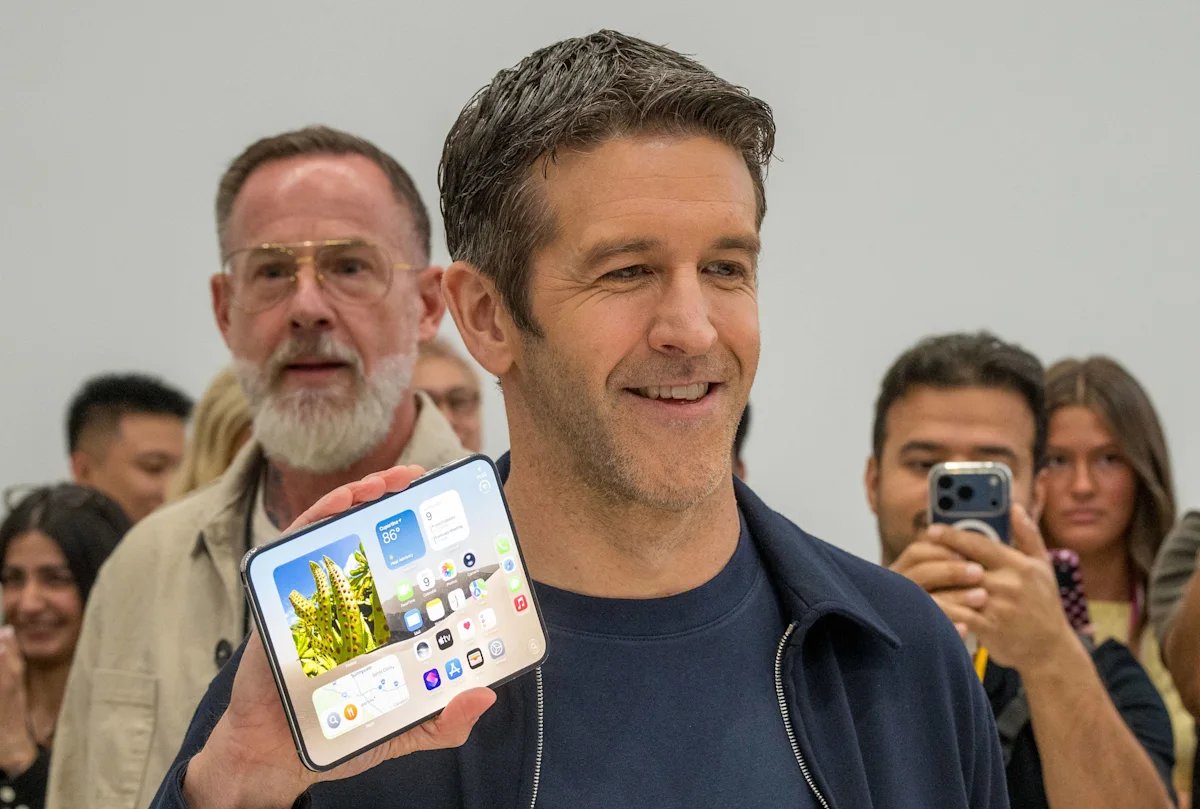
Apple officially entered the foldable smartphone market on Wednesday, September 9, with the unveiling of the iPhone Duo. Revealed during the company’s fall product event, the device represents a significant shift in Apple’s hardware strategy. However, the introduction of the phone has been met with measured skepticism from industry leaders, most notably AT&T CEO John Stankey, who weighed in on the device’s market potential during the Goldman Sachs Communacopia and Technology Conference held on the same day.
AT&T CEO on the iPhone Duo: “This is not new”
In his critique of the newly announced device, Stankey characterized the technology as a known commodity rather than a revolutionary leap. Having observed the trajectory of foldable devices in the Android ecosystem—spearheaded by companies like Samsung and Google over the past several years—Stankey noted that the form factor has struggled to move beyond a specialized user base.
“The best characterization I can give is, looking at the foldable phones that have been out in the market, this is not new,” Stankey stated. He acknowledged that while Android manufacturers have maintained a loyal following for their foldable hardware, these devices have remained niche products rather than mainstream staples. Stankey expressed doubt regarding whether the Apple brand alone would be sufficient to alter the penetration dynamics of the foldable category. His assessment suggests that the iPhone Duo may ultimately appeal to a specific segment of the user base that prioritizes large screens and is willing to pay a premium for that hardware, rather than triggering a mass-market shift away from traditional smartphone designs.
Defining the Apple iPhone Duo
The iPhone Duo made its debut alongside the iPhone 18 Pro, the latest iterations of the AirPods, and the Apple Watch Series 12. As a foldable, the device utilizes a book-style hinge mechanism that balances portability with expanded display real estate. The hardware features a 5.4-inch external screen that serves as a standard smartphone interface, which then transitions into a 7.6-inch interior display when unfolded.
This design is intended to consolidate functions that typically require multiple devices, such as tablet-based content consumption or productivity tasks involving split-screen multitasking. By positioning the device as an all-in-one productivity tool, Apple is targeting power users, though the price point of $1,999—the highest ever for an iPhone—serves as a significant barrier to entry. While IDC analysts project that foldable phones will represent only a small fraction of global smartphone volume by 2030, the category maintains a disproportionate share of global revenue due to these elevated price tags.
The “Replacement” Value Proposition
For industry executives and consumers alike, the decision to invest in the iPhone Duo depends heavily on its utility as a primary mobile device. Stankey indicated that his own potential interest in the device is conditional: it would only be worth the investment if it could effectively replace his existing tablet.
“I’m going to have to see if it replaces something that I use,” Stankey explained. “I’m pretty adept at moving back and forth between my iPad and my mobile device right now. And if it becomes something where it says maybe I don’t need to carry the larger iPad around with me, I might be interested.” This logic reflects the core challenge facing foldable manufacturers: the device must offer enough functional gain to justify its cost by eliminating the need for secondary hardware. For users who do not rely on tablets, the $1,999 price tag for a folding phone—which essentially performs the same software tasks as a much cheaper standard iPhone—presents a difficult value calculation.
Economic Implications for Wireless Carriers
For wireless carriers like AT&T, the introduction of a high-cost device like the iPhone Duo carries different economic implications. Even if the total unit volume is modest compared to standard smartphones, premium devices serve as vehicles for carrier growth. High-priced handsets typically necessitate longer device financing plans and provide incentives for users to sign up for premium subscription tiers.
By facilitating the financing of a $1,999 asset, carriers can secure long-term customer commitment and increase the average revenue per user through plan bundling. Stankey and other carrier leaders are closely monitoring preorder data and initial sales cycles to determine how the iPhone Duo will fit into their broader portfolio of services. Whether the device achieves the widespread adoption Apple typically expects, or remains a high-end luxury item, the financial structure of its sales remains a key factor in the revenue models of wireless service providers.
The release of the iPhone Duo marks a pivotal moment for the smartphone industry. As Apple enters a category that Samsung has occupied since 2019, the market will soon see whether the brand’s influence can transform foldables into mainstream technology or if the format is destined to remain a high-cost, limited-reach segment of the mobile industry.
Disclaimer: This content is auto-generated for informational purposes only.
Source: Read Original News