








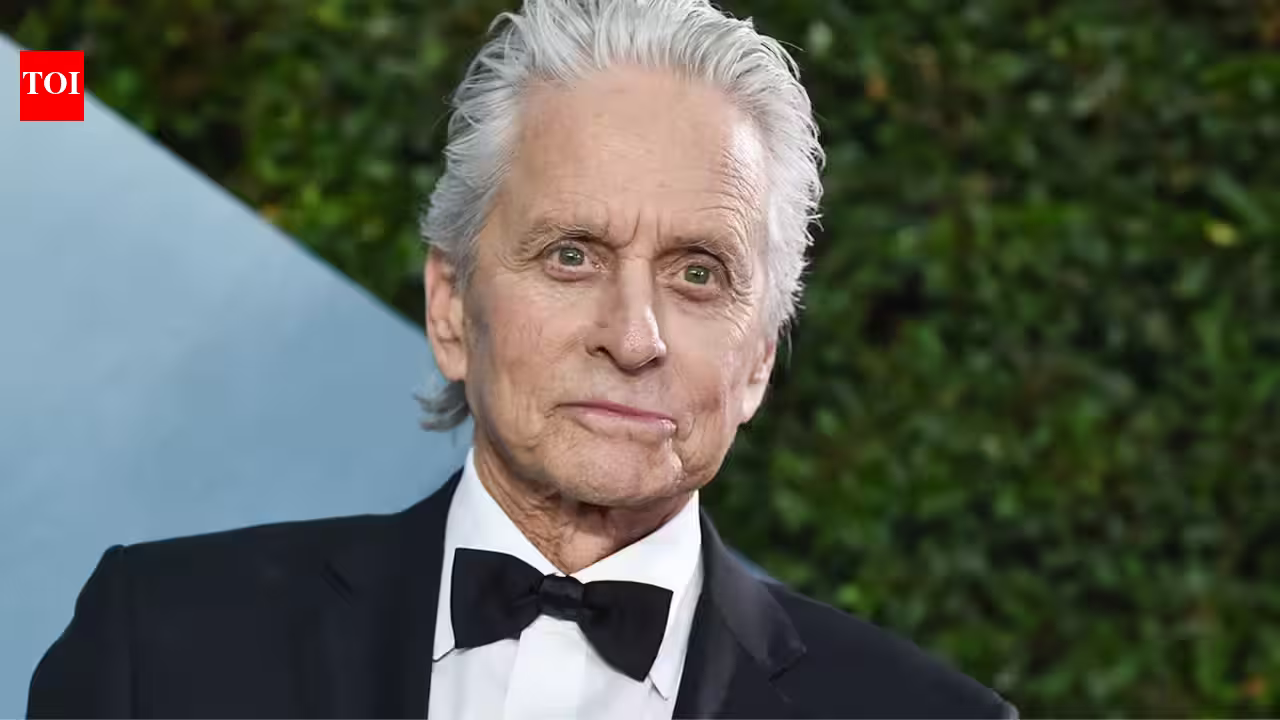
The industry of Hollywood is built on lineage. In a town where connections are the currency and family names often function as neon signs, it is easy to assume that talent is a hereditary trait. But for Michael Douglas, the shadow cast by his father, the legendary Kirk Douglas, was both a blessing and a burden. To the outside world, being a “Douglas” was synonymous with prestige, access, and an inevitable ascent to the top. To Michael, it was a complex inheritance that required more than just charisma to navigate.
In a candid reflection that resonates far beyond the red carpets of Los Angeles, Michael Douglas once summarized the reality of his upbringing with startling honesty: “My dad was a movie star. Having that name was good and bad. People think it’s a silver spoon. It’s not.” This single sentiment cuts through the mythology of Hollywood royalty, offering a rare glimpse into the psychological toll of being born into fame.
What does the quote by Michael Douglas mean?
When we talk about the “silver spoon,” we are talking about the cultural assumption that the children of the elite are born with a clear, obstacle-free path to success. The implication is that hard work is optional because the foundation has already been poured. Michael Douglas’s refutation of this concept is not a complaint about his upbringing, but a clarification of the nature of his struggle.
To be the child of a titan like Kirk Douglas is to be permanently under a microscope. While the name surely opened doors, it also ensured that every performance Michael delivered would be scrutinized for echoes of his father’s intensity. He wasn’t just competing against his peers; he was competing against the living legend in his own home. For Michael, the “silver spoon” argument ignores the sheer grit required to establish a distinct artistic identity when your father’s silhouette is already etched into the bedrock of cinema history. It’s the difference between being handed a career and being handed a target.
How is the quote by Michael Douglas relevant today?
The tension between parental legacy and personal achievement is a universal human experience, even if it usually plays out in quieter settings than a Hollywood studio. Whether it’s the child of a family business owner, an athlete whose jersey number hangs in the rafters, or a student stepping into the same university halls as their parents, the “comparison trap” is a modern epidemic.
Douglas’s perspective provides a necessary counter-narrative to the “nepo baby” discourse that dominates social media today. While structural advantages exist, they do not inherently diminish the individual’s pursuit of excellence. His words serve as a reminder that external perception—what people think about your success—is often disconnected from the internal reality of the effort expended. Today, his message is a call to decouple your own self-worth from the achievements of your predecessors. You can honor where you came from without letting that history define where you are going.
The early life of Michael Douglas
Born in 1944 in New Jersey to Kirk Douglas and Diana Dill, Michael entered a world where the spotlight was already burning bright. Yet, his path to the screen wasn’t a straight line. While he was immersed in the atmosphere of film sets, he was also witnessing the grueling reality of the work behind the glamour.
Instead of rushing to capitalize on his name, Michael took a more deliberate route. He studied drama at the University of California, Santa Barbara, prioritizing craft over convenience. He recognized, perhaps intuitively, that to survive in his father’s industry, he couldn’t rely on the “Douglas” charm alone. He needed technical range and a unique screen presence. By moving into television and working in smaller, formative roles, he began to develop the subtle, controlled energy that would later become his trademark. He wasn’t trying to be the next Kirk Douglas; he was learning how to be the first Michael Douglas.
A career defined by production, not just performance
The turning point that truly separated Michael from the legacy of his father came not just from acting, but from his savvy behind the camera. In 1976, he served as a producer for One Flew Over the Cuckoo’s Nest. When the film swept the Academy Awards, winning Best Picture, it was a watershed moment.
For the first time, Michael wasn’t just another actor in the family business; he was a creative powerhouse in his own right. This win wasn’t a “family favor”; it was a testament to his vision and his ability to identify brilliant source material. By shifting the narrative from “Kirk’s son” to “the man who produced Cuckoo’s Nest,” he effectively broke the seal on his own independent professional identity.
From Gordon Gekko to his own icon
The final transition from “legacy act” to bona fide superstar was solidified in the 1980s. When Michael stepped into the bespoke suits of Gordon Gekko in Oliver Stone’s Wall Street, he didn’t just play a role; he created a cultural archetype. The role was cold, sharp, and entirely different from the archetypal heroism often associated with his father’s most famous characters.
Winning the Academy Award for Best Actor for Wall Street silenced the skeptics who had spent the previous two decades waiting for him to stumble. He had successfully climbed out of the shadow by essentially outworking it.
Today, looking back at his illustrious career—from the gritty streets of San Francisco to the boardrooms of New York—it is clear that Michael Douglas’s success was not a gift of nepotism, but a hard-fought battle of attrition. He proved that while a famous name might get you into the room, it is your own capacity for transformation that determines how long you stay there. His life lesson remains clear: you can start your journey at the finish line of your parents’ careers, but you still have to run the race yourself.
Disclaimer: This content is auto-generated for informational purposes only.
Source: Read Original News