







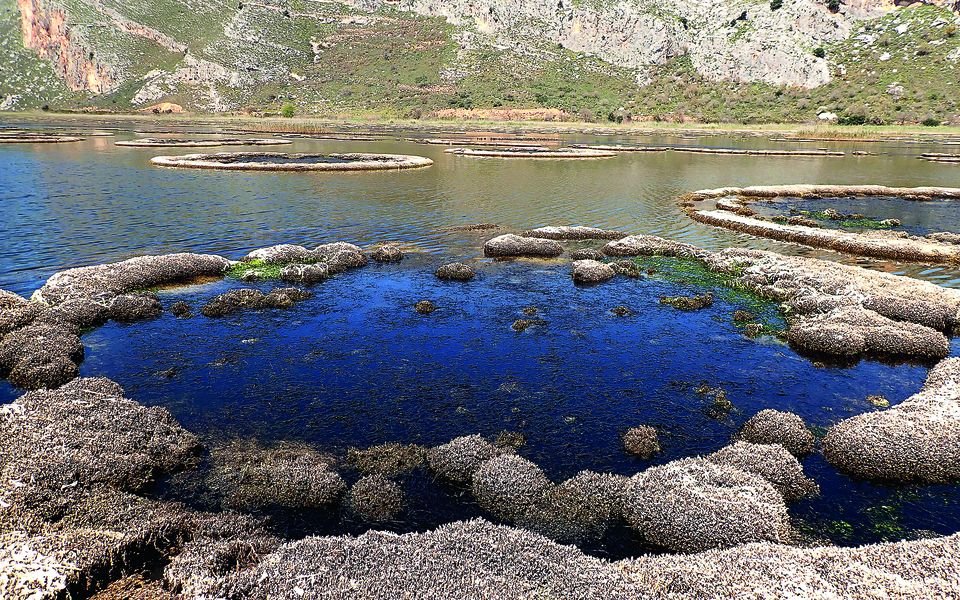
In the northwestern Peloponnese, the Prokopos Lagoon—a vital ecological site nestled beside the protected Strofylia Forest—is undergoing a dramatic physical transformation. Researchers from the University of Patras’ Sedimentology Laboratory have documented an unusual and concerning environmental phenomenon: the rapid proliferation of massive, ring-shaped reefs constructed by an invasive species of marine worm.
The culprit, Ficopomatus enigmaticus, is a tube-dwelling polychaete native to Australia. It is believed to have arrived in Greek waters approximately 60 years ago, likely introduced through international shipping activities. While the species remained relatively contained for decades, it has undergone a period of aggressive expansion since the 1990s, fundamentally altering the lagoon’s underwater topography.
Led by Professor Pavlos Avramidis and supported by funding from Greece’s Green Fund, the research team discovered that these worms engineer their environment by secreting calcium carbonate to build protective tubes. Individually, these tubes measure only up to two centimeters, but when they fuse together in dense colonies, they form complex, calcified reef structures. Some of these formations have reached remarkable dimensions, spanning up to 15 meters in width.
The life cycle of these reefs is linked to the seasonal fluctuations of the lagoon. Each March, as water levels recede, the outer layers of the colonies are exposed to the air and perish. The decaying organic matter leaves behind empty, hollowed-out calcified shells that harden into the distinctive ring-like formations now seen throughout the area.
While these structures may appear as natural geological features from a distance, their impact on the lagoon’s ecosystem is significant. The 1.5-square-kilometer lagoon is gradually shrinking, with researchers estimating that the worm reefs have reclaimed 10% to 15% of the total surface area. This physical encroachment has had a cascading effect on the local hydrology, as the dense reefs restrict water circulation and alter sediment distribution.
The ecological consequences are becoming increasingly apparent. The restricted water flow has been directly linked to recent mass fish die-offs, as the stagnant conditions exacerbate oxygen depletion within the lagoon. For local communities, the physical changes also pose practical challenges, particularly by hindering traditional fishing activities that have long relied on the lagoon’s open channels.
The significance of Prokopos extends beyond its current state; it is part of a wider network of Western Peloponnese lagoons, including Kotychi, Kaiafas, Pappas, and Gialova. These wetlands are highly prized by the scientific community, serving as critical “archives” of regional climate history and biodiversity. The encroachment of F. enigmaticus not only threatens the immediate health of the Prokopos ecosystem but also poses a challenge to the long-term preservation of this interconnected environmental network.
As researchers continue to monitor the expansion of these reefs, the situation at Prokopos highlights the broader risks posed by invasive marine species in the Mediterranean. The rapid restructuring of the lagoon’s shoreline underscores the fragility of coastal wetlands and the urgent need for management strategies that can mitigate the impact of invasive organisms on sensitive, climate-critical habitats.
Disclaimer: This content is auto-generated for informational purposes only.
Source: Read Original News