






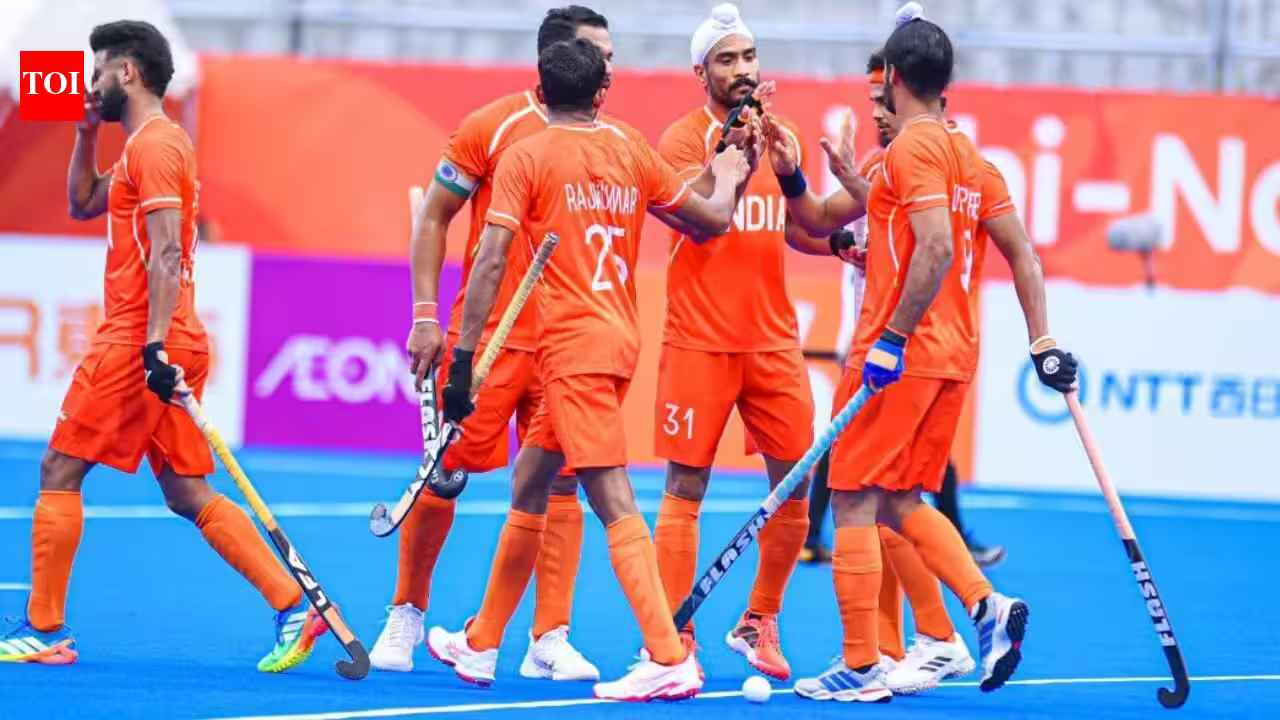
Saffron has once again dominated the headlines at the Asian Games, but for all the wrong reasons. In a development that has sent shockwaves through the Indian sports fraternity and exposed deep-seated fractures within the sport’s governing body, both the Indian men’s and women’s hockey teams took to the pitch in Kakamilgahara, Japan, wearing saffron kits for their opening matches—a direct contradiction of recent high-level assurances.
The sight of the national teams facing Indonesia and Uzbekistan in orange-hued jerseys has effectively rendered Hockey India’s “blue promise” void. For a country whose hockey identity has been inextricably linked to the color blue since its Olympic debut in 1928, the persistent shift toward saffron has become a focal point of administrative friction, sparking a public debate over tradition, political optics, and internal leadership authority.
A Promise Broken on the Pitch
The controversy is far from new. The current dispute mirrors the tension witnessed during last month’s World Cup in Belgium and the Netherlands, where the decision to move away from the traditional blue kit caused significant upheaval within Hockey India (HI). At the time, the switch was viewed by many as an unauthorized departure from the team’s historical aesthetic, sparking heated discussions within the organization’s executive board.
Following the World Cup fallout, Hockey India president Dilip Tirkey sought to put the matter to rest. During the official send-off ceremony for the Asian Games contingent, Tirkey provided a definitive stance to the media. He explicitly stated that the Indian Olympic Association (IOA) had provided several options for the team kits and that Hockey India had formally selected blue as the primary color, with white designated as the secondary option.
“The Indian Olympic Association had given us options regarding the team kit colours and Hockey India selected blue as the first choice for the Indian team’s kit,” Tirkey had declared. “Orange will be the second choice.”
Given these public assurances, the spectacle on Sunday morning—where both squads bypassed the blue kit entirely in favor of saffron—has signaled a clear breakdown in communication, if not a direct act of defiance, within the federation.
Administrative Discord at the Helm
The recurring jersey issue has cast a spotlight on the volatile power struggle within Hockey India. Reports indicate that the decision to favor saffron has pitted President Dilip Tirkey against HI secretary Bhola Nath Singh. Insiders suggest that while Tirkey has pushed for a return to the traditional blue, Singh has been a key proponent of the saffron kits, leading to a public impasse that threatens to overshadow the team’s on-field performance.
The disconnect has reached a point where the governing body cannot even offer a unified explanation for the gear being worn in Japan. When questioned on the discrepancy between the President’s promises and the reality of the kits being worn, a source within Hockey India suggested that the confusion lies with the leadership itself.
“The two colours for the Indian teams’ playing kits for the Asian Games were always saffron and the combination of white and sky blue, which was approved by the HI president himself,” the source stated in an interview with PTI. “As to why the president then said that India will wear all-blue at the Asian Games is something you need to ask the president himself.”
Visibility vs. Tradition: The Technical Argument
While the administrative rift dominates the conversation, the initial justification for the change in color—first floated during the World Cup cycle—centered on technical necessity. Proponents of the shift argued that the traditional blue jerseys often blended into the blue synthetic turf, creating visibility issues for players, officials, and even spectators.
By contrast, saffron provides a sharp, high-contrast silhouette against the standard blue hockey pitches, theoretically offering a performance advantage. However, the move away from the storied blue—a color that has draped Indian legends from Dhyan Chand to the current golden generation—has faced intense pushback from purists who argue that national identity should supersede technical convenience.
As the tournament progresses, the focus must shift back to the goals and the tactical execution on the field. Yet, as long as the players continue to don jerseys that seemingly contradict the public statements of their own president, the “saffron versus blue” debate will remain a distracting backdrop to India’s campaign.
For a federation aiming for continental dominance, the lack of clarity on something as fundamental as the team’s colors represents a troubling lack of cohesion. With the Asian Games now underway, Hockey India faces the immediate challenge of silencing the internal noise and ensuring that the confusion surrounding the kit does not seep into the players’ focus. Whether the teams eventually pivot back to the blue during the knockout stages remains to be seen, but for now, the orange jerseys stand as a vivid symbol of a sport currently at odds with its own leadership.
Disclaimer: This content is auto-generated for informational purposes only.
Source: Read Original News