






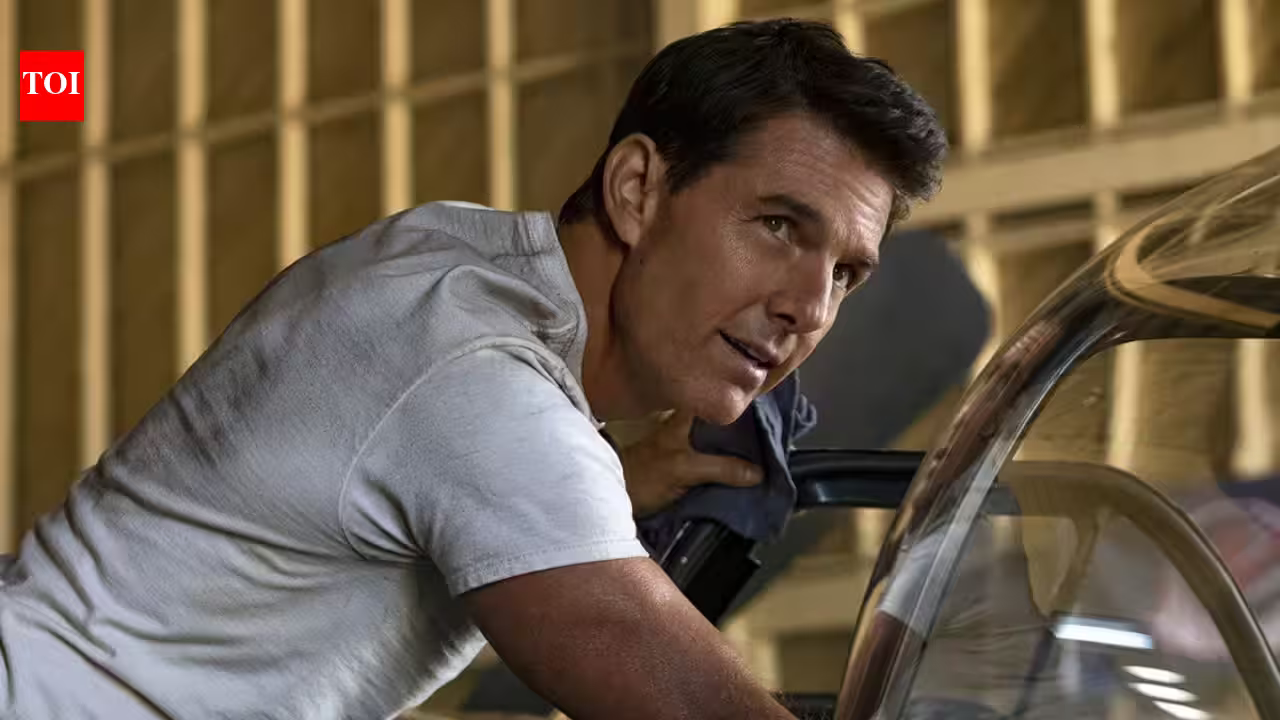
In an industry governed by grueling production schedules, complex intellectual property negotiations, and the relentless pressure of the box office, Tom Cruise remains the ultimate anomaly. He is the last true “movie star” in a landscape that has largely pivoted toward franchise-based content and algorithm-driven casting. Yet, for all his legendary dedication to death-defying stunts and technical precision, the man behind the myth has unveiled a creative process that is surprisingly—and perhaps counterintuitively—collaborative.
During a rare, candid conversation on Travis Kelce’s New Heights podcast, the Mission: Impossible icon pulled back the curtain on how he selects his roles. The revelation wasn’t just about his taste in scripts; it was a masterclass in how to preserve the purity of a story before the machinery of a major studio project begins to strip away its soul.
The Art of Listening: Why Cruise Skips the Script
Most actors are accustomed to sitting in a quiet office, hunched over a screenplay, highlighting their lines and dissecting their character arcs in isolation. Tom Cruise does the exact opposite. He admitted that he doesn’t read scripts before signing on to a project. Instead, he opts to have the writer or director read the story to him aloud.
“What I do with directors and writers is I don’t read the scripts,” Cruise explained. “I have them read it to me because I don’t want my ideas to invade it yet.”
It is a fascinating approach to the creative process. By removing the visual filter of a document, Cruise allows himself to experience the narrative as a piece of theater—an oral tradition that taps into the most primal elements of storytelling. He isn’t looking for a list of bullet points or a showcase for his own ego; he is looking for the heartbeat of the film. He wants to feel the rhythm of the writer’s cadence and understand their specific vision before he allows his own, admittedly massive, creative intuition to take the wheel.
Embracing the ‘Popcorn Guy’ Perspective
Cruise’s refusal to read in the traditional sense is also a strategic move to preserve his status as a viewer. Throughout his decades-long career, he has navigated the fine line between auteur-driven art and pure, unadulterated popcorn entertainment. When he hears a story being pitched to him, he listens not as a producer or a multi-hyphenate mogul, but as someone standing in line at the concession stand.
“I’m the audience. I am a movie; I’m a popcorn guy,” he told Kelce. “Is it moving me, or am I invested? Am I not invested? Where am I engaged? Where am I not engaged?”
This “meat-and-potatoes” philosophy is likely why Cruise’s films consistently resonate with global audiences. While other stars may get lost in the weeds of high-concept intellectualism or prestige-chasing, Cruise retains the perspective of the theatergoer. If he is bored during the pitch, the audience will be bored in the seats. It is an exacting filter that has served him well, ensuring that every project he greenlights passes the most fundamental test of cinema: Does it grab you, and does it hold on?
Beyond the Page: A Holistic Vision of Filmmaking
The script, for Cruise, is merely a blueprint—a suggestion of the final experience. Once he understands the director’s intent, the collaboration shifts into a deeper, technical phase. Cruise doesn’t just want to know what his character says; he wants to know how the light will hit the screen, how the camera will move through a space, and what the texture of the wardrobe will contribute to the visual language of the scene.
“We get to a place where I start to understand, and then I’m like, ‘I know how to contribute to that motion,'” he noted.
This holistic approach explains why he is often cited as one of the most hands-on producers in Hollywood. He isn’t just an actor hired to hit his marks; he is a architect of the scene. When he finally arrives on set, he isn’t carrying a dog-eared script filled with notes. Instead, he’s carrying a fully formed internal map of the film’s tone and pace. He doesn’t need to discuss his ideas at length; as he puts it, he simply does them.
The Anticipation for ‘Digger’
This philosophy of collaborative immersion is reaching a crescendo with his upcoming project, Digger. Directed by the visionary Alejandro González Iñárritu, the film is already generating significant buzz as one of the most intriguing entries in Cruise’s filmography.
In Digger, Cruise steps into the shoes of a wealthy businessman—a man holding the mantle of “the most powerful man in the world”—whose hubris inadvertently triggers a global nuclear crisis. It is a premise that feels uniquely tailored for the current cultural climate, blending high-stakes drama with the existential dread of modern reality. The film promises a return to original, character-driven storytelling, a rarity in an era dominated by pre-established IP.
Set for an October 2 release, Digger isn’t just another action vehicle. It is the culmination of a decade of the actor’s desire to push the boundaries of what he can do as a performer. By working with a director of Iñárritu’s caliber—a filmmaker known for his technical wizardry and deep, often visceral emotional explorations—Cruise is signaling that he is still hungry for new challenges.
The Enduring Power of the Cruise Method
Whether or not you are a fan of his blockbuster style, there is no denying that Tom Cruise’s unorthodox method works. By refusing to let his own ideas “invade” a script prematurely, he ensures that the director’s voice remains the dominant force. By prioritizing his role as the “popcorn guy,” he maintains a tether to the audience that many of his peers have long since severed.
As we look toward the premiere of Digger, it is clear that Cruise isn’t slowing down. He is evolving. He has found a way to remain relevant, not by changing the industry, but by refining his place within it—listening to the stories, understanding the craft, and, as always, making sure the audience is along for the ride.
Disclaimer: This content is auto-generated for informational purposes only.
Source: Read Original News