





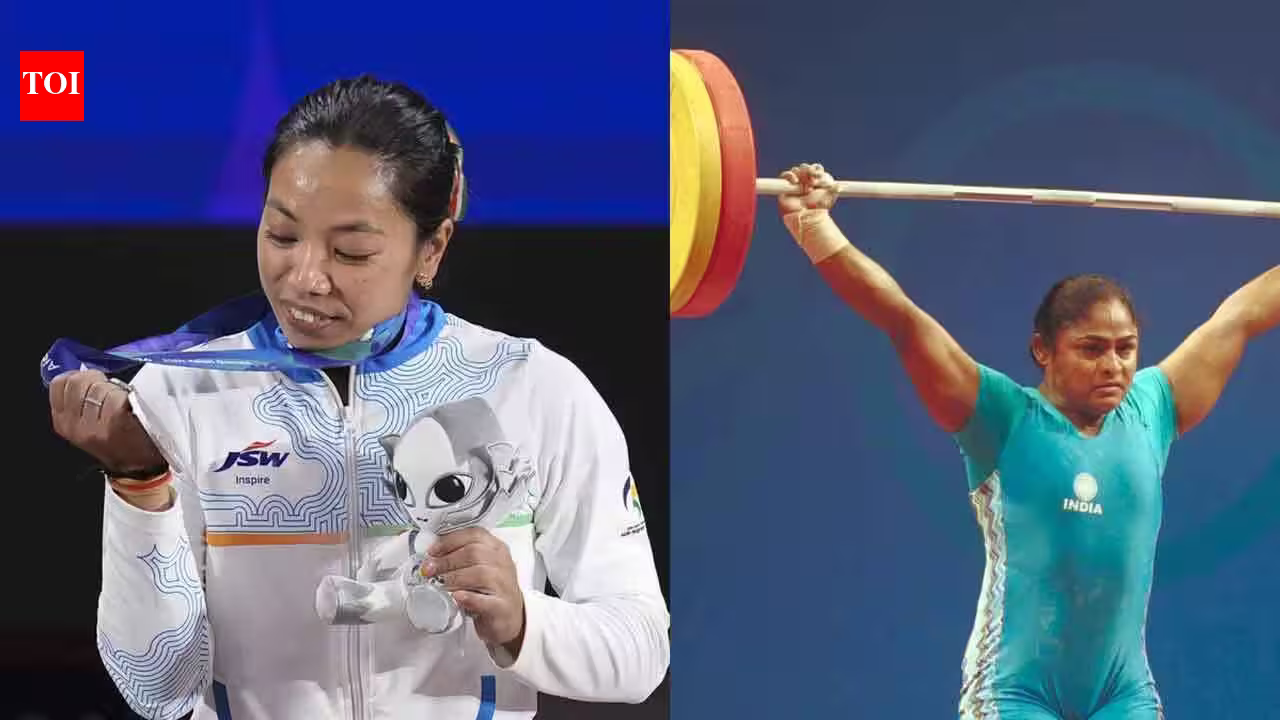
AICHI-NAGOYA — For nearly three decades, the Asian Games weightlifting stage had become a haunting anomaly for India—a theater of frustration where the nation’s lifters arrived with anticipation only to depart in silence. But on Wednesday, in the heart of Aichi-Nagoya, the shadow of a 28-year drought was finally incinerated by the indomitable spirit of Mirabai Chanu.
The Tokyo Olympic silver medallist stepped onto the platform carrying more than just the weight of the barbell; she carried the collective aspirations of a nation that had not seen an Indian weightlifter on an Asian Games podium since the legendary Karnam Malleswari claimed silver in the 1998 Bangkok Games. With a total lift of 198kg in the women’s 49kg category, Chanu didn’t just capture a silver medal—she bridged a historical chasm and re-established India as a formidable force in continental strength sports.
The long, barren stretch
To understand the magnitude of Chanu’s achievement, one must look at the brutal timeline of the last quarter-century. Since Malleswari’s heroics in 1998, Indian weightlifting has navigated a turbulent path marked by technical stagnation, governance crises, and heartbreaking near-misses.
The sport hit a nadir in 2006 during the Doha Asian Games, when a doping scandal and a subsequent failure by the Indian Weightlifting Federation to pay international fines resulted in a complete absence from the competition. Even when the nation returned to the fold, the results remained elusive. The 2010 Guangzhou Games saw a 12-member squad return empty-handed. In 2014, a talented cohort including future stars failed to make a mark. By 2018, even with seasoned veterans like Sathish Sivalingam leading the charge, the podium remained tantalizingly out of reach.
Hope surged again in 2023 during the Hangzhou Games, where Chanu, flanked by Bindyarani Devi, entered as the favorite. That campaign, however, ended in a cruel twist of fate when a recurring injury forced Chanu to withdraw during the clean and jerk, leaving her in a devastating fourth place. It felt, at the time, like a recurring nightmare for Indian fans. But while others might have been broken by the pressure of such a long-standing national burden, Chanu simply went back to work.
A masterclass in resilience
Entering the Aichi-Nagoya arena, Chanu arrived with momentum. Having dominated the Commonwealth circuit with a third consecutive gold medal in Glasgow earlier this year, she was battle-tested and refined. The competition, however, was as fierce as the international stage gets.
North Korea’s Ri Song Gum, a formidable world champion and the defending gold medallist, entered the event in peak form. As the contest unfolded, it became clear that while the gold was firmly in the grasp of the dominant North Korean, the battle for the silver was a high-stakes tactical game.
Chanu navigated the snatch portion with composure, logging a solid 87kg to set the foundation. When it came to the clean and jerk, the stakes reached a fever pitch. With the technical precision that has become her trademark, she hoisted 111kg. It was a lift executed with the calm of a veteran, ensuring that no technical errors or physical setbacks would derail her this time.
When the final tally was confirmed at 198kg, the relief was palpable. Ri Song Gum shattered records to take the gold with a staggering 215kg total, while Indonesia’s Luluk Diana Tri Wijayana secured the bronze with 191kg. Chanu’s silver was not just an individual accolade; it was the completion of a long-overdue national redemption arc.
More than a medal
For Mirabai Chanu, this silver is perhaps the most significant piece of hardware in a glittering trophy cabinet that already boasts Olympic silver, World Championship honors, and multiple Commonwealth golds. The Asian Games medal was the missing puzzle piece, the one title that had eluded her throughout her storied career.
“This is for the millions who kept believing,” Chanu remarked briefly following the ceremony, her gaze fixed on the podium that had rejected her compatriots for over two decades.
By standing alongside the best in Asia, Chanu has silenced the critics and validated the path of a new generation of Indian lifters. She has effectively turned the page on 28 years of “what ifs” and “almosts.” As the Indian tri-color was hoisted in the Aichi-Nagoya venue, the significance was clear: the drought is over, the record books have been rewritten, and Mirabai Chanu remains the undisputed titan of Indian weightlifting.
The weight that India has carried since 1998 has finally been lifted, and in its place, a new standard for success has been set. The message to the rest of the continent is unambiguous: Indian weightlifting is back, and it is here to stay.
Disclaimer: This content is auto-generated for informational purposes only.
Source: Read Original News