








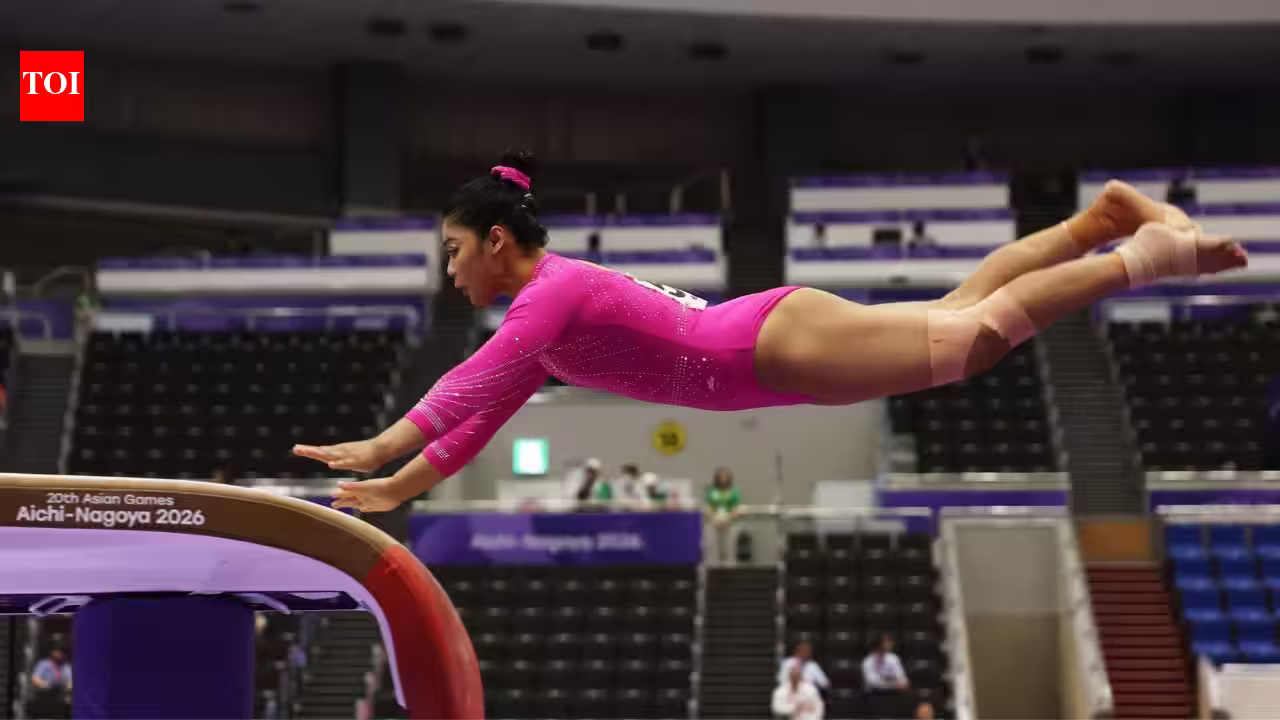
NAGOYA — In the high-stakes arena of the Nagoya Asian Games, India’s lone gymnastics representative, Pranati Nayak, delivered a performance defined by grit and technical precision. On Thursday, the 31-year-old veteran finished sixth in the women’s vault final, marking a significant step forward in her international career and providing a glimpse of resilience that has come to define her journey in the sport.
Competing against a field of the continent’s elite, Nayak stepped onto the mat with a calm focus, navigating the high-pressure environment of the final with the experience of a seasoned competitor. Her overall score of 13.100 was the result of a calculated effort, demonstrating the meticulous preparation required to excel at the Asian Games level.
Breaking Down the Performance
Nayak’s technical execution on Thursday showcased her consistency, a critical asset in the vaulting apparatus where the margin for error is razor-thin. Throughout the final, the Indian gymnast opted for a balanced approach, attempting a difficulty score of 4.4 on both of her vaults.
Her execution remained remarkably stable across both attempts, with the judges awarding her an 8.500 for each performance. By securing a 0.20 bonus on top of her base scores, Nayak reached her final tally of 13.100. The consistency of her two vaults—each mirroring the other—highlighted not only her physical preparation but her ability to execute under the glare of the international spotlight.
While the podium remained out of reach, the performance was a clear upgrade from the previous Asian Games in Hangzhou, where Nayak finished eighth with a score of 12.350. The jump from an eighth-place finish to a sixth-place finish in a competitive field of eight finalists is a tangible indicator of progress, proving that Nayak is trending upward despite the grueling nature of elite artistic gymnastics.
A Journey Defined by Resilience
To understand the significance of Nayak’s sixth-place finish, one must look at the path she traveled just to reach Nagoya. Her participation in these Games was far from guaranteed; she spent months leading up to the event locked in a battle with a persistent leg injury. Gymnastics, a sport that demands explosive power and sudden, jarring impacts, is notoriously unforgiving for athletes nursing lower-body ailments.
Nayak’s ability to qualify for the Asian Games despite these physical setbacks speaks volumes about her dedication. Earlier this year, the veteran gymnast faced a sobering reality in Glasgow at the Commonwealth Games, where she missed the vault final after failing to qualify. That disappointment served as a turning point, fueling her training sessions as she sought to refine her technique and regain her competitive edge. Finishing sixth in Nagoya, against a high-caliber field, provides a measure of redemption for the challenges she faced in Glasgow.
The Continental Landscape
The competition at the Nagoya Asian Games was fierce, reflecting the deep talent pool within Asian gymnastics. South Korea’s Yeo Seojeong claimed the top spot on the podium, clinching the gold medal with a dominant score of 14.100. The silver medal went to North Korea’s An Chang Ok, who finished with 13.033, while China’s Du Siyu rounded out the medalists with a bronze at 12.800.
Nayak’s presence in the final eight remains a historic benchmark for the country. India’s relationship with gymnastics at the Asian Games has been long and lean; since Ashish Kumar captured a bronze medal in the floor exercise at the 2010 Guangzhou Asian Games, the country has struggled to secure another podium finish. Nayak’s consistent appearance in the final is a testament to the growth of individual talent, even as the nation works to build a larger foundation for the sport.
Looking Toward the Future
As the dust settles on the vault final in Nagoya, the narrative surrounding Pranati Nayak is one of perseverance. At 31, she stands as a beacon for aspiring Indian gymnasts, proving that age and injury are not insurmountable barriers to success. While the elusive Asian Games medal remains the ultimate goal for the Indian contingent, Nayak’s performance provides a structural roadmap for what is possible.
For now, the veteran will take away the satisfaction of an improved standing and a clean, technical display on the continental stage. Having overcome the physical tolls of her craft and the disappointment of early-year qualification gaps, Nayak has solidified her role as a formidable presence in women’s vault. As she returns from Nagoya, the focus shifts to whether this momentum can be sustained, potentially closing the gap to the continental elite even further in the competitions to come. Her sixth-place finish is more than just a number; it is a statement that Indian gymnastics is still in the hunt.
Disclaimer: This content is auto-generated for informational purposes only.
Source: Read Original News