








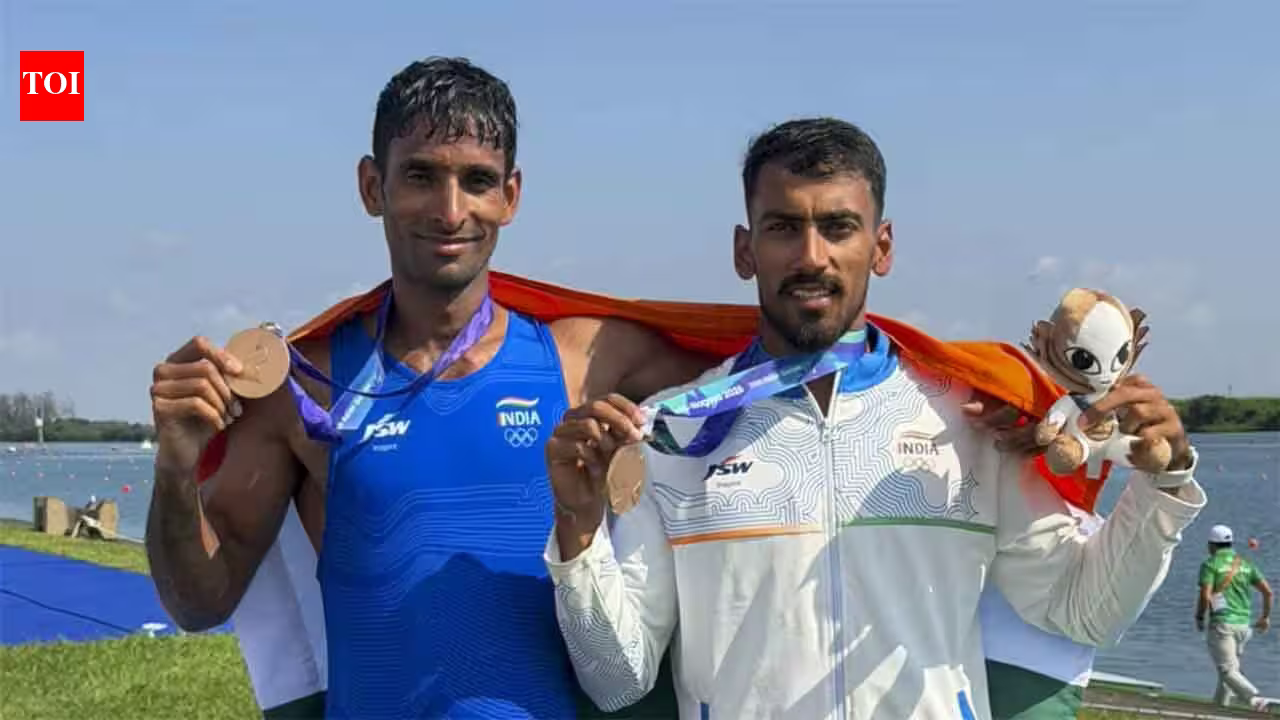
INDIA’S rowing contingent etched their names into the history books at the Nagaragawa International Regatta Course this week, as Satnam Singh and Salman Khan clinched the nation’s first-ever Asian Games medal in the men’s double sculls. Beyond the hardware and the historic achievement, the performance served as a poignant reminder of the unifying power of sport, transcending the divisive rhetoric that so often dominates public discourse.
For Satnam Singh, the bronze medal was far more than a statistical milestone. As he stood on the podium, he looked toward his partner—a man he calls a brother—and reflected on the deeper message their victory sends to the country. “Today, a Khan and a Singh won a medal for India,” Satnam told reporters. “I want people to remember that. Long after we are gone, this fact will live on. Salman is like a brother to me. There are things we hear and read about, and that disturbs us. I want our people to stop fighting on religious lines.”
The pair clocked a hard-fought 6:13.25 to claim third place. China’s Yi Xudi and Nie Yide took gold with a time of 6:09.77, while Uzbekistan’s Mekhrojbek Mamatkulov and Pavel Sorin secured silver at 6:10.49. Despite leading the charge at the 1,500-meter mark, the Indian duo faced a grueling final 500 meters that saw them slip into the bronze position, a result they defended with grit and synchronized precision.
A Medal Forged in Adversity
The path to this podium was anything but straightforward. Originally selected for the quadruple sculls team alongside Jakar Khan and Balraj Panwar, Satnam and Salman were abruptly reassigned to the double sculls event following a strategic shift in team combinations.
“I won’t say we were not affected by it, but we decided to give our best,” Satnam admitted. “It helped that me and Salman have been training together for seven months for quadruple sculls, so we had good understanding.”
The duo benefited from a combination of tactical intelligence and physical adaptation. Being the lightest finalists in the field—weighing in at approximately 85kg compared to the 90-95kg range of their competitors—the pair utilized the still waters and a favorable tailwind to maximize their speed. It was a masterclass in capitalizing on environmental variables, proving that in rowing, raw power is only half the battle.
The Redemption of Satnam Singh
For Satnam, the bronze medal carried the weight of personal redemption. The 26-year-old Punjab native had been haunted by the memories of the previous Asian Games in Hangzhou, where he finished last in the double sculls. That experience, coupled with a crushing exhaustion-induced collapse in the quadruple sculls event that cost his team a silver medal, had become a mental hurdle he was determined to clear.
“The failure in Hangzhou had haunted me all these years,” said the Chief Petty Officer in the Indian Navy. Born in the village of Fatta Maluka in Punjab’s Mansa district, Satnam’s journey began on the playing fields of school, where he was inspired by London Olympian Swarn Singh Virk. Mentored under the guidance of Virjender Singh Cheema at the Punjab Institute of Sports in Ropar, Satnam joined the Navy in 2019. Throughout his rise, his family remained his bedrock—his father farming cotton and his mother tailoring clothes to ensure his progress. Delivering this medal was, ultimately, a promise kept to his mother to move past the heartbreak of the past.
Salman Khan’s Extraordinary Journey
If Satnam’s story is one of redemption, Salman Khan’s is one of sheer survival and perseverance. Hailing from Pure Dhingai in Uttar Pradesh, Salman’s path to the national team began in the wake of tragedy. After losing his father to dengue when he was just 18, Salman took up work as an Uber driver in Delhi to support his mother and siblings.
His life took a dramatic turn when he joined the Bombay Engineering Group of the Indian Army in 2018. Standing 6’4″ with a natural aptitude for the sport, his development at the Army Rowing Node was rapid and impressive.
“It feels like a dream come true,” said Salman, a Naib Subedar in the Army. “I was expecting to win a medal at the Asian Games, and I am delighted that I could fulfil that expectation. But this is only the beginning; my next target is the Los Angeles Olympics. I know what struggle means in life, but I never lost hope.”
A Shared Legacy
As they move forward, both rowers carry the hopes of a nation and the lessons of their unique backgrounds. Satnam finds solace in his roots, often listening to the music of the late Punjabi icon Sidhu Moosewala during his pre-race warm-ups, a reminder of the culture that shaped him. Meanwhile, Salman remains fixated on the horizon, eyeing the Olympic stage with the same tenacity that once kept him moving behind the wheel of a taxi in the bustling streets of Delhi.
In a sport that demands total physical and mental alignment, Satnam Singh and Salman Khan have proven that their bond—built on mutual respect and shared hardship—is their greatest asset. By winning together, they haven’t just earned a place in the record books; they have offered a blueprint for national unity that resonates far beyond the finish line.
Disclaimer: This content is auto-generated for informational purposes only.
Source: Read Original News