




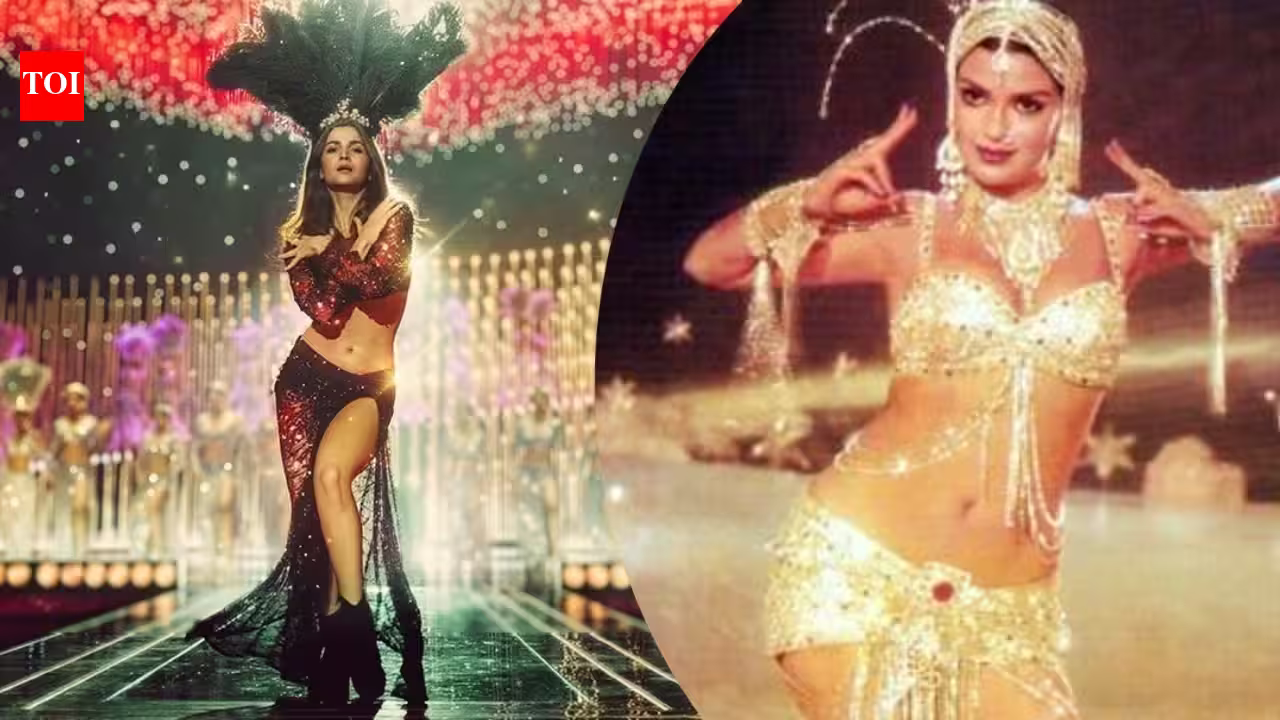


The corridors of Bollywood are humming with a singular, high-octane frequency, and it all leads back to the master of opulence himself, Sanjay Leela Bhansali. As the industry looks toward the horizon of 2027, the unveiling of the character posters for Love & War has become an event in itself—a slow-burn marketing masterclass that reminds us why, in an era of streaming, the “big screen” event still holds absolute dominion over the cultural imagination.
After the initial stir caused by Ranbir Kapoor’s gritty, intense first look, the spotlight has swung toward Alia Bhatt. If the intention was to break the internet, consider it mission accomplished. Clad in a wine-red sequined ensemble that screams old-school cabaret, Bhatt has traded her typically grounded, girl-next-door versatility for a high-wattage “showgirl” aesthetic that feels like a stylistic homecoming for the Bhansali universe.
The Showgirl Returns: Alia’s Bold New Avatar
There is a specific brand of visual poetry that Bhansali commands—a world where color, fabric, and posture tell a story before a single line of dialogue is delivered. In the newly released poster, Alia Bhatt stands center stage, draped in a shimmering, deep red outfit complete with a daring thigh-high slit and a headpiece that evokes the golden age of cabaret.
It is a departure from the nuanced, often vulnerable roles that have defined her career of late. Here, the lens captures a performer who looks ready to command a room, dripping in the kind of curated glamour that the director is famous for. The caption accompanying the image, “Aag bhi, dilon ki jaan bhi!” (Both fire and the life of hearts), suggests a character defined by complexity and heat. For a director who once gave us the tragic elegance of Devdas and the fierce grit of Gangubai Kathiawadi, this cabaret persona feels like a fusion of his most iconic archetypes.
Zeenat Aman’s Stamp of Approval
Perhaps the most significant nod of validation came from none other than the undisputed queen of 70s chic, Zeenat Aman. Known for her razor-sharp wit and legendary fashion history, Aman didn’t just offer a polite social media acknowledgement; she engaged with the image as a peer who recognizes the transformative power of a costume.
“Well, well… SLB has unleashed a showgirl!” Aman wrote, punctuating the sentiment by sharing the poster on her own profile with the observation, “The 70s are back and cabaret never looked this good.” Coming from the woman who defined the era of the cinematic “item number” before the term even existed, this is the ultimate seal of approval. When an icon of the seventies speaks, the industry listens, and her endorsement adds a layer of heritage to Bhatt’s modern-day performance, bridging the gap between two generations of Bollywood’s most stylish leading ladies.
From Plunging Necklines to Curated Auras
Coincidentally, this exchange arrived during a week where Zeenat Aman herself was engaged in a fascinating dialogue about the evolution of her own style. Reflecting on her transition from the “sex symbol” of her youth to the refined icon she is today, Aman shared a candid perspective on the camera’s gaze.
“Back in the day, my body was the focus of the camera, and the less I wore the better I looked,” she noted in a recent social media update regarding a new photoshoot. It’s a poignant reflection on how the industry’s aesthetic focus has shifted. She contrasted that bygone era with her current approach, where the “aura” takes precedence over the “outfit.” It is a testament to her enduring relevance that she can transition from discussing the constraints of 70s costuming to dissecting the “showgirl” energy of a 2027 release, proving that whether covered from head to toe or dressed in sequins, the command of a screen presence remains constant.
This discourse highlights the broader narrative of Love & War: a film that seems deeply concerned with the history of Indian cinema while simultaneously pushing the aesthetic boundaries of the future.
The Waiting Game: Vicky Kaushal and the 2027 Countdown
As the fervor around Bhatt’s look settles, the focus of the fandom has shifted to the final piece of the central trio: Vicky Kaushal. With the anticipation mounting, the wait for his character reveal has turned into a suspenseful game for followers of the project. Bhansali is known for his deliberate pacing, and by staggering these reveals, he is ensuring that Love & War maintains a constant, buzzing presence in the public consciousness, even with a release date still nearly three years away.
The sheer logistics of this production are monumental. Love & War marks the first time Ranbir Kapoor, Alia Bhatt, and Vicky Kaushal will share the screen in a project of this scale, directed by one of the most demanding and perfectionist filmmakers in India. The film is slated for a worldwide release on January 21, 2027, across Hindi, Tamil, and Telugu, signaling an intent to capture a pan-Indian audience that transcends language barriers.
The Bhansali Effect
Ultimately, the excitement surrounding Love & War is a testament to the “Bhansali effect.” In an industry that is currently navigating the volatility of box office trends and changing audience tastes, the director remains a constant—a brand of high-art, high-drama, and high-stakes spectacle that feels increasingly rare.
Whether or not the film lives up to the gargantuan expectations set by its poster campaign remains to be seen. But for now, the audience is content to participate in the spectacle. We are witnessing a piece of cinema being treated as a cultural landmark before it has even finished filming. As fans dissect every sequin on Bhatt’s dress and every word of praise from Aman, one thing is clear: the road to 2027 is going to be paved with nothing short of, as the director might put it, “fire and soul.”
Disclaimer: This content is auto-generated for informational purposes only.
Source: Read Original News