


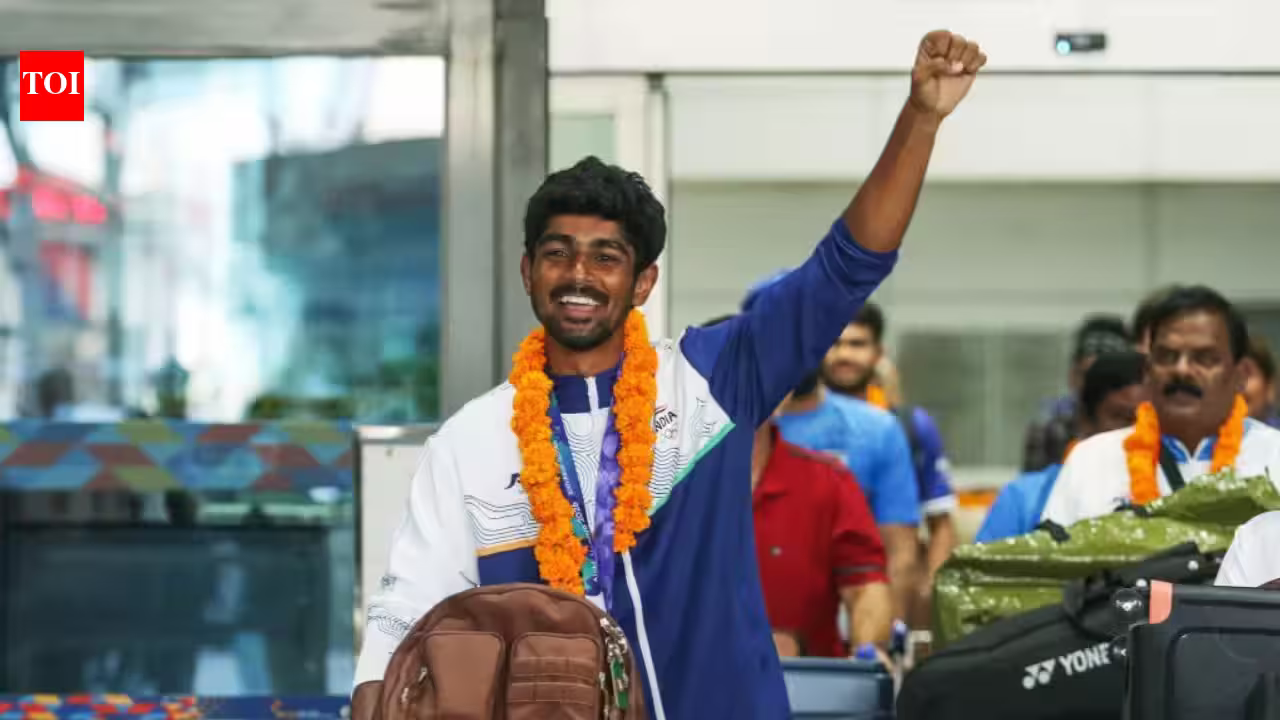


JAY MEENA’S historic bronze medal at the 2026 Asian Games in Nagoya is not merely a feat of athletic endurance; it is a testament to the sheer force of human will. For the 25-year-old from Dewas, Madhya Pradesh, the path to the podium was fraught with physical agony, nutritional crises, and the crushing weight of self-doubt. Yet, as the final shot of his opponent drifted long, cementing India’s first-ever Asian Games medal in soft tennis, the exhaustion of the preceding months evaporated into a roar of pure, unadulterated relief.
A Race Against Time and Health
The triumph is even more remarkable when considering that, just weeks before the Games, Meena was confined to his bed, ravaged by typhoid and a severe viral infection. The illness was catastrophic for his preparation; he lost eight kilograms, leaving him in a weakened state where even walking a few steps triggered dizziness.
“For 15 days, I was completely out of action,” Meena revealed. “The clock on the Asian Games was ticking down. All my efforts over the course of the past few months had just been undone.”
Despite being physically depleted, his resolve remained unbroken. He resumed light training, desperate to avoid wasting his opportunity. However, the adversity followed him to Japan. Without a formal Games village, the lack of tailored nutritional support for athletes with restricted diets meant Meena was forced to survive on a sparse menu of corn, bread, and cereal. Compounding his physical hardship was a nagging hip injury that flared during his semi-final clash with Japan’s Takuya Kurosaka, causing him “pinching” pain during every backhand strike.
The Mental Battlefield
Beyond the physical limitations, Meena had to navigate the psychological toll of a tournament that began with disappointments. The Indian men’s team suffered a disheartening 0-2 exit in the quarter-finals against Indonesia, followed by an early exit in the mixed doubles alongside partner Aadhya Tiwari.
“There were a lot of disappointing nights, a lot of self-doubts,” Meena admitted. “It was very difficult to come back and gain confidence after the self-doubt. It was very difficult to wake up every morning with new hope and get on the court with a new zeal.”
A Family’s Sacrifice
The road to Nagoya was paved with collective sacrifice, most notably from Meena’s family. His father, Rameshwar, a lawyer, was a constant pillar of support, traveling to national tournaments and accompanying his son to Japan. But the most poignant burden fell on Meena’s younger brother, Yash.
Also a talented soft tennis player, Yash was forced to abandon his own sporting ambitions due to the family’s limited financial resources. As the family poured their means into Jay’s training, Yash pivoted to engineering.
“Somewhere or the other, my younger brother’s life was sacrificed because of me,” Meena said reflectively. “Because my parents paid more attention to me for about 10 years. If we had continued, then maybe he would have been with me in the Asian Games.”
From Childhood Troublemaker to National Hero
It is a poetic turn of fate that the sport which defined Meena’s career was originally introduced to him as a disciplinary tool. As a child, Meena was a notorious agitator. His antics, which famously included setting off fireworks under his school principal’s desk, eventually led to his rustication from school in the fourth grade.
Desperate to channel his energy, his parents turned to coach Sudesh Sangte, who ran a two-court sports academy. The condition was simple: Jay had to stay at the academy and focus on the sport. What began as a mandatory regimen to keep a restless boy out of trouble transformed into a lifelong passion.
“My family was very upset with me. I would not stay at home, I would not allow anyone to relax… they said, you are out now. You stay on the ground,” Meena recalled with a laugh. Under the tutelage of Sangte, the once-unruly child found purpose, eventually rising through the ranks to claim national titles and international acclaim.
The Olympic Equivalent
While soft tennis has yet to be included in the Olympic program, Meena views his Asian Games achievement as the pinnacle of the sport. Given that the continent houses the world’s most dominant soft tennis powerhouses—including Japan, South Korea, and Chinese Taipei—the level of competition in Nagoya was elite.
“For me, this is an Olympic medal. It’s no less than an Olympic medal,” Meena asserted. “All the strongest teams come in the Asian contingent.”
As he stood on the podium, holding his bronze medal, the journey from a local court in Dewas to the international stage in Nagoya served as a profound reminder: success is rarely a linear path, but rather a series of moments where one chooses to persevere in spite of the odds. For Jay Meena, those moments have now earned him a permanent place in the annals of Indian sporting history.
Disclaimer: This content is auto-generated for informational purposes only.
Source: Read Original News