Acute health risks
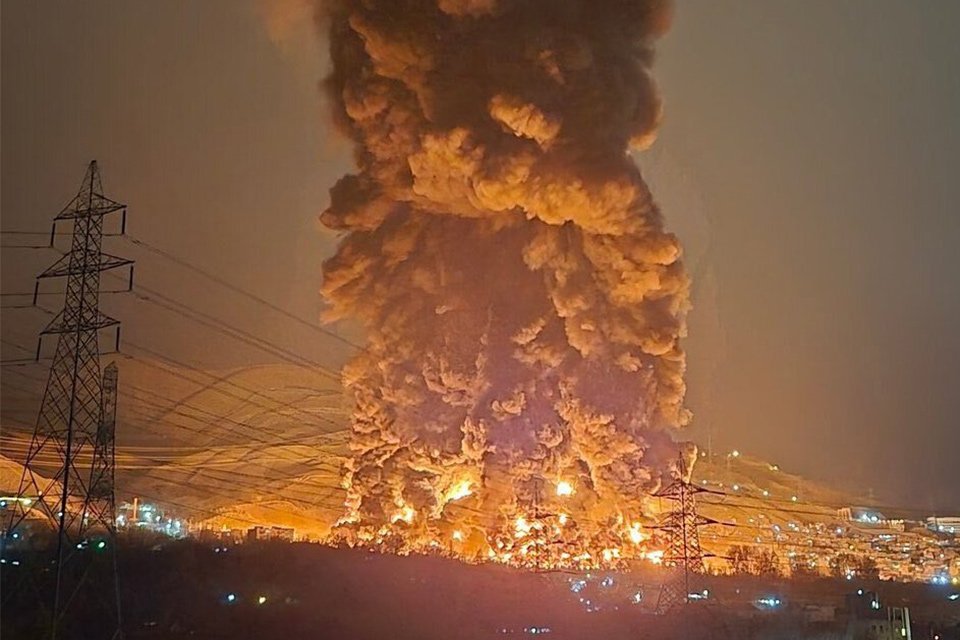
Iranians on social media described the ensuing oil fires as ‘hellscapes’, ‘a black monster’, and ‘apocalyptic’; a mark of their psychological impact. But what of their acute physical health impact? While the health impacts of long-term exposure to air pollution are relatively well established, the literature on acute exposure for similar events is limited. Even less so on the compound effects of such exposures and those from other conflict pollutants such as pulverised building materials dispersed by blasts. Nonetheless, health impacts will be informed by the smoke composition, concentration, exposure pathways and comorbidities, which we explore below.
Smoke composition
Smoke from oil or refinery fires is a complex mixture of gases and particles produced by incomplete combustion of hydrocarbons and industrial materials. Typical pollutants include carbon monoxide, sulphur dioxide, nitrogen oxides and volatile organic compounds (VOCs), alongside particles composed of soot, organic material and trace metals.
It is often difficult to attribute symptoms in a specific event to any one component of the smoke mixture with confidence, but we know one particle of particular concern is black carbon, a near-pure carbonaceous component of soot produced during incomplete combustion. Acute exposure can lead to respiratory disorders, particularly for high-risk groups like those with asthma and the elderly. The very small black carbon particles can penetrate deep into the lungs and can also carry other toxic pollutants on their surfaces, including polycyclic aromatic hydrocarbons (PAHs). Trace metals that occur naturally in crude oils are also of concern, such as nickel and vanadium, which cause respiratory irritation and inflammatory effects.
Reports out of Tehran describe “toxic acid rain”. This phenomenon is caused by the combustion of sulphur rich “sour” crude oil when sulphur dioxide gas is emitted into the atmosphere, turning into sulphuric acid in raindrops. Depending on concentration, sulphuric acid exposure can irritate the eyes and respiratory tract, but in practice it is often difficult to separate those effects from the wider impacts of soot, acidic gases and other potential combustion products like dioxins and furans, which act together rather than in isolation.
Smoke concentration
People in Tehran will have exposure to different pollutant concentrations based on their proximity to the fires, their local built environment, their building construction, how long they spent outside, and the weather.
In the early stages of the oil fires, large energetic plumes thrust the majority of the pollution up high, and away from people near the ground. These towering plumes punctured the planetary boundary layer, with smoke exported away (see below). However, as the fires lost energy, the plumes lowered and all smoke was within the boundary layer. This is particularly problematic in Tehran, owing to the local geography.
Tehran lies on the southern foothills of the Alborz Mountains in a semi-enclosed basin where surrounding peaks rise to 2-4 km, strongly restricting air circulation over the city. In winter and early spring the daytime boundary layer typically reaches only around 1-1.5 km, far below the surrounding mountain crest heights, forming a temperature inversion that acts as a cap to trap pollutants. What’s more, after sunset the boundary layer collapses to a few hundred metres, which concentrates pollutants near the ground. This effect produces the highest pollution levels overnight and in the early morning, until the boundary later starts to rise as the sun warms the ground.