







The landscape of consumer electronics repair has long been defined by the struggle between device miniaturization and accessibility. For nearly a decade, Apple’s AirPods line has served as the gold standard for non-repairability, consistently receiving a zero out of ten score from repair experts at iFixit. However, the release of the AirPods 5 marks a significant, if modest, turning point in the design philosophy of the world’s most popular wireless earbuds.
A Historic Shift in Repairability
For years, the internal architecture of AirPods has been dominated by copious amounts of industrial adhesive, soldered connections, and tightly packed components that rendered the earbuds essentially single-use devices. Once the lithium-ion batteries reached their end-of-life cycle, the entire unit usually ended up in electronic waste. The AirPods 5 breaks this cycle, achieving a repairability score of 2 out of 10. While this may seem low in a general consumer context, it represents a monumental shift for the product line, as it is the first time the hardware has been engineered with even a marginal path toward maintenance.
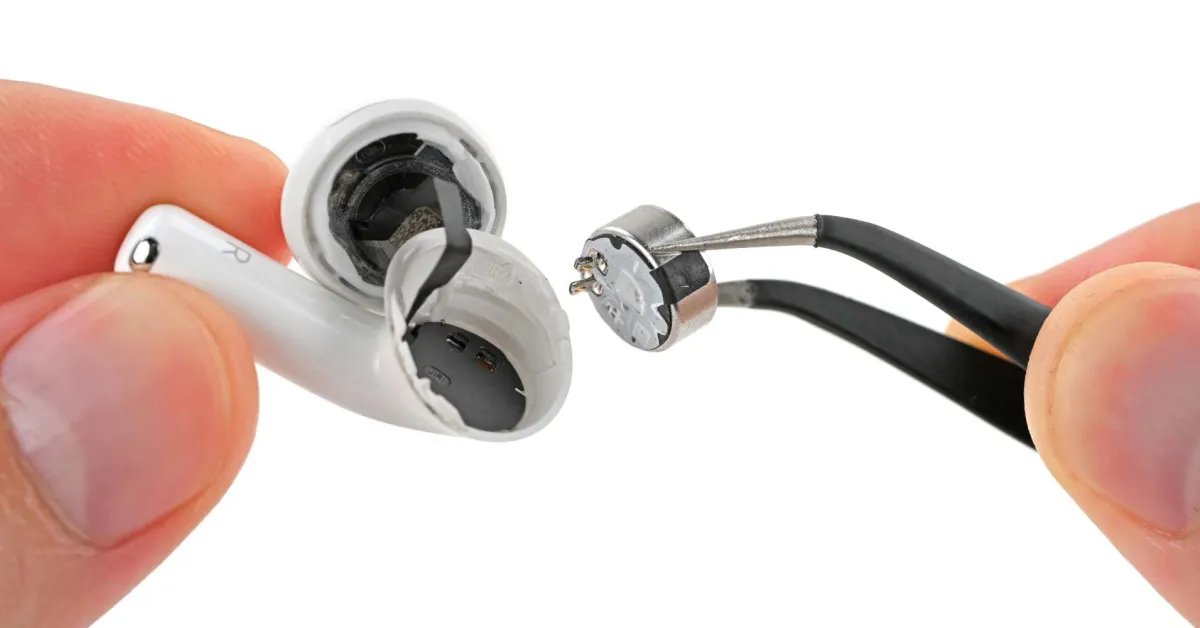
The core of this improvement lies in the accessibility of the internal battery. In previous iterations, the battery was fused directly to the internal circuitry and structural housing, requiring destructive disassembly to reach. The AirPods 5 features a refined internal layout that permits a skilled technician to extract and replace these power cells without permanently compromising the structural integrity of the shell.
Engineering Constraints and Challenges
Despite this progress, the repair process remains far from straightforward. The iFixit teardown reveals that the structural constraints of the device still pose substantial barriers to the average user. A primary technical hurdle involves the polarity and orientation of the batteries. The left and right earbuds utilize batteries that are not interchangeable; they feature reversed polarity and distinct contact placements. This design choice complicates the supply chain for replacement parts and demands high levels of precision during reassembly.
Furthermore, the advancement in accessibility stops at the power supply. While the battery is now reachable, the deeper core of the device—specifically the H2 processor, the microphone arrays, and the antenna modules—remains inaccessible without specialized equipment and significant damage to the chassis. The charging case remains similarly sealed, maintaining the traditional, non-serviceable design that has persisted since the inception of the product.
Technical Insights via Advanced Diagnostics
The teardown process provided more than just a physical assessment of the device; it utilized high-resolution CT scanning to map the internal density of the AirPods 5. These scans offer a rare glimpse into the precision engineering required to house modern audio technology in a tiny form factor. The images highlight how tightly the H2 system-in-package (SiP) is integrated with the micro-electro-mechanical systems (MEMS) microphones and acoustic drivers.
By visualizing the internal architecture in this way, observers can better understand why repair has been historically difficult. The density of the electronics is such that even a minor error in component placement would result in acoustic interference or connectivity failure. This level of miniaturization requires a level of manufacturing precision that is difficult to replicate in a repair shop environment, which explains why Apple has historically opted for replacement over repair.
The Broader Impact on Sustainability
The move to make batteries replaceable—even if only by professionals—carries significant implications for the lifecycle of consumer audio hardware. Lithium-ion batteries are the most common point of failure for wireless earbuds, as their chemistry inevitably degrades after several hundred charge cycles. By allowing for battery replacement, the AirPods 5 potentially extends the useful lifespan of the product, preventing thousands of units from entering landfill streams prematurely.
This design evolution likely stems from increasing regulatory pressure, particularly from the European Union and various right-to-repair legislations in the United States, which are pushing manufacturers to design products that allow for battery access. While the AirPods 5 is not a modular device, it signals that the industry is beginning to treat internal power sources as consumable items rather than permanent features of the hardware.
Practical Guidance for Future Maintenance
For the adventurous user or the professional repair technician, accessing the interior of the AirPods 5 requires unconventional methods, such as controlled thermal application. The use of a standard hairdryer to soften the internal adhesives, as demonstrated in the latest teardown, illustrates that the threshold for entry is lowering. However, this is not an endorsement for home repairs. The delicate nature of the internal ribbon cables and the proprietary adhesive seals means that a single slip could render the touch-sensitive housing or the noise-cancellation microphones non-functional.
As consumers move toward a future where hardware is expected to last longer, the AirPods 5 stands as an indicator of an emerging trend. It is a calculated compromise between the pursuit of extreme compactness and the growing demand for device longevity. While the repairability score of 2/10 is not a victory for the general public, it is a noteworthy departure from the absolute zero that defined the first four generations of the product. The focus moving forward will likely be on whether manufacturers can improve upon this score without sacrificing the acoustic performance or aesthetic profiles that have made the AirPods series a global standard.
Disclaimer: This content is auto-generated for informational purposes only.
Source: Read Original News