








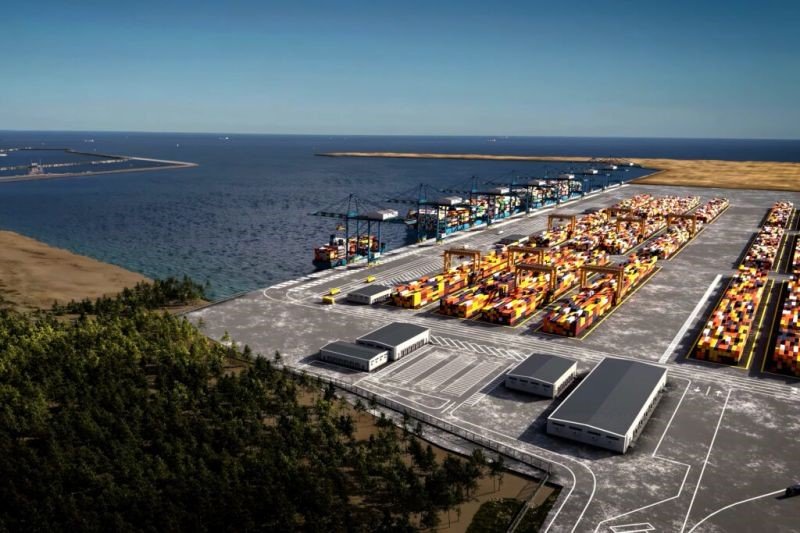
Poland’s Szczecin and Świnoujście Seaports Authority has secured a decisive legal victory following a ruling by the Supreme Administrative Court in Warsaw, which dismissed a cassation appeal filed by the German environmental association Lebensraum Vorpommern EV. This judicial decision removes the final major legal obstacle to the construction of a long-planned deepwater container terminal in the port city of Świnoujście.
The project, which has been under intense scrutiny due to its location near the border and its potential impact on the sensitive Baltic Sea ecosystem, is set to become a cornerstone of Poland’s maritime infrastructure strategy. By dismissing the appeal, the court has upheld the validity of the environmental decisions previously granted to the port authority, effectively validating the project’s compliance with national and regional planning regulations.
For the Szczecin and Świnoujście Seaports Authority, the ruling marks the conclusion of a lengthy period of uncertainty. The deepwater terminal is designed to handle the world’s largest container ships, significantly expanding the capacity of the Polish port network. Proponents of the project argue that the facility will strengthen the country’s position in global supply chains, enabling the port to compete more effectively with major regional hubs such as Hamburg and Gdańsk.
However, the path to this point has been marked by persistent opposition from environmental groups on both sides of the border. Lebensraum Vorpommern EV, based in the neighboring German state of Mecklenburg-Vorpommern, has consistently challenged the project on the grounds of potential ecological degradation. The association raised concerns regarding the destruction of protected marine habitats, the impact of dredging operations on local water quality, and the potential for increased noise and light pollution to disrupt migratory bird populations and local marine life in the Pomeranian Bay.
The litigation centered on the interpretation of environmental impact assessments (EIA) conducted during the planning stages. While the Polish authorities maintained that the project included comprehensive mitigation strategies designed to protect the local environment, the environmental groups argued that these measures were insufficient and failed to account for the transboundary nature of the ecological risks. The Supreme Administrative Court’s decision to dismiss the cassation appeal confirms that the lower court rulings in favor of the port authority were legally sound, effectively signaling that the environmental documentation meets the necessary regulatory threshold.
The approval comes at a critical time for the Baltic shipping sector, which is currently undergoing a shift in trade routes and logistics demands. The Świnoujście terminal is expected to alleviate pressure on existing terminals and shorten transit times for cargo entering Central and Eastern European markets. Economically, the Polish government views the terminal as a vital asset for regional development, projecting that it will create thousands of jobs both directly at the port and within the associated logistics and transport sectors.
Despite the judicial finality of this decision, the project will still be subject to ongoing environmental monitoring and strict operational guidelines. Under the terms of the existing permits, the Seaports Authority is required to implement specific restoration programs and continuous oversight of the surrounding waters to ensure that the ecological footprint remains within the bounds established by the approved environmental impact reports.
With the legal challenges now exhausted, the focus shifts to the procurement of contractors and the mobilization of resources for construction. The Szczecin and Świnoujście Seaports Authority has indicated that it intends to move forward with the project expeditiously, aiming to solidify the port’s role as a primary gateway for Baltic trade. While environmental organizations remain critical of the project’s scope, the court ruling provides the necessary legal certainty for investors and stakeholders to proceed with the terminal’s development.
Disclaimer: This content is auto-generated for informational purposes only.
Source: Read Original News