








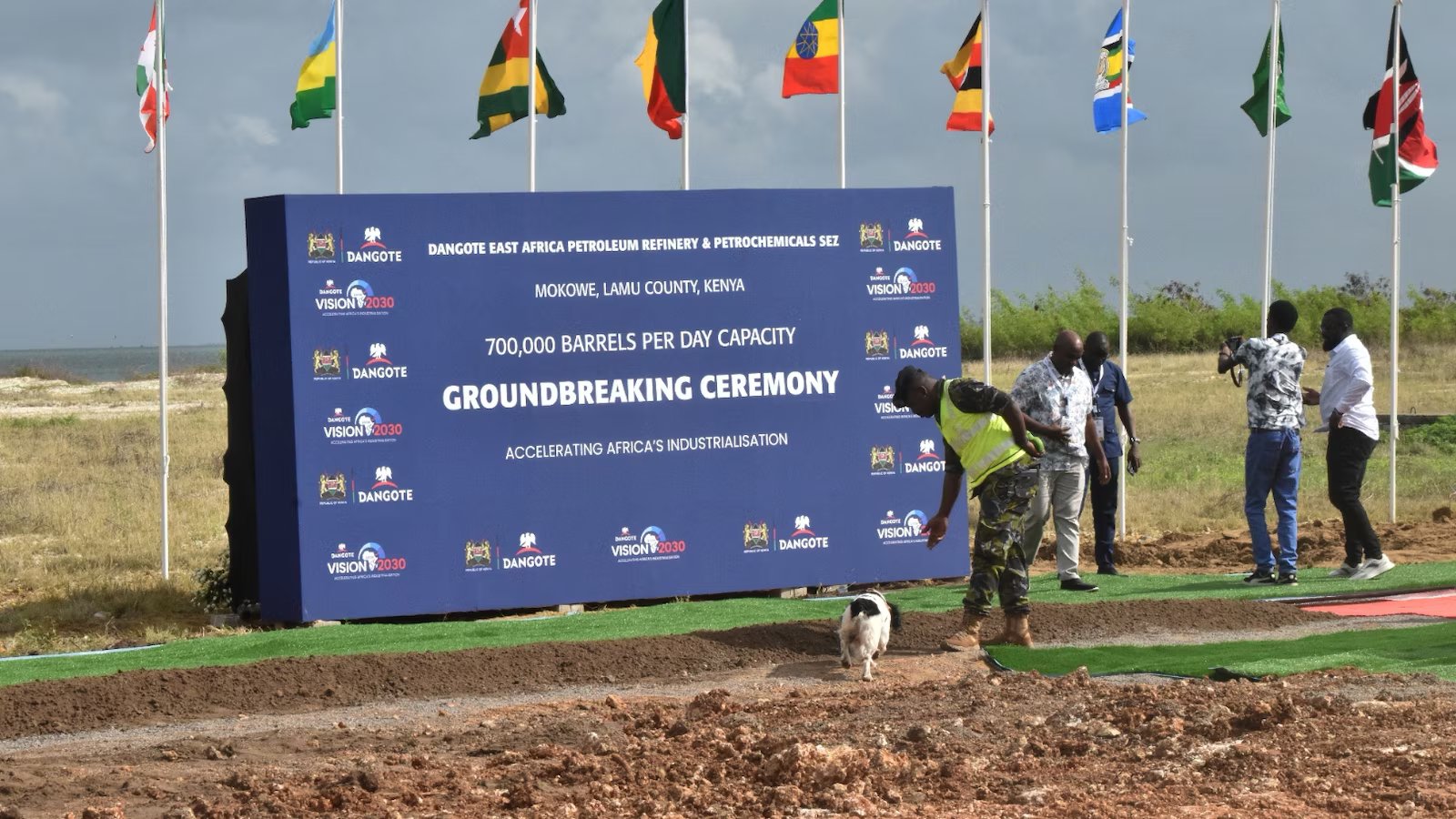
NAIROBI, Kenya — In a landmark move signaling a strategic shift toward continental self-sufficiency, five African heads of state gathered in the coastal town of Lamu, Kenya, on Wednesday to break ground on a massive $16-billion oil refinery project. The ambitious undertaking is set to transform the regional energy landscape by processing raw materials locally rather than exporting them abroad.
Kenya’s President William Ruto hosted a high-profile delegation, including the leaders of Uganda, Ethiopia, Togo, and Benin, as well as Nigeria’s former President Olusegun Obasanjo. Together, the dignitaries shoveled soil at the site, a symbolic gesture marking the formal commencement of construction for a facility expected to revolutionize East African industrialization.
The project, spearheaded by Nigerian billionaire Aliko Dangote, aims to process 700,000 barrels of oil per day upon its completion in 40 months. During the ceremony, Dangote emphasized the urgent need for economic autonomy, stating, “Africa must industrialize Africa.” He criticized the long-standing economic model that sees the continent “exporting what it has and importing what it needs,” asserting that the refinery will serve as a vital step in breaking that cycle.
Lamu was selected for the site after extensive technical evaluations. While initial plans once pointed toward Tanzania’s coastal town of Tanga, developers determined that Lamu offered superior logistical advantages, including deeper waters, stable geological conditions capable of supporting massive industrial equipment, and direct deep-sea access.
The refinery is positioned to become a central hub for the region’s growing petroleum sector. It is designed to handle crude oil from neighboring producers, including Uganda—which has existing pipeline plans through Tanzania—and South Sudan, which currently routes its exports through Sudan. Dangote noted that the market for refined products in East Africa is already robust, as regional consumption levels significantly outpace the refinery’s projected output of 700,000 barrels per day. This ensures a captive and growing consumer base for the finished product.
The significance of the project drew a wide coalition of support from across the continent. Beyond the leaders present in person, representatives from Rwanda, Burundi, South Sudan, and Tanzania were in attendance, underscoring the collective interest in the venture.
As construction gets underway, the refinery is being heralded as a beacon of pan-African cooperation. By shifting the value chain to East African shores, proponents argue the project will not only create thousands of jobs but will also shield regional economies from the volatility of global refined-oil prices. If completed on schedule, the Lamu refinery stands to become one of the most consequential infrastructure projects in recent African history, turning the region from a raw-resource exporter into a major player in the global energy market.
Disclaimer: This content is auto-generated for informational purposes only.
Source: Read Original News