






In Plato’s Phaedrus, the Greek philosopher Socrates critiques the invention of the written word as a supplement to memory, because writing, rather than aiding memory, removes the necessity of memory and therefore eliminates it. This argument, privileging the living presence required by oral speech over the deadness of written script, is now famous because of philosopher Jacques Derrida, who uses the ambivalence of the Greek word “pharmakon”, which means both poison and remedy, to show that writing is never one thing but always other to itself.
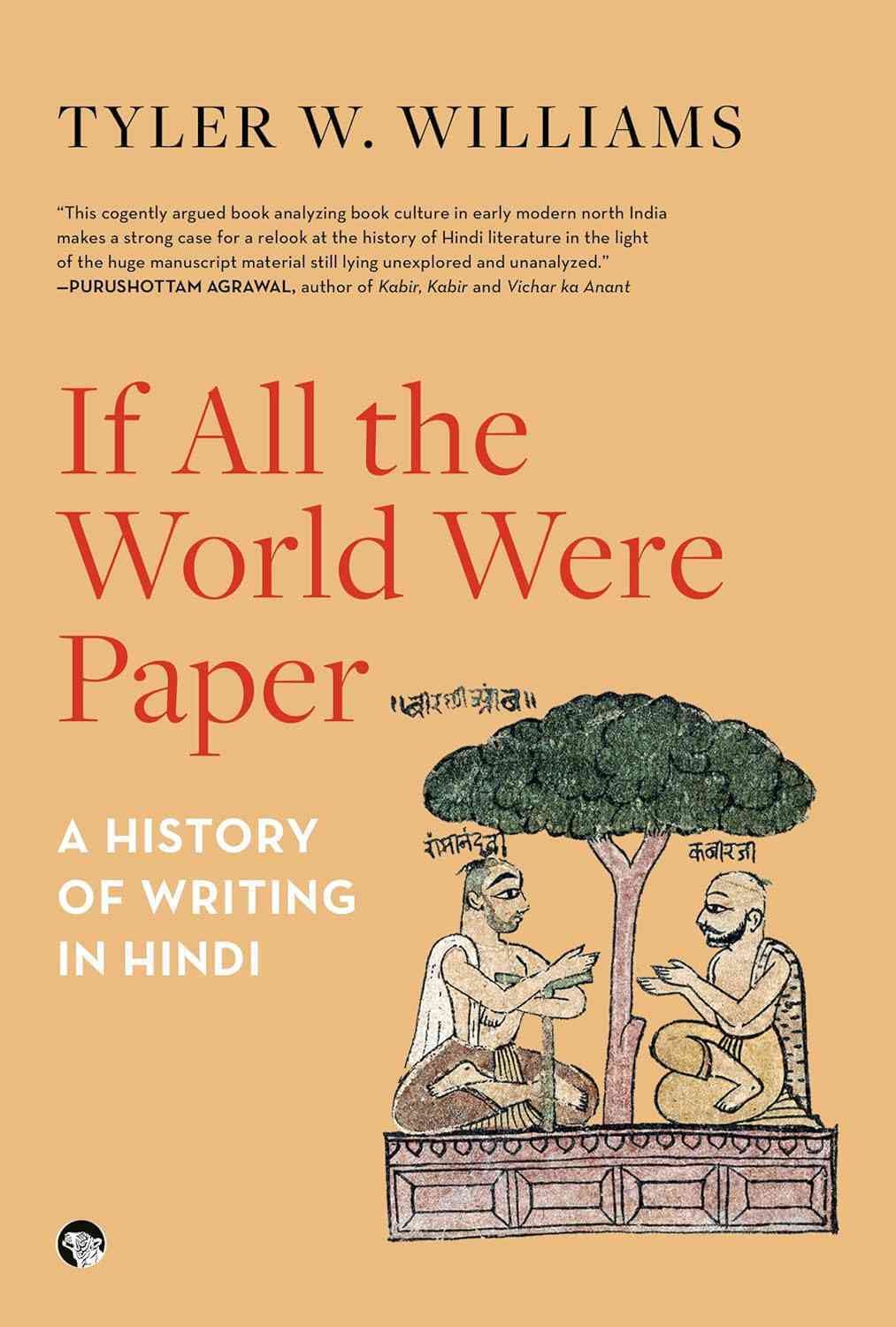
In contrast to Derrida’s attempt to rescue writing from the indictment of deadness and absence is the connection of non-Western cultures to living traditions of orality. Indeed, many studies of early modern South Asia have emphasised the rich performative and oral literary and religious traditions which offered a counterpoint to the materialism, textuality, and therefore fixedness of the Western canon. Tyler Williams, in his book, If All The World Were Paper: A History Of Writing In Hindi, surveys the manuscript histories of early modern Hindi-speaking South Asia, offering us a way to read history otherwise than this, and to reconcile these seemingly disparate arguments.
The archive and the method
Williams draws on the vast, understudied archives of early modern Hindi texts to make a remarkably original argument which deconstructs the oral/written binary in a Derridean move while considering the specificity and singularity of four South Asian literary traditions – the Sufi romance or pem-katha, the poems composed by nirguni bhakti poet-saints Kabir, Ravidas, Dadu Dayal and Haridas Niranjani, the pothi archives of the monks of Niranjani Sampraday and Dadu Panth, and the sacred scriptures of Sikhs, Dadu Panthis and Niranjanis.
In a combination of distant reading employing the methodologies of digital humanities, close readings which attend to the varying semantics and sounds of early modern Hindi texts, and a keen sensitivity to book history, Williams asserts the importance of foregrounding the materiality of texts in literary history. Previous studies on premodern material tend to construct archives around genre, religious orientation or literary form, and lead to a homogeneity in our imagination of the premodern world. Williams’s reorganisation of this material startles that imagination from its complacency to reveal how literary exchanges across religious traditions and languages were the norm rather than the exception – an endeavour with radical political implications in the current order, which privileges the purity and stability of textual traditions.
Considering the materiality of texts, apart from letting us into the affective world of the intimacies of reading and into the complex relationship between textual genre and material form, also gives us access to alternate histories, which in turn helps us reimagine their philosophical orientations. For instance, it lets us know that the nirguni saints of North India, who were thought of us deriding the sacrality accorded to Brahminical scriptures, did keep written records of everyday, mundane matters. Likewise, carefully studying manuscripts gives us information about literacy and its social distribution, about linguistic traditions, and about the intellectual and material exchanges between different sections of society. Many of the archives Williams uses have been systematically studied for the first time, and they lead to surprising insights about early modern Hindi literary and social life.
Writing about writing
Even as Williams considers the physical and visual characteristics of texts and the practices of inscription and circulation, he also pays keen attention to the theories of writing that they conjure. How was writing viewed in a culture deemed primarily oral? What can the kinds of things that were written, and the ways in which they were written, tell us about how writing was imagined? The material can become a point of access into the abstract; the artefact of writing can tell us something of the art of writing. So, Williams reads his own theoretical inclinations, his own understanding of reading and writing as a material, embodied practice and not the solitary activity of the intellect, into the corpus of works he studies. Nirguni bhakti becomes involved in the epistemological critique of limited access to a pure, untouchable text; Kabir’s famous doha about a letter of love superseding extensive readings of pothis becomes a call not to abandon the practice of reading, but to read differently.
Compulsively readable, immensely enjoyable, and a remarkable work of scholarship, this book comes at a critical juncture in the study of the Hindi language and its history. The tensions around the history of Hindi and the history of India being synonymous are felt searingly across the length and breadth of the subcontinent. This flattening not only of the linguistic diversity of South Asia, but also of the diversity in the histories and geographies of the Hindi language itself, comes at a cost. Williams’s book, in its exploration of the early modern history of the written word in Hindi, marks a deviation from this homogenising and hegemonising reading of the history of the language, and makes an attempt to allay these costs. His story is not one that fits well with the Hindi–Hindu–Hindustani train of thought. Bereft of ideological impulses to the study of an ancient language which was once at the margins of linguistic politics but is now the veritable vehicle of linguistic politics, this book is a labour of love which offers a rich and varied imagination of premodern South Asia.
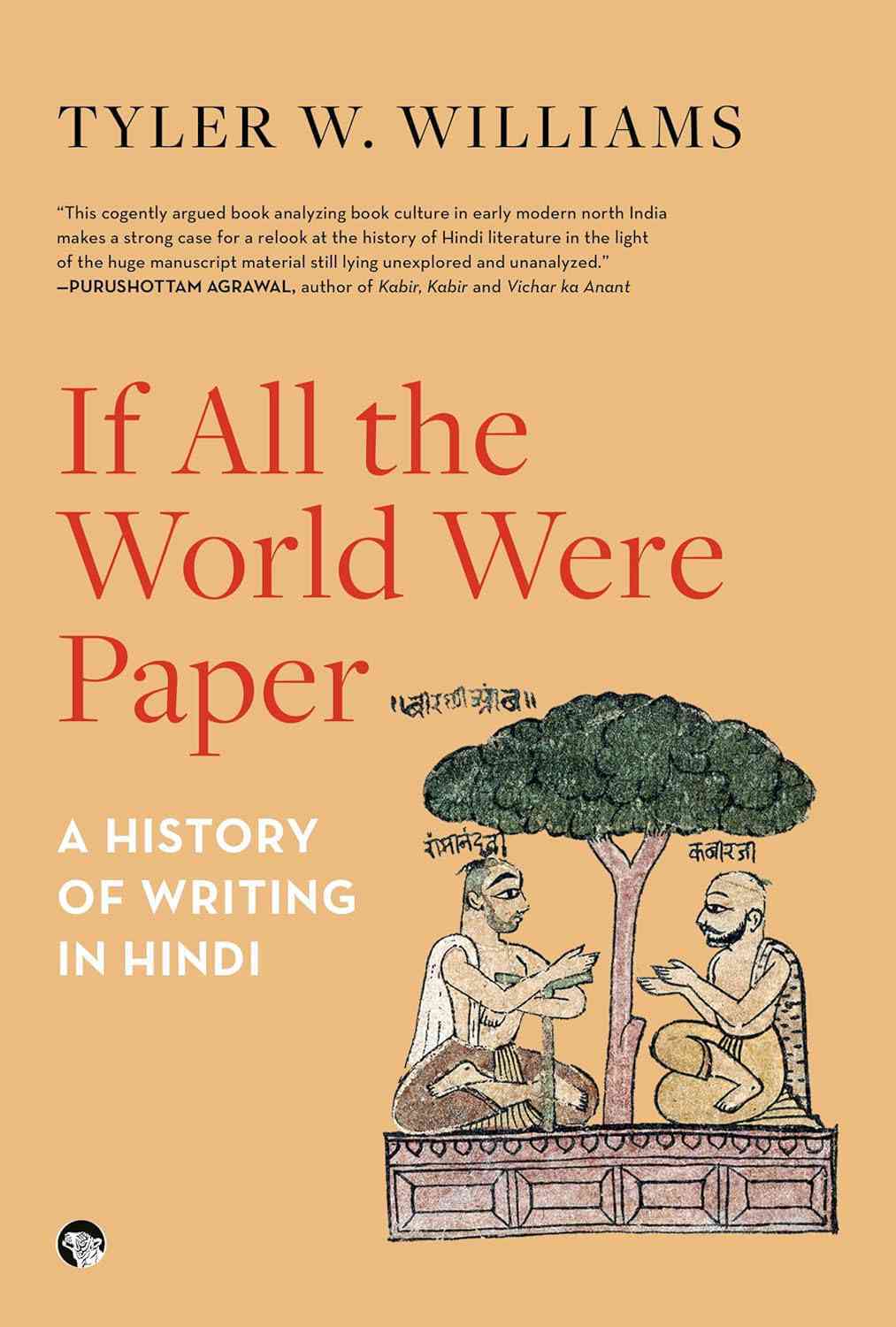
If All The World Were Paper: A History Of Writing In Hindi, Tyler W Williams, Speaking Tiger Books.