







The Intersection of Microscopy and Generative AI
The Nikon Small World in Motion contest has long served as a prestigious platform for celebrating the intersection of scientific research and artistic presentation. By highlighting the movement of biological structures at microscopic scales, the competition elevates the efforts of researchers who spend countless hours documenting the complexities of the natural world. However, the 16th annual competition has triggered a rigorous debate regarding the boundaries of digital enhancement and the role of generative artificial intelligence in scientific reporting.
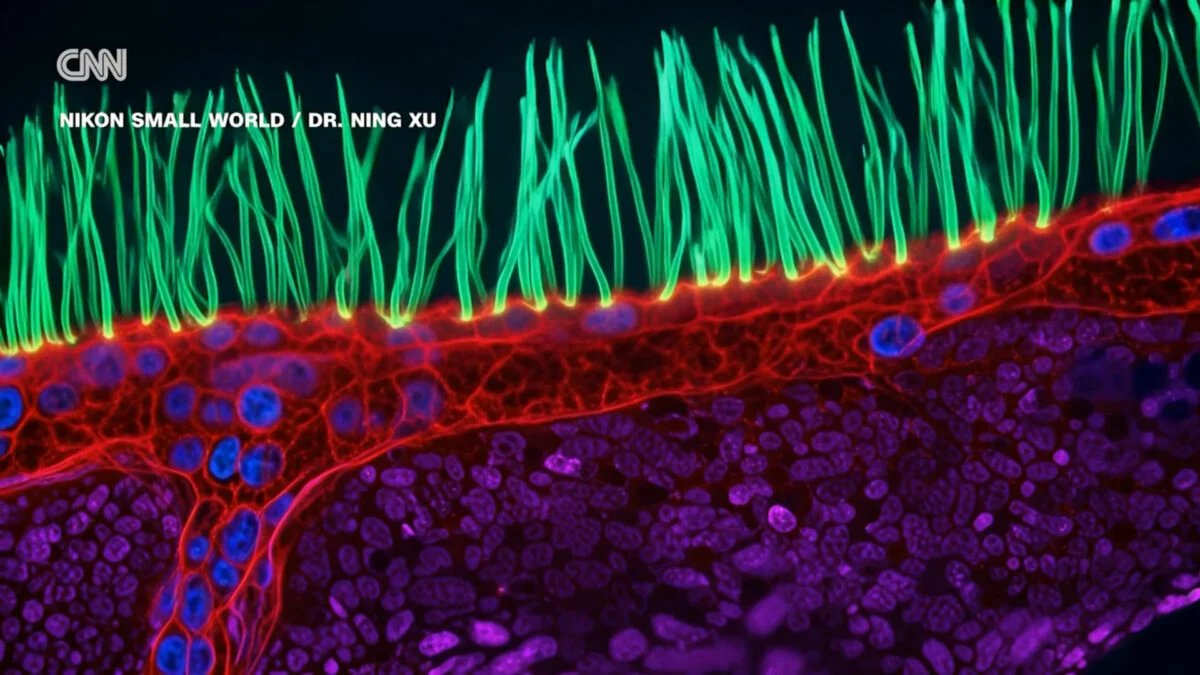
The controversy centers on a winning video submission by researcher Ning Xu, which purported to document the movement of cilia in human lung tissue samples collected from a patient with primary ciliary dyskinesia. While the underlying cilia movement was captured via microscopy, the video featured distinct red, blue, and purple structures beneath the cilia that appeared to be biologically inconsistent. Expert observers quickly flagged these additions, noting that the structures lacked the anatomical characteristics of known organelles and exhibited properties that do not exist within human cellular biology.
Technical Discrepancies and Forensic Evidence
The skepticism surrounding the submission intensified when technical discrepancies were identified by researchers in the field of bioengineering. Edward Phelps, a researcher at the University of Florida, highlighted that the purple structures presented in the video resembled mitochondria but occupied a scale and position within the cell that is not biologically possible. Furthermore, the blue nodules failed to behave as cellular nuclei would, and the red structures could not be correlated with any identifiable biological feature.
Beyond visual inspections, forensic evidence emerged in the form of a SynthID watermark. Developed by Google’s DeepMind, SynthID is a technology designed to embed invisible digital signals into content generated or heavily altered by AI. Its presence suggests that the final output was not merely a raw capture from a microscope, but a processed file influenced by artificial intelligence. This discovery challenged the foundational requirement of the contest: that entries must be derived from genuine microscopy and should avoid generative fabrication.
The Evolving Definition of Data Visualization
The core of the dispute lies in the methodology used for image reconstruction. Nikon initially faced significant backlash after the announcement of the winner, but later updated its documentation to acknowledge that an unsupervised neural network was employed during the post-processing phase. According to this updated disclosure, the AI was used to “distinguish and visualize features in the grayscale data” to create a more vivid output.
From a technical perspective, this creates a conflict between aesthetic presentation and scientific integrity. In scientific research, imaging is synonymous with data. Scientists rely on the veracity of captured light to make determinations about cellular processes, disease states, and physiological mechanics. When neural networks are introduced to interpolate or “reconstruct” data, they often introduce hallucinations—pixels or patterns that the algorithm predicts should be there based on training data, rather than what is actually present in the physical sample.
The Challenge of Transparency in Scientific Imaging
The Nikon incident highlights a broader tension in scientific publishing and microscopy: the standard for disclosure. Historically, scientific guidelines have permitted the colorization of images or the use of stains, provided those modifications are explicitly disclosed. These guidelines, however, were formulated for traditional image processing where manual adjustments were performed by the researcher.
Generative AI operates on a different logic. It does not merely adjust contrast or hue; it generates new visual data based on probability models. As former judge Andrew Moore noted, this process is akin to restoring an old photograph with AI; while the final result may appear aesthetically pleasing, it may deviate from the original subject in ways that are scientifically misleading. The current controversy serves as a litmus test for how institutions should treat AI-processed images, particularly when the generated features are presented without a clear distinction between the raw microscopy data and the computational interpretation.
Impact on Future Scientific Competitions
As artificial intelligence becomes increasingly accessible, the ability to discern the provenance of an image is becoming difficult. While AI detection tools exist, they are often inconsistent and prone to errors. Consequently, the onus remains on the creators to provide exhaustive documentation of their methodology. Nikon’s decision to perform a “careful re-review” of the submission underscores the necessity for updated contest regulations that specifically address the role of generative AI.
Moving forward, organizers of scientific visual competitions must weigh the demand for visually engaging content against the risk of undermining the credibility of the underlying science. The academic community, as voiced by developmental biologists like Melanie White, remains firm that trust in scientific measurement is paramount. If the public and the scientific community cannot distinguish between a real biological observation and a generative approximation, the utility of these images for research and education is compromised. The result of the Nikon review will likely influence future policies across the scientific community regarding the use of AI in imaging workflows, ensuring that advancements in visualization do not outpace the necessity for rigorous, evidence-based documentation.
Disclaimer: This content is auto-generated for informational purposes only.
Source: Read Original News