








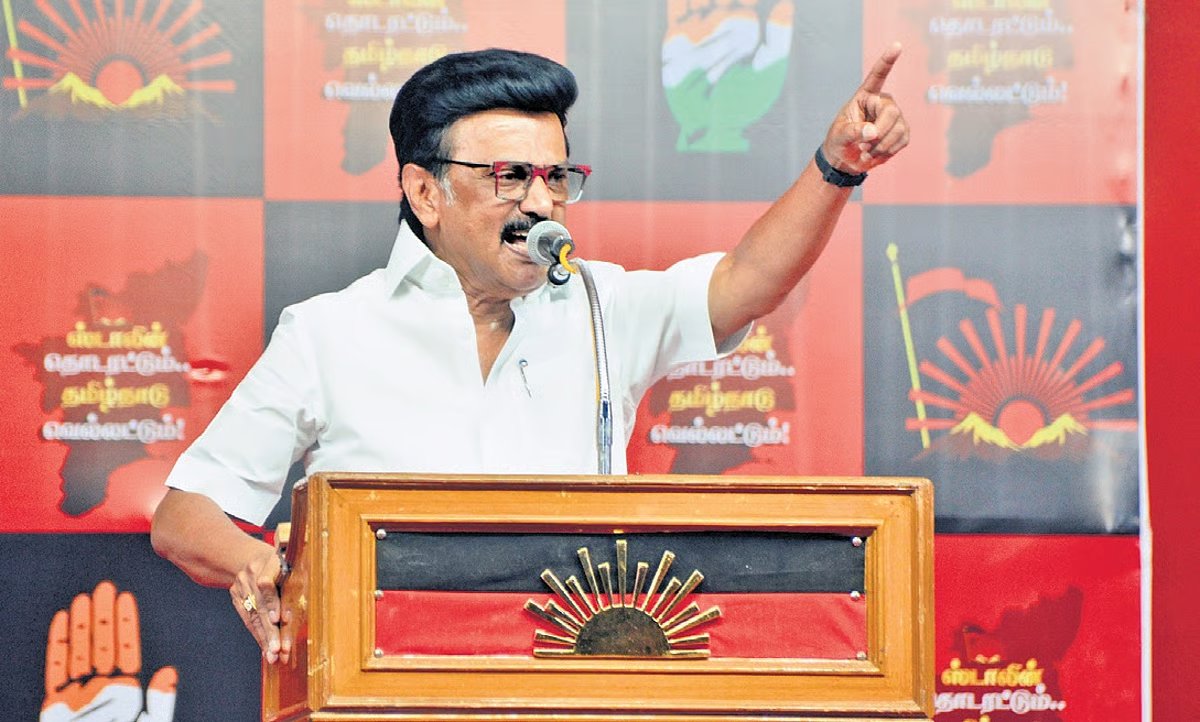
Tamil Nadu Chief Minister M K Stalin on Saturday criticised the CBSE’s newly introduced curriculum framework, alleging that the “three-language formula” is effectively a disguised effort to promote Hindi in non-Hindi-speaking states.
Stalin, who is also the DMK president, said the framework, aligned with the National Education Policy 2020, was not merely an academic change but a deliberate move that reinforces long-held concerns about linguistic imposition.
He further accused the BJP-led NDA government of pushing a centralising agenda under the pretext of promoting “Indian languages”, claiming it gives undue preference to Hindi while sidelining the country’s linguistic diversity.
“The so-called three-language formula is, in reality, a covert mechanism to expand Hindi into non-Hindi speaking regions,” he alleged in a statement.
For students in southern states, this framework effectively translates into “compulsory Hindi learning.”
He alleged: “Yet, where is the reciprocity? Will students in Hindi-speaking states be mandated to learn Tamil, Telugu, Kannada, Malayalam-or even languages like Bengali and Marathi? The complete absence of such clarity exposes the one-sided and discriminatory nature of this policy. The irony is stark and unacceptable.”
The same Union government that has “failed” to make Tamil a mandatory language in Kendriya Vidyalaya Sangathan schools-and has consistently failed to appoint adequate Tamil teachers, now seeks to lecture states on promoting Indian languages.
“This is not commitment, this is rank hypocrisy.”
Stalin wondered if the Union government had any understanding of ground realities; of availability of teachers, training capacity, and infrastructure.
He asked: “Where are the qualified teachers to implement this sweeping exercise. And crucially, where is the funding to support this enormous burden on the education system? Hence, this appears to be yet another ill-conceived policy announced without planning, resources, or accountability. This was not merely a question of language, it was a question of fairness, federalism, and equal opportunity.”