








President Donald Trump has increasingly intertwined federal emergency relief with his midterm election strategy, sparking intense debate over whether his administration is politicizing disaster recovery efforts. As a major hurricane barrels toward the U.S. Gulf Coast, critics are raising alarms that the president is leveraging disaster declarations and funding to reward political allies.
The strategy has become a fixture of Trump’s campaign rhetoric. On Wednesday, the president announced $17.9 million in disaster funds for Wisconsin—an announcement coupled with an endorsement of Republican gubernatorial candidate Tom Tiffany. The move drew immediate backlash from Democratic Governor Tony Evers, whose office stated they were never informed of the funding.
“Clearly, President Trump and Congressman Tiffany are continuing to play politics with emergency aid that’s meant to help communities recover in the wake of disasters,” an Evers spokesperson said.
This follows a series of similar incidents. During a campaign rally in North Carolina, Trump joked that federal funds for survivors of Hurricane Helene—still desperately needed two years after the storm—would be cut off if Republican Senate candidate Michael Whatley lost his bid. While the president later labeled the comment a “joke,” the rhetoric underscored a recurring theme of linking federal largesse to electoral outcomes.
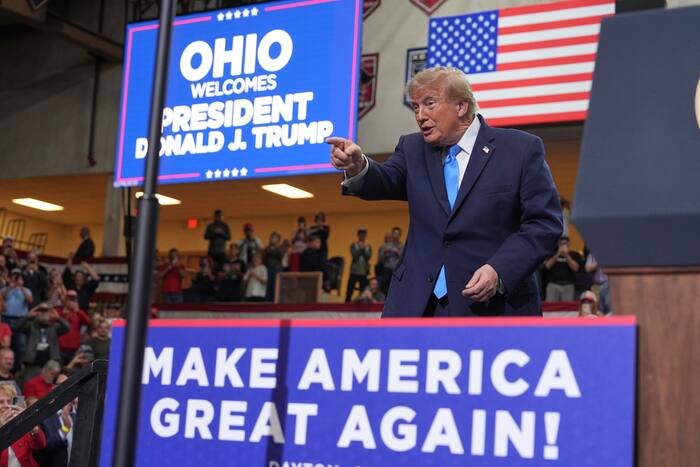
In Ohio, Trump approved a disaster declaration just a day before a rally with Sen. Jon Husted. The move allowed him to tout his responsiveness to supporters at a high school gymnasium, despite the fact that 15 other disaster requests from various states and territories—some lingering since late summer—remain pending on his desk. Among these are requests from Hawaii, which suffered back-to-back hurricanes, yet received no such priority.
Advocacy groups are pushing back against the trend. Sierra Lindsey-Kos, co-founder of the nonprofit Extreme Weather Survivors, emphasized that the nature of disaster relief should remain neutral. “Recovery isn’t partisan,” she said. “Neighbors help each other without asking who anyone voted for, and that’s exactly the way it should be.”
Experts echo these concerns, noting that the traditional norms of disaster management are being eroded. Rafael LeMaitre, who served as a FEMA spokesperson under President Barack Obama, argued that even the perception of a link between votes and aid is “out of bounds.” He warned that such behavior diminishes the integrity of the disaster management system and erodes public trust in government.
The White House has consistently rejected accusations of political interference. “There is no politicization to the president’s decisions on disaster relief,” spokesperson Lauren Bis said Tuesday. A FEMA spokesperson echoed this, stating that any suggestion of bias “does not reflect how this process works.”
However, data from an Associated Press analysis suggests a pattern: Trump has approved more than three-quarters of requests from states that supported him in the 2024 election, compared to less than half from states that did not. For those waiting on the front lines of recovery, the political maneuvering has become a source of profound frustration.
Disclaimer: This content is auto-generated for informational purposes only.
Source: Read Original News