








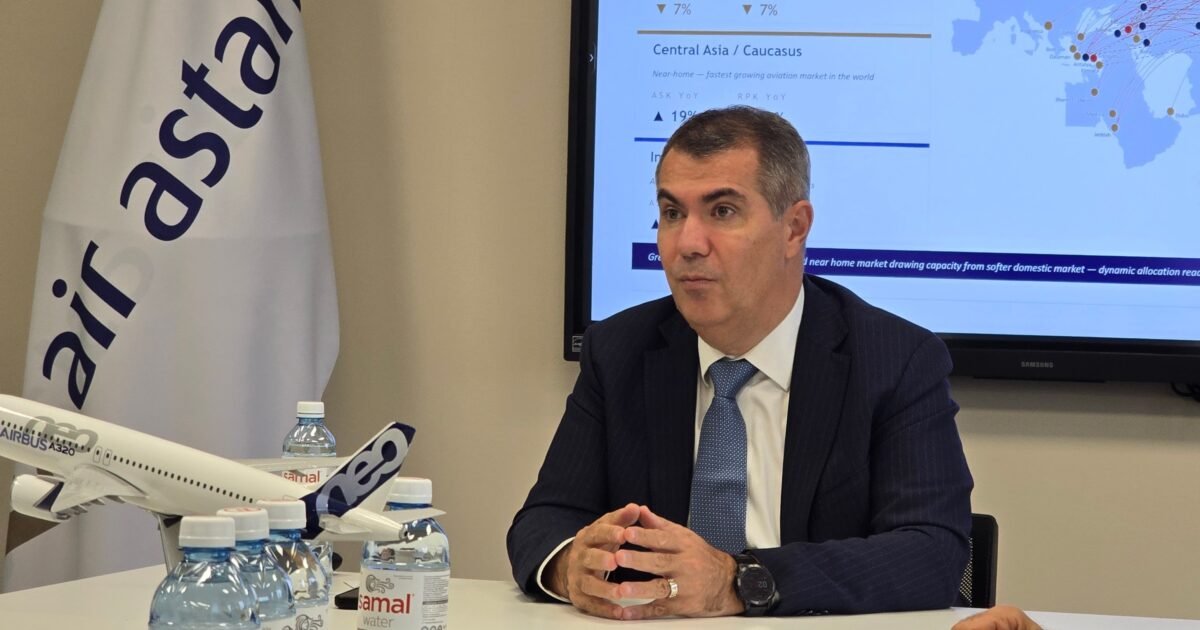
Air Astana’s new leadership is marking a bold shift in Central Asian aviation, leveraging rapid technological and logistical agility to navigate geopolitical volatility. Under CEO Ibrahim Canliel, who took the helm in April, the airline group has successfully pivoted its network strategy, moving away from Middle Eastern reliance to capture booming demand in China, India, and Southeast Asia.
This strategic recalibration was born of necessity. On February 28, the sudden closure of Middle Eastern airspace forced the carrier to suspend 15% of its international capacity overnight. Rather than stagnating, Canliel’s team utilized advanced flight scheduling and capacity management tools—the backbone of modern airline operations—to reallocate aircraft within 48 hours. By the start of the Nauryz spring holiday, the airline had already redirected its fleet toward high-growth Asian corridors.
## Leveraging Data for Network Agility
The transition from a Middle East-centric hub to an East-South Asia gateway highlights a broader trend in the aviation industry: the reliance on data-driven predictive modeling to adjust routes in real-time. By utilizing regional traffic analytics, Air Astana identified that the Xinjiang region in China offered a massive, untapped market. With a population comparable to all of Kazakhstan concentrated in a short flight radius, the airline’s decision to increase its Chinese footprint from 23 to 52 weekly flights demonstrates how carriers are using localized data to optimize capacity.
Beyond route planning, the group is aggressively digitizing its customer-facing operations. By integrating low-cost subsidiary FlyArystan with the full-service Air Astana brand, the group now commands a dominant domestic market share. This has increased Kazakhstan’s mobility rate significantly, with the airline group effectively utilizing pricing algorithms and fleet utilization software to stimulate domestic travel, bringing the country’s trip-per-capita rates closer to developed economic benchmarks.
## Technical Resilience and Supply Chain Buffering
While software and scheduling are vital, Canliel is also addressing the hardware realities of the post-pandemic aerospace sector. Amid global supply chain disruptions affecting Pratt & Whitney GTF engine maintenance, Air Astana has adopted a “high-buffer” maintenance strategy. By maintaining a reserve of 26 spare engines for its fleet of 43 aircraft—a ratio exceeding 30% compared to the industry standard of 10%—the carrier is essentially using inventory management as a shield against technical downtime. This proactive approach ensures operational integrity, preventing the flight cancellations that have plagued many international carriers currently struggling with engine availability.
The airline’s reliance on the Airbus A321LR, which uses advanced aerodynamic efficiency to bridge long-haul gaps without the fuel-burn of traditional widebody jets, further underscores the industry’s move toward narrowbody long-haul efficiency.
## The Future: Dreamliners and Long-Haul Connectivity
Looking ahead, the group is preparing for a technological leap with the integration of Boeing 787-9 Dreamliners. Scheduled for delivery beginning in late 2026, these aircraft are expected to be the final piece in the airline’s plan to launch non-stop flights to the United States by late 2027.
The challenge of “Ultra-Long-Haul” operations remains a priority for the engineering team, who are currently evaluating polar routing software and payload trade-offs. To remain competitive against legacy carriers, Air Astana is adamant about avoiding technical refueling stops, which would degrade the passenger experience and add unnecessary carbon overhead. By carefully calculating fuel burn against payload capacity, the airline aims to provide a seamless, non-stop connection that leverages its position as a central, efficient hub between the East and the West. As Air Astana enters this new chapter, its fusion of logistical agility and hardware foresight provides a blueprint for mid-sized airlines aiming to compete in an increasingly complex global airspace.
Disclaimer: This content is auto-generated for informational purposes only.
Source: Read Original News