






Beijing’s status as a “Dual Olympic City” has reached new economic heights, as the recent National Day “Golden Week” transformed the capital into a bustling hub of high-level international sports and mass-participation events. The surge in activity, headlined by the China Open and the World Table Tennis (WTT) China Grand Smash, has effectively integrated competitive athletics with tourism and retail to create a thriving “sports event economy.”
The festivities culminated on the evening of October 6 at the National Tennis Center, where Novak Djokovic secured his seventh China Open title after opponent Alex de Minaur was forced to retire due to injury following the first set. However, the tournament’s impact stretched far beyond the court. The National Tennis Center evolved into a vibrant social park, featuring big-screen viewing areas, bustling food outlets, and retail stores that saw over 10,000 visitors daily. According to Yin Xufei, head of the officially licensed merchandise stores, the events provided a “tangible carrier” for thousands of fans looking to preserve their tournament memories.
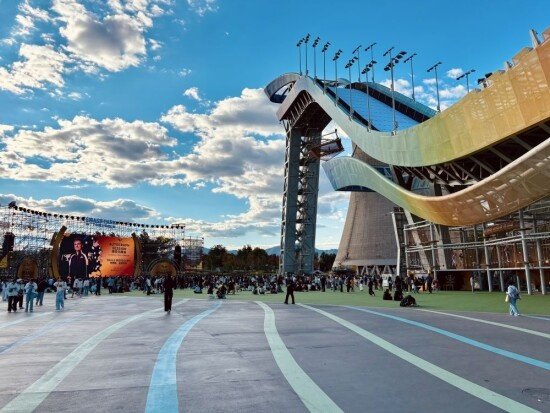
Simultaneously, Shougang Park in Shijingshan provided a unique backdrop for the WTT China Grand Smash. By blending industrial heritage with the fast-paced energy of table tennis, the park offered a holistic experience where fans could dine, shop, and watch world-class athletes. A standout feature for attendees was the “Explore Shijingshan in One T-Shirt” campaign. Functioning as a “walking ticket stub,” the tournament-themed apparel granted fans exclusive discounts at hundreds of local partner merchants, effectively funneling the influx of spectators into surrounding restaurants, hotels, and historical sites.
The momentum of the “Golden Week of Sports Events” was felt across every corner of the city. In the Yizhuang district, the GT World Challenge roared to life by Tongming Lake, drawing over 26,000 spectators to an automobile-themed carnival that combined racing with technological showcases. Meanwhile, in the outskirts of Miyun, the China Men’s 3×3 Basketball League Championship successfully linked sports with local culture, hosting a “Chao San” Market that spotlighted intangible cultural heritage and regional delicacies like starch noodles.
This strategic alignment of sports and leisure marks a significant shift in Beijing’s tourism model. By embedding cultural tourism scenarios directly into the tournament experience, the city has successfully expanded consumption channels, from ticket sales and merchandise to dining and accommodation. As the capital continues to leverage its Olympic legacy, the success of the recent Golden Week serves as a powerful demonstration of how professional sports can serve as a primary engine for urban economic growth and vibrant, community-focused tourism.
Disclaimer: This content is auto-generated for informational purposes only.
Source: Read Original News