








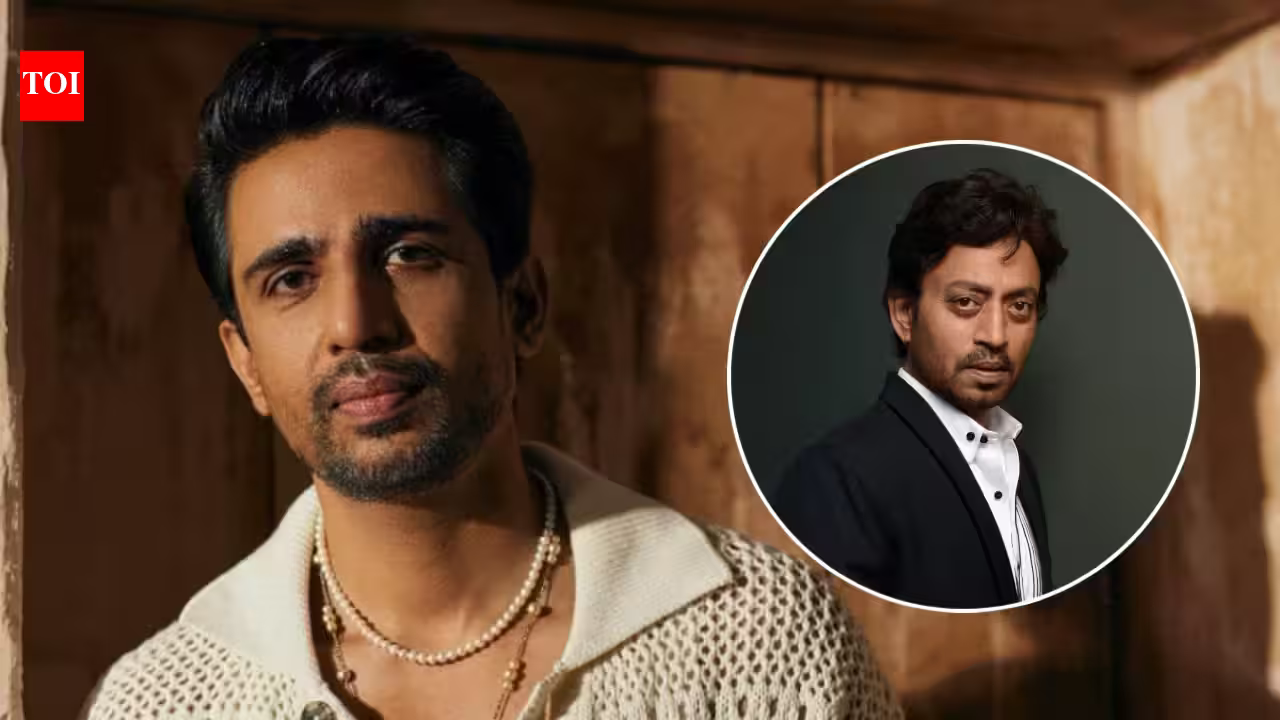
In the fraternity of Indian cinema, there are stars, there are performers, and then there are the few who fundamentally change the vocabulary of acting. Irrfan Khan belonged to the latter, a master of the unspoken who could transmit volumes of human experience through a single, weary blink of his eyes. For those who shared the screen with him—or, like Gulshan Devaiah, spent years studying the alchemy of his craft from the audience’s side of the curtain—his absence remains a palpable, aching void.
In a recent, candid reflection on his own artistic evolution, Gulshan Devaiah, one of the most versatile actors working in Hindi cinema today, opened up about the man who served as his unofficial mentor. It is a rare admission in an industry often fueled by ego: that a peer’s work could be the primary blueprint for one’s own growth.
The Architect of an Unconventional Path
For an actor like Devaiah, who arrived in Mumbai without the formal credentials of a traditional drama school, the screen became his classroom. While some would look toward the glitz of the marquee idols of the 90s, Devaiah found his North Star in the grounded, gritty, and profoundly human performances of Irrfan Khan.
“Irrfan was a huge influence on me throughout my career,” Devaiah reflects. Yet, he is quick to clarify the distinction between inspiration and imitation. In a landscape where young actors are often incentivized to mimic the “masala” heroes of the past, Devaiah treaded carefully. He consumed the work of global titans—Manoj Bajpayee, Daniel Day-Lewis, Robert De Niro, and Kate Winslet—but always with the intent to distill, not to replicate.
“I never tried to copy him,” he says, emphasizing the importance of the individual voice. “I was very conscious that I didn’t want to copy anyone. That’s how I learned—by observing, absorbing, and then filtering it through my own sensibility.”
The Science of the “Restrained” Performance
What was it about Irrfan that commanded such reverence, even from his fellow professionals? It wasn’t the bombastic monologues or the high-octane dance numbers that defined the typical Bollywood protagonist. Instead, it was Irrfan’s deliberate decision to pull back, to occupy the space of the “unpredictable.”
Devaiah points to a specific quality that separated the late legend from his contemporaries: the refusal to over-explain. “Irrfan had this quality where you didn’t know what he would do next, and many times, he didn’t do much; he would hold back,” Devaiah explains.
He highlights the “god-gifted” eyes that Irrfan possessed, tools he used to hold a frame long after the dialogue had ceased. “He was doing things that were really different. He would deliver lines without even looking at his co-actor. It was unconventional.” By stripping away the performative artifice, Irrfan turned the act of acting into an act of being. For Devaiah, that magnetic, quiet intensity proved that you didn’t need to fit the conventional “hero” mold to dominate a frame. He was a beacon for every actor who realized that the most powerful movements in a scene are often the ones that don’t happen at all.
A Grief That Caught Him Off Guard
Perhaps the most poignant moment of Devaiah’s reflection is his admission that the depth of his admiration for Irrfan was, in some ways, a surprise to himself. We often quantify our feelings through our reactions, and for Devaiah, the news of Irrfan’s passing in April 2020 acted as a mirror, reflecting a depth of loss he hadn’t fully processed.
“I remember weeping on the phone with my mother when the news broke,” he says. The image of a seasoned actor, one who has navigated the complexities of human emotion for years, breaking down in a private, familial setting, speaks to the unique space Irrfan held in the collective psyche of his peers.
When his mother expressed her own surprise at the intensity of his grief, Devaiah had a moment of clarity. “I was like, ‘Yeah, neither did I.'” It was a recognition that Irrfan wasn’t just a cinematic icon to him; he was a silent companion whose presence had guided his artistic maturity. His passing felt less like the death of a distant star and more like the loss of a mentor—a family member whose absence suddenly left the creative world feeling much colder.
Looking Forward: ‘Little Thomas’ and the Future
Even as he pays tribute to the ghosts of his past, Gulshan Devaiah remains firmly rooted in the present, continuing to push the boundaries of his own range. His latest project, Little Thomas, directed by Kaushal Oza, sees the actor taking on a narrative that shifts away from the darker, high-tension roles he is often known for.
The film centers on the innocence of a young boy yearning for a sibling, offering a change of pace that promises to showcase a more tender side of Devaiah’s acting toolkit. Slated for an October 23 release, the film is yet another testament to an actor who refuses to stand still.
As Devaiah continues to evolve, he carries the lessons of his predecessor with him—not in his mannerisms or his tone, but in the quiet commitment to truth. In an industry that often celebrates the loud and the spectacular, it is a comfort to know that the legacy of Irrfan Khan lives on in actors who choose to hold back, to observe, and, most importantly, to keep it real. For Gulshan Devaiah, the best way to honor a legend isn’t to walk in his footsteps, but to keep forging a path that is just as brave and entirely his own.
Disclaimer: This content is auto-generated for informational purposes only.
Source: Read Original News