










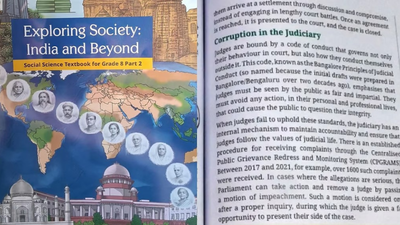
NCERT’s textbook wars are hardly new. They have become a recurring feature of India’s curriculum politics. In recent years, controversies have followed the ‘rationalisation’ of Mughal-era material, the deletion of references to the 2002 Gujarat riots, and later tweaks that added the abrogation of Article 370 to updated school texts. But the latest flashpoint went further than the usual curriculum skirmish. The Supreme Court took strong exception to passages in Chapter 4, The Role of Judiciary in our Society (pages 125–142) of NCERT’s Class 8 Social Science textbook, Exploring Society: India and Beyond, Vol II, which referred to corruption at various levels of the judiciary and a massive backlog among the system’s challenges. NCERT, which released the book on 24 February 2026, first admitted that “inappropriate textual material” and an “error of judgement” had crept into the chapter and said it would be rewritten. By 10th March, NCERT had issued an unconditional and unqualified apology and withdrawn the entire Class 8 book from circulation. The real issue is much wider than only the apology, anger of the Apex Court and withdrawal. It is about whether schoolbooks should talk about public institutions as perfect ideals or as living systems that are sometimes under stress, behind schedule, and prone to human error too.
What this row is really about
What the disputed chapter described was corruption at all levels of the judiciary and illustrated the enormous backlog, linking it to structural issues such as too few judges, unwieldy procedures, and poor infrastructure. On paper, these are not subterranean truths that are muttered in hostile corners. They’re a part of public conversation. But as these hard facts appeared in the Class 8 textbook, everything changed. The Supreme Court objected sharply. NCERT apologised. The book has been withdrawn. This sequence is what gives the episode its sting. The crux of the problem here is not merely the fact that one book is written, circulated and then retracted. This episode has shed light on a subtle but enduring uncertainty in Indian education: When schoolbooks introduce children to public institutions, what exactly are they supposed to offer: Moral architecture, civic realism, or perhaps some rather uneasy combination of the two?
The classroom problem is not truth, but framing
No serious civics textbook can pretend that the judiciary is beyond criticism. We adults know that it is full of contradictions. It stands for justice and constitutional protection, but it is also slow, expensive and often hard to access. At times it inspires confidence while at other times, it leaves people frustrated. That is a complicated truth for sure. But a child meeting the judiciary for the first time cannot be expected to absorb the whole of that truth in one go.Backlogs, high legal costs and unequal access are not made-up complaints. They are a reality. So they cannot be kept out of schoolbooks altogether. If they are, students are left with a version of public life that is far too clean. But the opposite is not healthy too: A 13-year-old meeting a constitutional institution for the first time through the lens of decay and failure.This is why framing matters so much in textbook writing. There is a real difference between acknowledging that an institution is under strain and making that strain look like its defining feature. A textbook can introduce the judiciary as a constitutional safeguard that also faces delays and structural problems. Or it can make it seem, from the outset, like a lofty institution weighed down by dysfunction. Those are not the same lessons. They shape opinions in a young reader in different ways.A textbook needs to first explain what the judiciary is for, why independence matters, what rights require protection, how disputes are settled, why constitutional remedies exist. Only after that foundation is in place, a textbook can carefully suggest that institutions meant to uphold justice are not always able to operate with the smoothness that they are expected to.
Writing civics textbooks is harder than it looks
History has one advantage that civics does not. Most of history’s protagonists are dead, gone, out of office. Civics deals with institutions that are still here, powerful, capable of commanding respect and provoking anger in the same breath. That changes everything. A civics chapter is not just explaining the state. It is also shaping a child’s first instincts about authority.So, writing civics for middle-school children is one of the most demanding tasks in the domain of public pedagogy. The task is not merely to state facts. It is to decide which truth enters first, which waits its turn, what gets emphasis, and what kind of moral weather the chapter creates around an institution.If you sanitise it too much, a student inherits a shiny, fragile idea of the republic that cracks as reality hits for the first time. Go too far the other way, and an institution may seem compromised before the student has even understood its purpose. So, the problem is that of composition: How to write about imperfect institutions without making imperfection their only identity.
Why textbook rows in India become so charged
Textbooks in India are never merely textbooks. They are proxies in larger contests over memory, authority and national self-description. Every alteration is read as signal, every deletion as motive, every insertion as ideological intent. That is why NCERT controversies never remain administrative for long. They spiral into television studios, courtrooms, ministerial statements, and social media trench warfare. Seen in that light, the current row about NCERT’s Social Science book for class 8 is not just about a chapter that crossed an invisible line. It is about the country’s uncertainty over how much realism it can tolerate in its own pedagogy.
What this debate is really asking of schoolbooks
Perhaps the safest conclusion is also the most difficult one to write. They should not offer children a polished and grand version of institutions. But neither should they bring in adult disillusionment into early civic education and pass it off as truth-telling. Both are forms of distortion.What a nation owes its children is a language in which institutions are neither worshipped nor misunderstood. Now that requires writers of unusual steadiness and editorial judgement, undaunted by complexity. This, finally, is what makes this NCERT episode worth thinking about beyond the controversy. It is a reminder that education, in its purest form, lives or dies by the tone as much as by authenticity of facts. The children in the classroom shouldn’t be lied to. But they should also not be handed a fragmented truth either.Between those two obligations lies the difficult craft of civics writing. If this controversy makes us pause and think more carefully about how schoolbooks introduce children to institutions, it may end up leaving behind something more valuable than just another burst of outrage.