







Lucinda Andreani pushes back against future floods following catastrophic wildfires.
Wildfire is as much a part of summer in Coconino County as popsicle stains and cannonballs into swimming holes. Fire, almost inevitably, comes with the season.
The Northern Arizona county covers so much ground, it clocks in as the second-largest in the country. While part of that land mass is vast desert landscapes, a significant portion includes the largest ponderosa pine stand in the world. And in a dry climate, that can create problems.
When catastrophic wildfires sweep through a pine forest, they can scorch away trees and plants and bake the soil like a kiln firing pottery. Instead of soaking into the soil, rainfall rapidly runs off the surface, causing flash floods. That means rural communities are not only at risk from destructive fires, they’re also vulnerable to dangerous floods that follow.
In and around Flagstaff, the county seat, a series of wildfires in recent years has created conditions ripe for hazardous flash flooding, some powerful enough to carry away large tree trunks, cars and more. A 12-year-old girl tragically lost her life in a flash flood in 2010 following the Schultz Fire, which burned at least 15,000 acres.
After the Schultz Fire, the area experienced the 2,000-acre Museum Fire in 2019. In 2022, Coconino County battled both the 26,000-acre Pipeline Fire and the 19,000-acre Tunnel Fire.
The two fires in 2022 later resulted in 45 major flood events.
In areas scorched by wildfires, known as burn scar areas, mitigation efforts could save lives. A downpour the area received in early July tested the efforts of Coconino County Flood Control District Administrator Lucinda Andreani and her team.
“We had a good test of the system,” she said. “And it worked.”
Andreani is referring to a multi-million-dollar flood mitigation system the county recently completed by utilizing $60 million in funding from the Natural Resources Conservation Service and $42 million from the U.S. Forest Service. That federal funding was spread across nine watersheds to address the capture of sediment and reduce erosion.
Along with the new system, the county shored up more conventional flood-control measures, including retention basins and storm drains. The combined efforts reduce the risk of damage to about 1,500 homes, Andreani said. Without federal investment, the county said it would have taken up to 20 years to complete the project on its own.
“This is our third rodeo. We have a lot of experience in this arena,” Andreani said of flood mitigation, which the county has gained attention for in other areas of the country. “We have developed this system of mitigation and key to that system are these on-forest watershed restoration measures. Lots of places build traditional flood mitigation. It’s much more challenging in this environment because our flood flows have gone up 10 to 31 times per fire.”
Coconino County Board of Supervisors Chair Patrice Horstman, the supervisor for District 1, called the wildfire to post-wildfire mitigation a vicious cycle for Coconino County. Relationships across the varied layers of government are critical to response, recovery and restoration, she said.
“It has been an incredible partnership. The county never would have been able to do it had it not been for the relationships with our Arizona Senators and Representatives, the USDA, the Department of Interior and the State of Arizona.”
Horstman has worked with municipal and Tribal governments as well as state, congressional and federal offices. This coordination ahead of an emergency, Horstman said, ensures that all stakeholders are at the table.
For Andreani, flood mitigation projects are more than wildfire recovery, they are public safety projects. And she’s grateful the funding was available to not only create safer water flow throughout the county, but also to put minds at ease.
“Without the partnerships, we could not have done the extent of mitigation we were able to do,” she said. “This is life threatening. And what we hear from people in the communities is that there is so much fear that people can’t sleep at night. What we hear when we’re done is relief.” FBN
By Lisa Abelar
Lisa Abelar is a writer for the newswire service, Resource Rural.
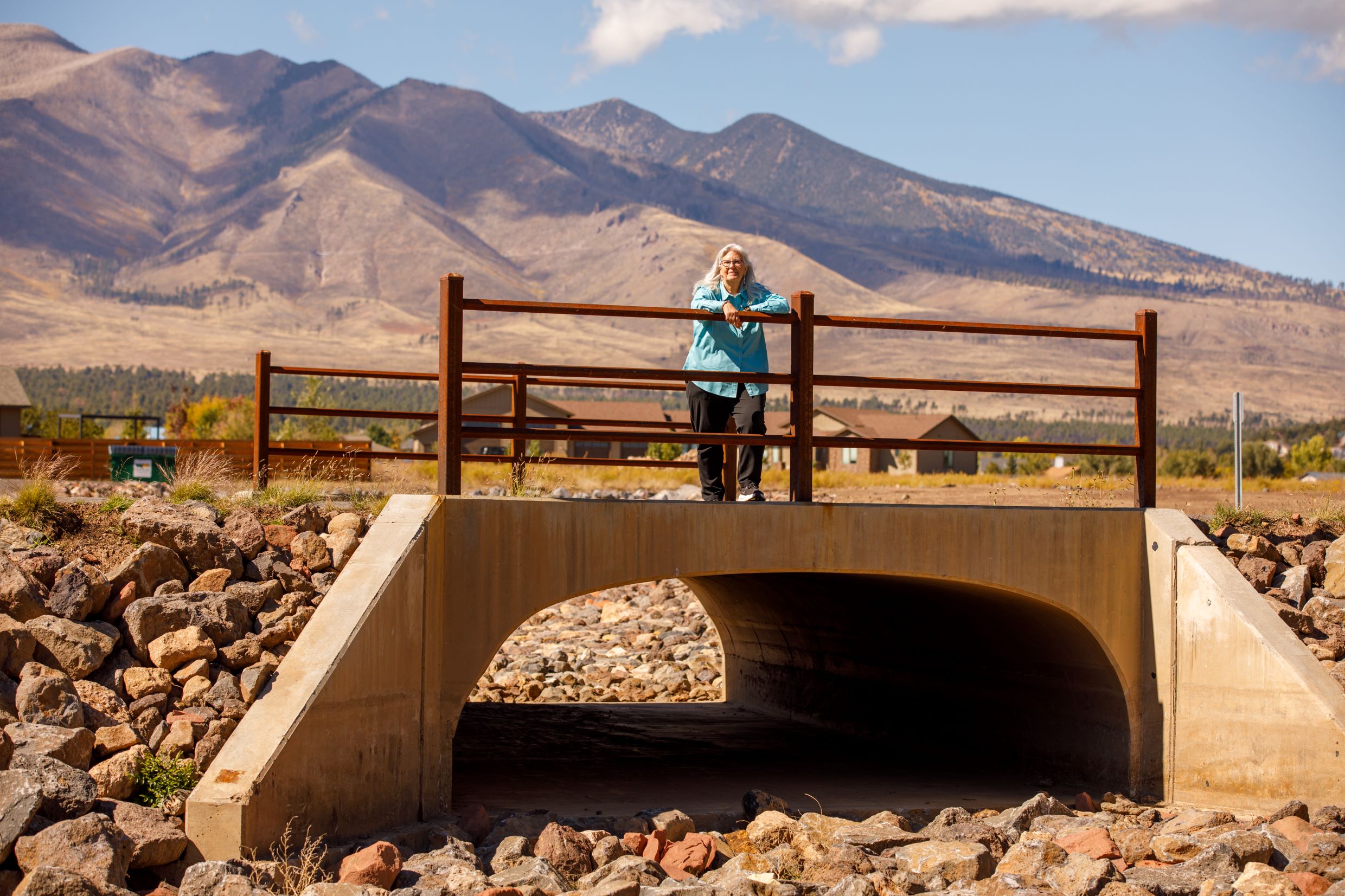
Photo courtesy of Resource Rural and photographer John Stember: Coconino County Flood Control District Administrator Lucinda Andreani has led the massive multi-million-dollar undertaking of flood mitigation projects to protect Flagstaff homes, businesses, infrastructure and families.