







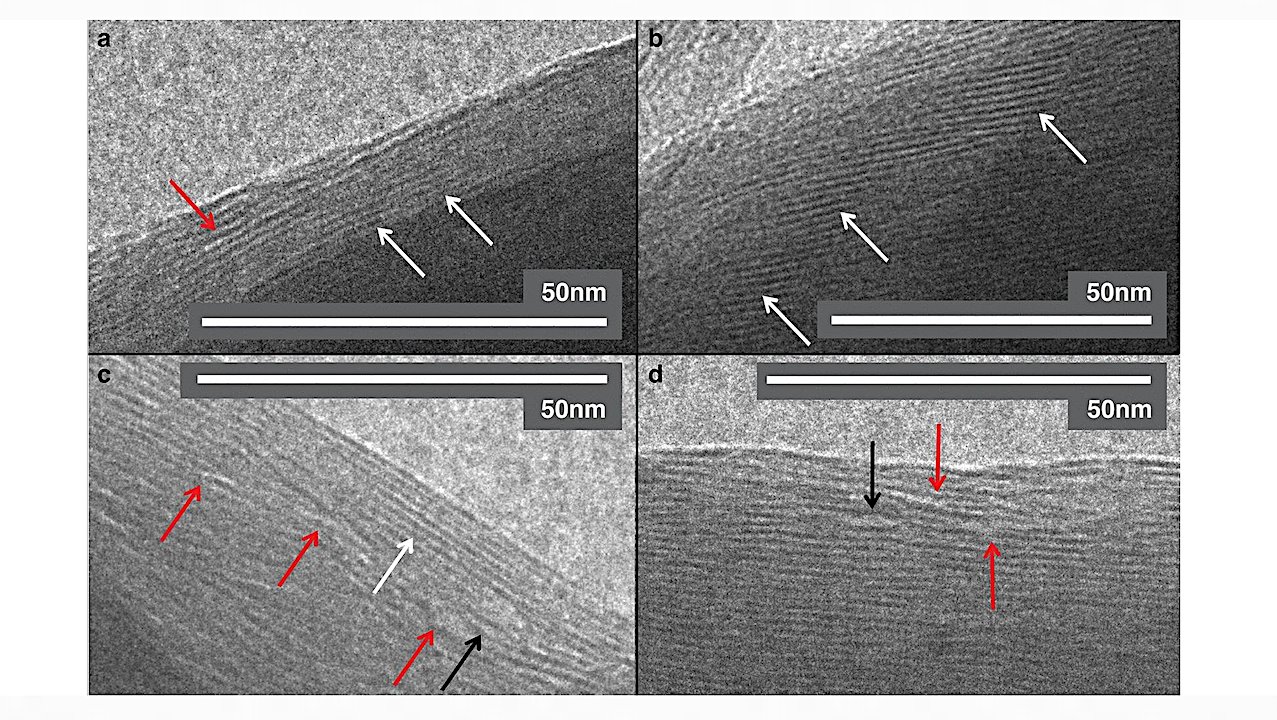
TEM images of Ca-MMT’s ordered and distorted layered structures including nanocavities after exposure to amino acids. a Control sample showing characteristic layering; ordered yet with slight distortions, considered as ordered for this clay material. b Sample exposed to single-organic Lys showing ordered layering only. Clay samples exposed to organic mixtures of c Lys-GABA d Arg-GABA; showing highly-distorted layering and nanocavities with well-defined lattice fringes that are embedded within distorted layered structures. In all panels, ordered layering, distorted layering, and nanocavities are marked with white, red and black arrows, respectively. See Methods for detailed image analysis procedure and limitations. — Scientific Reports via PubMed
Prebiotic chemistry in nano-environments confined within catalytic mineral media is emerging as a promising frontier in origins-of-life research. Such confined spaces exhibit physicochemical properties distinct from bulk conditions, enabling out-of-equilibrium processes such as condensation reactions in aqueous media.
Here, we demonstrate that a yin-yang interplay of organo-clay interactions generates and supports a variety of confined geochemical nano-environments within clay layers and facilitates the persistence of partial exfoliation.
We investigate how the structure of Ca-montmorillonite clay is affected by exposure to aqueous amino acid mixtures containing proteinogenic species (L-lysine or L-arginine) and their 1:40 mixture with the meteorite-common, non-proteinogenic γ-aminobutyric acid. Using attenuated total reflectance Fourier transform infrared spectroscopy, X-ray diffraction, thermogravimetric analysis and electron microscopy, we reveal opposing effects of the different amino acids on the clay’s structure.
Lysine and arginine intercalate between clay layers, bridge across them and suppress swelling, whereas γ-aminobutyric acid induces pronounced layer distortion, exfoliation and nanocavity formation, even in the presence of the strongly-interacting species.
The contrasting, complementary effects between fixation of the interlayer and formation of nano-compartments create and sustain diverse nano-environments. This balance could play a role in shaping nano-environments that facilitate prebiotic polymerisation and other chemistry central to life’s emergence on rocky bodies.
Astrobiology, Genomics,