








Nanomaterials (NMs) are increasingly used in everything from cosmetics to electronics, and their inevitable release into aquatic environments raises concerns about their potential risks to ecosystems. The concentrations of these tiny particles in surface waters can reach microgram-per-liter levels, and lab studies have shown they can harm aquatic organisms.
When these NMs enter rivers, lakes, and oceans, they are not pristine. They quickly interact with natural organic matter (NOM)—a complex mixture of substances from decomposed plants and organisms—to form a coating called an “ecological corona” or “eco-corona.” This natural cloak dramatically changes the properties and behavior of the nanomaterials, making it a critical factor in their environmental impact.
The Double-Edged Sword of the Eco-Corona
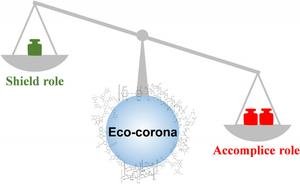
A comprehensive review published in Carbon Research highlights the complex and often contradictory role of this eco-corona. The authors’ analysis of over 100 publications reveals that the organic coating can act as both a shield, reducing the toxicity of NMs, and an accomplice, enhancing their harmful effects. This duality makes it incredibly difficult to predict the environmental fate and risk of nanomaterials based on their pristine properties alone.
The review systematically discusses how the eco-corona exerts its dual influence. By altering a nanomaterial’s surface charge, size, and stability, the corona can either promote its dispersion in water, increasing exposure for some organisms, or cause it to clump together and sink, posing a threat to sediment-dwelling life. Furthermore, the corona changes how NMs interact with cell membranes, sometimes blocking uptake through steric hindrance and other times facilitating it if the organic matter itself is readily internalized by cells.
Unraveling Complex Toxicity Pathways
The eco-corona’s influence extends to the core mechanisms of nanotoxicity. For instance, it can affect the generation of reactive oxygen species (ROS)—highly reactive molecules that cause cellular damage. Some organic matter can “quench” or neutralize ROS produced by NMs, making them less toxic. However, NOM itself can produce ROS under sunlight, and the corona can facilitate electron transfer processes that increase ROS production, amplifying toxicity. Similarly, the corona can either inhibit or accelerate the release of toxic metal ions from certain nanomaterials.
The impact of the eco-corona is not limited to the nanomaterials themselves. The review points out that this organic layer can also alter how other pollutants, such as heavy metals and organic contaminants, behave in the environment. The corona can provide new binding sites for these pollutants, turning the nanomaterial into a “Trojan horse” that carries other toxins into organisms, or it can block existing sites, reducing the co-transport of pollutants.
A Call for New Research Methods
The authors conclude that current laboratory-based studies are often too simplistic to capture the real-world complexity of these interactions. They call for the development of novel techniques to accurately assess the composition of the eco-corona in different environments. They also advocate for the use of advanced mathematical modeling and large-scale mesocosm studies—which mimic natural environments more closely—to build a more predictive framework for assessing the ecological risks posed by nanomaterials in the environment.
Corresponding Author:
Xiaoli Zhao, Wenhong Fan
Original Source:
https://doi.org/10.1007/s44246-022-00013-5
Contributions:
XW and DL: Creating the idea, visualization, investigation, collecting review of literature, creating tables and figures, and writing the original draft. YW: Visualization, writing, review and editing. WP: Writing-review and editing. FAM: Writing-review and editing. XZ: Writing-review and editing. ZD: Writing-review and editing. WF: Creating the idea, visualization, writing-review and editing, and corresponding. All authors read and approved the final manuscript.
Disclaimer: AAAS and EurekAlert! are not responsible for the accuracy of news releases posted to EurekAlert! by contributing institutions or for the use of any information through the EurekAlert system.