







Behind the facade of South Asia’s rapidly growing economy, a silent catastrophe is gathering force, symbolized by skies blanketed in toxic smoke from thousands of brick kilns. A recent report by The Daily Morning Bell has exposed a harrowing reality: Bangladesh’s brick manufacturing sector is operating in a state of systemic lawlessness, posing an existential threat to public health, food security, and environmental stability.
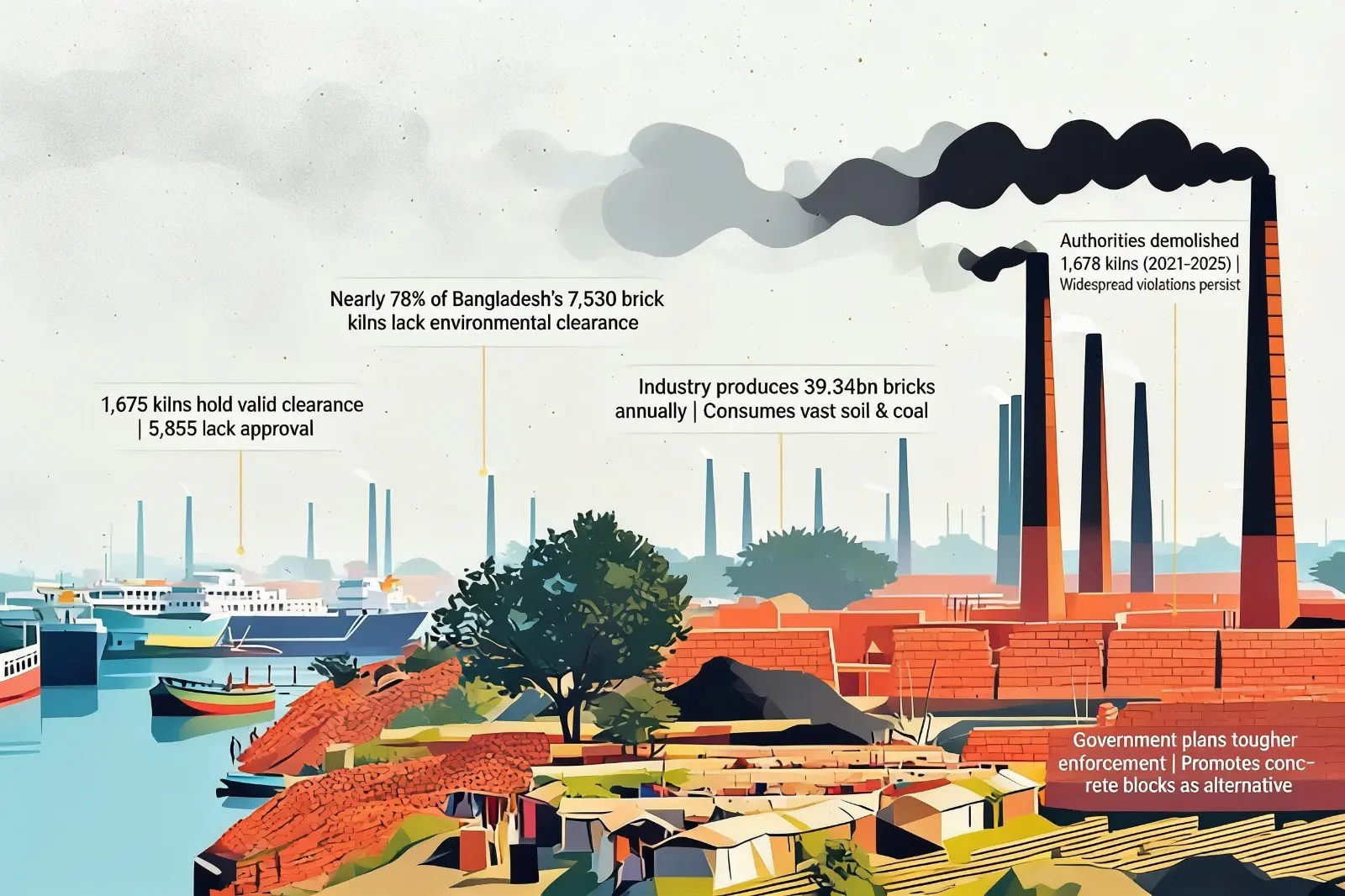
According to government data, 78% of the country’s 7,530 brick kilns—totaling 5,855 facilities—operate without valid environmental clearances or legitimate permits. This blatant disregard for regulatory frameworks persists despite a November 2022 High Court directive mandating the closure of all illegal kilns. While the Department of Environment has initiated demolition drives and levied hundreds of millions of takas in fines, these measures have largely failed to curb the proliferation of these toxic industrial sites. Experts argue that this is not merely an administrative failure, but a manifestation of systemic apathy deeply rooted in corridors of power, where economic profit is routinely prioritized over the lives of millions.
The human cost of this negligence is most visible in the country’s rural and peri-urban landscapes. In regions such as Dohar, near the capital city of Dhaka, illegal kilns operate with impunity within 500 meters of schools. As children sit in classrooms attempting to learn, they are exposed to heavy metals and hazardous particulate matter that infiltrate their lungs, compromising their long-term health and cognitive development. Environmental advocates categorize this exposure as a form of environmental violence, noting that it constitutes a direct violation of the fundamental human right to grow up in a healthy, safe environment.
Beyond the immediate public health crisis, the kilns are systematically dismantling the nation’s agricultural foundations. To meet an annual demand for 39.34 billion fired bricks, the industry consumes approximately 150 million tonnes of fertile topsoil and 7 million tonnes of coal. Research conducted by the Bangladesh Agricultural Research Institute (BARI) confirms that crop yields for rice, wheat, and essential vegetables decline by 20 to 50 percent within a one-kilometer radius of these kilns. In a nation where food security is a delicate, high-stakes balance, the destruction of arable land for brick production poses a grave, long-term threat to national stability.
While the government has promoted the adoption of eco-friendly alternatives—such as concrete blocks—and established a 2025 deadline to transition public construction projects away from fired bricks, progress remains sluggish. The lack of strategic implementation has left the industry stagnant, with traditional kilns continuing to dominate the market.
Addressing this crisis requires a transition from sporadic, punitive enforcement to a comprehensive, unyielding strategy. First, the government must strictly enforce the High Court’s ruling by permanently shutting down all illegal and environmentally destructive kilns, moving beyond mere fines which many operators treat as a cost of doing business. Second, there is an urgent need to expand subsidies and provide robust support for the fledgling concrete block industry to make sustainable building materials the standard rather than the exception. Finally, the state must establish a framework for environmental justice that includes the rehabilitation of degraded agricultural land and long-term medical support for communities harmed by air pollution.
The crisis in Bangladesh is not an isolated local issue but an interconnected facet of a global climate and human emergency. As the international community increasingly focuses on sustainable development, the situation in Bangladesh serves as a critical test case. Protecting the future requires immediate, decisive action to ensure that the relentless pursuit of industrial growth does not continue to consume the health of the next generation or burn away the nation’s most precious natural resources.
Disclaimer: This content is auto-generated for informational purposes only.
Source: Read Original News