








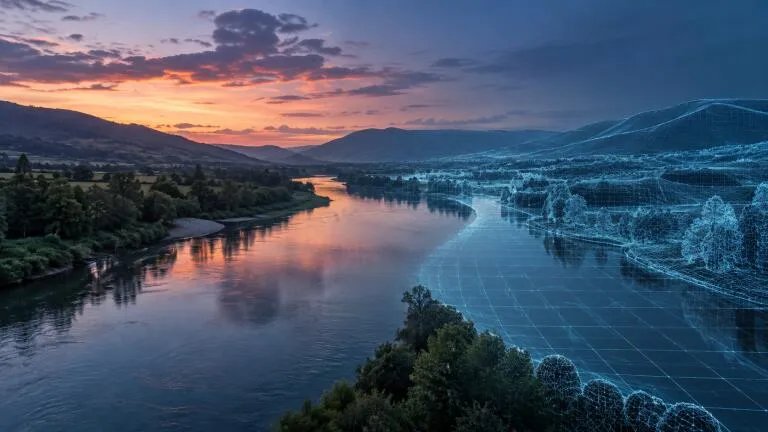
Environmental science is poised for a paradigm shift that could move the field from reactive observation to proactive risk management. According to a recent Perspective article published in the journal Artificial Intelligence & Environment, the integration of artificial intelligence (AI) with environmental digital twins offers a revolutionary way to predict environmental hazards and test potential interventions before they are deployed in the real world.
Led by corresponding author Dawei Lu, the research team outlines the architecture and applications of these systems, which serve as continuously updated virtual representations of real-world environmental processes. While the term “digital twin” is frequently used in industry, the authors offer a rigorous definition that clarifies the distinction between basic models and true, actionable twins.
Defining the Digital Twin
The authors identify three levels of physical-virtual connection. A standard digital model functions independently, with no automatic data exchange with the physical system. A digital shadow is more advanced, receiving one-way data feeds from the environment. However, a “true” digital twin requires a recurring, two-way interaction. In this setup, virtual simulations inform real-world decisions, and the resulting real-world responses are fed back into the virtual system to refine its accuracy.
“Environmental systems are dynamic, uncertain, and often difficult or even impossible to study through conventional trial-and-error experiments,” Lu noted. By bridging the gap between observation, modeling, and feedback, AI-enabled digital twins allow scientists to experiment in a virtual space while maintaining a constant link to real-time environmental data.
A Framework for Implementation
The article introduces a five-layer framework designed to guide the development of these systems. This framework spans from physical sensing and connectivity to data integration, virtual modeling, and final AI-enabled feedback loops. Within this architecture, AI plays a critical role by harmonizing heterogeneous data types, identifying anomalies, accelerating complex climate simulations, and quantifying uncertainty.
Potential applications for this technology are broad. In urban environments, digital twins could optimize wastewater treatment plants or provide sophisticated flood forecasting. In coastal and atmospheric science, they could combine satellite imagery, ground-based sensors, and advanced modeling to create more accurate air-quality forecasts and environmental risk assessments.
Navigating Limitations
Despite the technical promise, the authors remain cautious regarding the current state of the industry. Many systems currently marketed as “digital twins” fail to meet the requirement of true bidirectionality. Most are currently limited to digital shadows or offline decision-support tools.
The team identified three primary barriers hindering widespread adoption: the lack of robust physical-virtual feedback mechanisms, the difficulty of accurately modeling microscale or extreme-condition environmental processes, and a general absence of standardized architectures and benchmark datasets.
Supporting Human Expertise
A central theme of the research is that digital twins should act as a force multiplier for human decision-makers rather than a replacement for them. This is particularly vital in high-stakes sectors such as pollution response, nuclear safety, and extreme climate event management.
Looking forward, the authors suggest the concept could evolve into predictive digital toxicology, linking environmental exposure data directly to health outcomes, or even optimizing the design of future environmental monitoring instruments themselves.
While this paper serves as a conceptual roadmap rather than a report on existing, fully operational systems at scale, it provides a valuable diagnostic tool for environmental professionals. By applying the authors’ definition of a “true” digital twin, industry stakeholders and policymakers can better evaluate the capabilities of current technologies and direct future investments toward systems that offer genuine, bidirectional connectivity between the virtual and physical worlds.
Disclaimer: This content is auto-generated for informational purposes only.
Source: Read Original News