








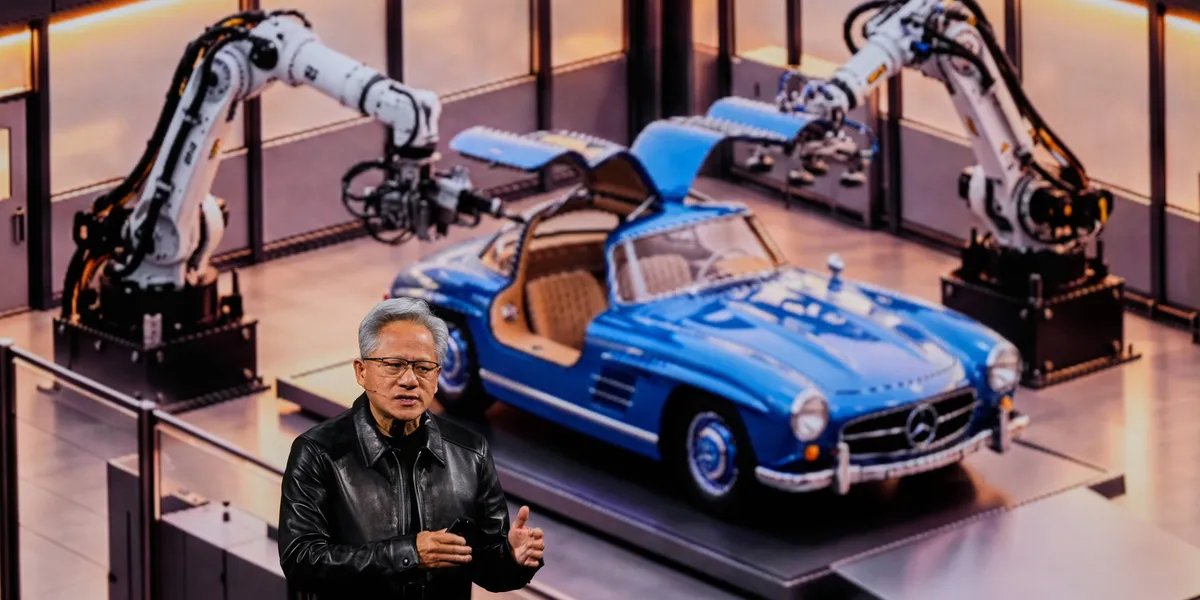
Nvidia CEO Jensen Huang took to the stage at the Tempodrom in Berlin this week with a clear mission: to catalyze the European artificial intelligence sector and bridge the region’s widening gap in computing infrastructure. Speaking before a packed crowd of 3,000 developers and industry leaders, Huang painted a picture of a continent on the cusp of an industrial revolution, underscored by the transition from generative language models to “physical AI” in manufacturing.
The event, which served as a major showcase for Nvidia’s latest hardware and software solutions, highlighted the urgency of closing the disparity between Europe and the United States, where the latter currently commands 75% of global AI computing capacity, leaving Europe with a mere 5%.
The Modular Infrastructure Revolution
To tackle the “compute bottleneck” that has historically stifled European innovation, Huang unveiled the Vera Rubin DSK Pod. This hardware solution is designed to bypass the traditional, multi-month logistical nightmares of building custom server farms. Delivered in a shipping-container-style modular unit, the system allows companies to deploy high-performance data centers in a matter of days.
Huang argued that by streamlining the physical infrastructure, European startups and enterprises can pivot more quickly toward building complex AI systems. With Nvidia having poured $10 billion into European startups and partnerships over the past year, the company is betting heavily that this modular approach will provide the necessary foundation for the region’s burgeoning AI economy. “Every company in the future will be an AI company,” Huang stated, emphasizing that access to rapid, scalable computing is no longer a luxury but a fundamental business necessity.
Physical AI and the Future of Industry
The conference underscored the deep integration of Nvidia’s technology into the European industrial backbone. Representatives from automotive giants like Mercedes-Benz and Volkswagen’s Audi were highlighted as core partners, showcasing how AI is moving beyond the screen and into the factory floor and the road.
Mercedes-Benz CEO Ola Kallenius joined the discourse, outlining a vision where autonomous driving technology, powered by Nvidia chips, could effectively eliminate human-error-related traffic accidents. By embedding intelligence into the physical world—through robotics, automated manufacturing lines, and self-driving systems—European firms are hoping to maintain their competitive edge in high-end industrial engineering.
Addressing Safety and Accountability
As the scope of AI applications expands, so does public anxiety regarding unchecked automation. Recognizing these concerns, Huang dedicated a portion of his presentation to AI safety, introducing software tools known as OpenShell and Sentry. These utilities are designed to act as a digital “sandbox,” exerting external oversight on AI models.
By defining strict policy boundaries, these tools allow companies to automatically halt AI operations if a system begins to deviate from set guidelines. This move is a strategic nod to the European Union’s rigorous regulatory environment, which has consistently prioritized digital safety and ethical compliance.
The presentation was briefly disrupted by protesters calling for more accountability in the tech sector. Huang handled the interruption with composed urgency, instructing security to ensure the protesters were treated calmly while promising a dialogue—an approach that mirrored his keynote’s emphasis on maintaining control in a rapidly evolving technological landscape.
Ultimately, Huang’s message was one of optimism tempered by pragmatism. While Europe lags behind in sheer hardware volume, the CEO believes that by accelerating infrastructure deployment and doubling down on “physical AI,” the region can transform itself into a global leader. With new tools in place to keep systems both powerful and secure, the focus now shifts to how quickly the European tech ecosystem can translate this momentum into tangible market results.
Disclaimer: This content is auto-generated for informational purposes only.
Source: Read Original News