









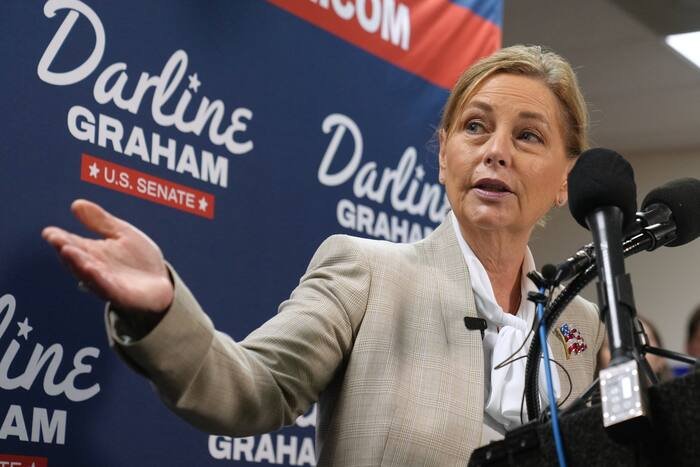
PENDLETON, S.C. – President Donald Trump is set to arrive in South Carolina this Wednesday for a high-stakes campaign rally, a tactical move aimed at shoring up the candidacy of U.S. Sen. Darline Graham. The visit underscores the Republican Party’s anxiety regarding a seat once considered safely in their column but now unexpectedly competitive.
Darline Graham, a political newcomer and former director of the state agency for the blind, was appointed to the Senate seat this past July following the sudden death of her brother, longtime Senator Lindsey Graham. While her appointment initially garnered bipartisan goodwill, her transition into an election-cycle candidate has been marked by stumbles that have provided an opening for her Democratic challenger, pediatrician Annie Andrews.
Trump’s decision to headline the rally comes as Republicans scramble to protect their grip on the state. Though South Carolina is rarely viewed as a national battleground, the race has seen an unprecedented influx of more than $34 million. Despite the party’s backing, some friction has surfaced between the White House and the Senator; the two recently diverged over Trump’s decision to waive Ukraine war sanctions on Russia—a move that carries personal weight as those sanctions were codified under a law bearing the late Lindsey Graham’s name.
Throughout the campaign, Andrews has characterized the Republican nominee as “Trump-endorsed and unqualified,” pointing to a notable gaffe during a debate where Graham admitted she was “not that informed on national security” when pressed on U.S. policy toward Taiwan. Graham has defended her record, arguing that her ability to serve while grieving her brother’s death proves her resilience and capability.
For her part, Andrews has centered her platform on the economic struggles of South Carolina families, campaigning on the slogan “building a South Carolina that we can all afford.” Republicans have countered by casting the pediatrician as a “radical liberal,” launching aggressive attack ads alleging she supports controversial medical procedures for transgender minors—claims Andrews flatly denies.
Trump’s appearance is part of a larger nationwide strategy to rally voters in both red and blue-leaning districts. He has explicitly urged his base to “pretend I’m on the ballot,” hoping to galvanize turnout to prevent a lackluster midterm showing.
While some Democrats express cautious hope that the current climate might allow them to break through the state’s Republican stronghold, others remain realistic about the uphill battle. Paul Davis, an Aiken voter, noted that while voters are “angry and fed up” with current economic conditions, a victory for the Democratic Party in the state may still be “a cycle or two away.”
As the election nears, the focus remains on whether Trump’s presence can boost Graham enough to overcome both the recent political friction and the surging momentum of the Andrews campaign. For many supporters on both sides, the contest has become a definitive test of the state’s political identity.
Disclaimer: This content is auto-generated for informational purposes only.
Source: Read Original News